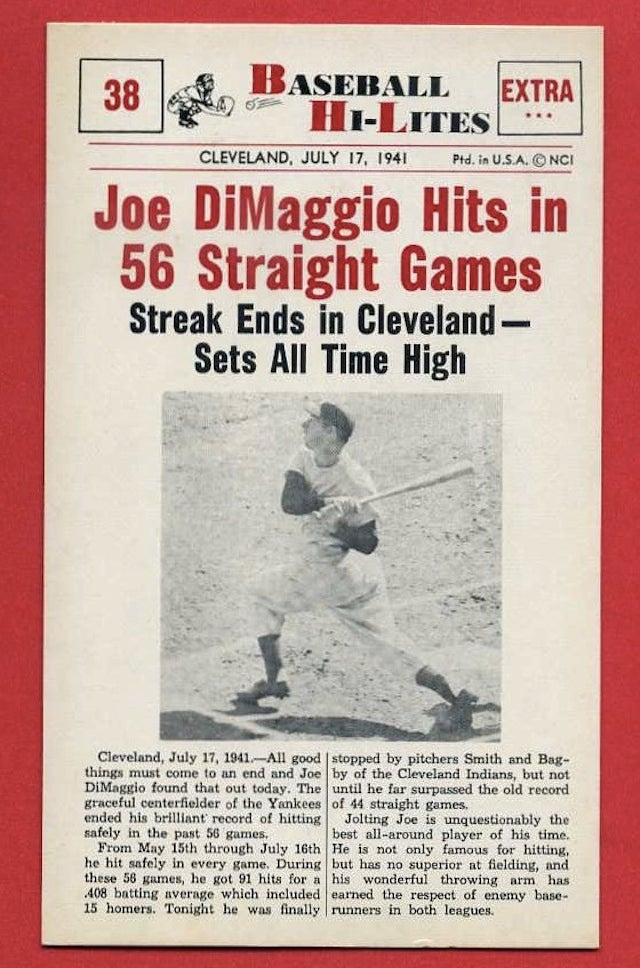
In the annals of Major League Baseball, few individual achievements command the awe and reverence reserved for Joe DiMaggio’s 56-game hitting streak in 1941. It is a statistical marvel, a testament to sustained excellence, and a cultural touchstone that continues to fascinate generations of fans. For any true baseball enthusiast, particularly one with a deep appreciation for the storied history of the New York Yankees, understanding the layers behind “The Streak” is paramount. It wasn’t just a string of hits; it was a daily drama that captivated a nation on the cusp of global conflict, showcasing a unique blend of skill, mental fortitude, and sheer will that solidified the “Yankee Clipper’s” legend. Let’s delve into the deeper reasons why this extraordinary feat remains baseball’s most untouchable record.
1. The Unfathomable Number: 56
The number 56 itself stands as a statistical anomaly, almost defying the very principles of baseball. In a sport where even the greatest hitters fail 70% of the time, maintaining a hit in every single game for over two months is mind-boggling. Most players consider a 10-game streak a notable achievement, and anything beyond 20 is rare. To more than double the common benchmark for extended hitting, over 14% of a full season, paints a picture of statistical improbability that modern analytics only further underscore.
2. A Pre-War America’s Distraction
The timing of the streak in 1941, just months before the United States entered World War II, gave it a profound societal resonance. As global tensions mounted and Americans faced an uncertain future, DiMaggio’s daily pursuit offered a much-needed escape and a unifying national narrative. It provided a common, positive topic for discussion across dinner tables and workplaces, momentarily diverting attention from looming international crises and offering a sense of hope and everyday heroism.
3. The Stoic Persona of the Yankee Clipper
DiMaggio’s legendary reserved demeanor, earning him the moniker “The Yankee Clipper,” added to the mystique of the streak. He carried the immense pressure with an outward calm that belied the internal strain, presenting a façade of effortless greatness. This stoicism, combined with his quiet pursuit of excellence, cemented his image as an almost mythic figure, a man who performed under extraordinary pressure without a hint of self-aggrandizement.
4. The Daily Grind and Unrelenting Pressure
Imagine waking up every single day knowing that your singular objective is to get a base hit, with millions watching and hoping. The physical demands of playing daily, coupled with the psychological burden of potentially ending the streak, were immense. Every at-bat became a high-stakes moment, every defensive play a potential opportunity for error. The mental fortitude required to consistently deliver under such continuous scrutiny is almost incomprehensible.
5. Media Hype and National Obsession
As the streak grew, it became a national obsession, transforming from a sports story into front-page news. Newspapers ran daily updates, radio broadcasts paused to announce DiMaggio’s latest performance, and fans across the country tuned in specifically to hear about “Joltin’ Joe.” This constant media attention amplified the pressure on DiMaggio, but also turned the streak into a collective experience, pulling the nation into its daily drama.
6. The Quality of Opposing Pitching
Some critics suggest pitching was “easier” in 1941. This notion is quickly debunked when one considers the caliber of arms DiMaggio faced. During the streak, he hit safely against future Hall of Famers like Bob Feller, Hal Newhouser, and Lefty Grove, as well as multiple All-Stars. This wasn’t a streak against a league of lesser talent; it was a testament to DiMaggio’s ability to hit against the very best pitchers of his era, consistently and effectively.
7. A Glimpse into Sustained Excellence
The streak wasn’t just about hitting; it was about the profound consistency required to maintain peak performance day in and day out. It showcased DiMaggio’s ability to adjust to different pitchers, ballparks, and game situations, demonstrating a complete mastery of his craft. This sustained excellence, over more than two months, is what truly elevates the streak beyond a mere statistical oddity.
8. The Near Misses and Close Calls
The legend of the streak is peppered with countless stories of close calls and near misses. There were games where DiMaggio only got his hit in his very last at-bat, or thanks to an error by an opposing fielder, or a bloop single that just eluded a glove. These moments, often forgotten in the grand narrative, highlight the razor-thin margin of error and the sheer luck that can accompany such an extraordinary run.
9. The Improbable Start of May 15th
The streak began humbly on May 15, 1941, with a single off Chicago White Sox pitcher Eddie Smith. The Yankees had been struggling, and DiMaggio was in a slump. Neither he nor anyone else in the ballpark could have envisioned that this innocuous single would be the first step in baseball’s most iconic journey. It underscores how even the greatest achievements often begin from the most unassuming circumstances.
10. The Streak’s Dramatic Conclusion
The streak finally ended on July 17, 1941, against the Cleveland Indians at Municipal Stadium. Indians pitchers Al Milnar and Joe Krakauskas managed to hold DiMaggio hitless, but the true heroes of the day were the defensive players. DiMaggio hit three hard-hit balls that night, but each was snared by extraordinary fielding, sealing the streak’s fate.
11. Ken Keltner’s Unsung Heroics
Cleveland third baseman Ken Keltner became an indelible part of the streak’s history, thanks to two spectacular defensive plays that night. Playing deep at third, Keltner made two backhanded grabs of screaming line drives hit by DiMaggio, throwing him out at first base both times. His almost superhuman efforts denied DiMaggio a hit and brought the legendary run to an end, immortalizing Keltner in the process.
12. The Immediate Aftermath and a New Streak
What makes DiMaggio’s character even more remarkable is what happened immediately after the streak ended. The very next day, he started a new hitting streak that lasted 16 games. This incredible rebound performance, proving that the 56-game run was no fluke, further solidified his status as one of the game’s most consistent and mentally tough players.
13. Its Unbreakable Status in Modern Baseball
In today’s game, the streak is considered virtually unbreakable. Factors like specialized relief pitching, higher strikeout rates, defensive shifts, and the increased focus on pitch counts and analytics make stringing together hits for 56 consecutive games incredibly difficult. Modern players face a gauntlet of fresh, high-velocity arms and strategically placed fielders that would make such a streak an even greater statistical outlier.
14. A Defining Achievement in a Hall of Fame Career
Even for a player of DiMaggio’s caliber, with nine World Series rings, three MVP awards, and a career .325 batting average, the 56-game hitting streak stands as the defining accomplishment of his career. It’s the first thing mentioned when his name comes up, overshadowing his immense team success and individual accolades, testament to its singular power and enduring legacy.
15. The Enduring Cultural Resonance
The streak transcended baseball, embedding itself into American popular culture. It’s referenced in songs, literature, and common vernacular as a benchmark for sustained, exceptional performance. Simon & Garfunkel’s “Mrs. Robinson” famously asks, “Where have you gone, Joe DiMaggio? A nation turns its lonely eyes to you,” directly linking him to a bygone era of American greatness and innocence, forever etched in the national consciousness.
16. The Mental Fortitude Required
Beyond the physical talent, the streak required unparalleled mental fortitude. To ignore the growing noise, the fatigue, the slumps within games, and the constant pressure to perform daily is a psychological feat as impressive as any physical one. It speaks to a level of concentration and resilience that few athletes ever achieve, let alone maintain for such an extended period.
17. A Benchmark of Baseball Immortality
Ultimately, Joe DiMaggio’s 56-game hitting streak is more than a record; it’s a monument to the human spirit’s capacity for greatness. It stands as a poetic representation of baseball’s enduring magic, a perfect blend of skill, luck, and unwavering determination. It is a benchmark of immortality, forever distinguishing Joe DiMaggio not just as a great player, but as the architect of an achievement so profound it almost seems like fiction.