Baseball cards are more than just pieces of cardboard—they’re time capsules, frozen moments of athletic brilliance that collectors cherish for their beauty, rarity, and connection to the game’s legends. Among the modern crop of players, Harrison Bader stands out not just for his defensive prowess in center field or his clutch hitting, but for the quiet mystique surrounding his rookie cards. These aren’t the flashy autographs of superstars or the limited-edition parallels of household names. No, Bader’s rookie cards occupy a fascinating middle ground: accessible enough to be within reach of the average collector, yet intriguing enough to spark debates about their long-term value. Could a Harrison Bader rookie card be the sleeper investment pick of the next decade? Let’s dig deeper.
To understand why Bader’s rookie cards might be undervalued, we first need to examine the player himself. Drafted by the St. Louis Cardinals in the third round of the 2015 MLB Draft, Bader quickly became a fan favorite for his electrifying speed, cannon arm, and uncanny ability to rob home runs in the outfield. His 2017 debut was a revelation—he flashed all the tools that scouts had raved about, even if his bat struggled to keep pace early on. Over time, Bader refined his offensive game, becoming a consistent contributor with power potential and a knack for timely hitting. By 2021, he was a full-fledged star, posting a 120 wRC+ and flashing 20/20 potential (hits and steals). Injuries have tempered his trajectory, but his defensive reputation remains untarnished, and his offensive ceiling still looms large.
This dual-threat profile—elite defense paired with offensive upside—is precisely what makes Bader’s rookie cards so compelling. Unlike one-dimensional sluggers whose value hinges solely on home runs, Bader’s cards encapsulate a more holistic baseball experience. Collectors aren’t just buying a player’s bat; they’re investing in a player’s entire skill set. That versatility adds a layer of depth to his cards that transcends mere statistics. It’s the kind of multifaceted appeal that often gets overlooked in a market obsessed with flashy rookies or aging veterans.
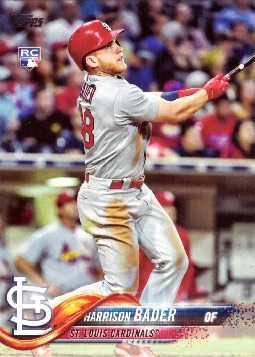
Harrison Bader’s 2018 Topps Chrome Rookie Card – a modern classic with understated appeal.
The Rookie Card Landscape: Where Bader Fits In
The modern rookie card market is a labyrinth of parallels, autographs, and serial-numbered variants, each vying for collector attention. For Harrison Bader, the most coveted rookie card is his 2018 Topps Chrome #199, a shimmering chrome parallel that captures his rookie-year luster. But Bader’s rookie card story doesn’t end there. His base 2018 Topps #217 is a more attainable entry point, while his Bowman Chrome Autograph (/50) adds a layer of exclusivity for those willing to pay a premium. Then there’s his 2018 Topps Heritage #489, a nod to baseball’s rich history, blending nostalgia with modernity.
What’s fascinating about Bader’s rookie card lineup is its balance between accessibility and scarcity. Unlike the stratospheric prices of Juan Soto or Ronald Acuña Jr. rookies, Bader’s cards remain within the realm of possibility for mid-tier collectors. A PSA 9 Bader Chrome can be had for under $50, while a PSA 10 might push $150—still a far cry from the four-figure price tags of top-tier rookies. This affordability is a double-edged sword. On one hand, it makes Bader’s cards an easy entry into the hobby for newcomers. On the other, it raises questions about long-term appreciation. Could these cards be the next big sleeper, or are they destined to remain budget-friendly novelties?
The answer may lie in Bader’s trajectory and the broader market trends. Baseball card investing has evolved from a nostalgic pastime into a speculative asset class, with collectors increasingly treating cards like stocks. In this environment, players with a mix of star power, longevity, and marketability tend to outperform. Bader checks some of these boxes—he’s a fan favorite, a defensive highlight reel, and a player with untapped offensive potential. But he’s not a household name, and that obscurity might be his secret weapon. In a market saturated with overhyped rookies, Bader’s cards offer a refreshing alternative: a chance to invest in a player before the masses catch on.
The Sleeper Factor: Why Bader Could Outperform Expectations
Sleeper investments thrive on unpredictability. They’re the cards that fly under the radar, only to surge in value when the player’s narrative shifts from “promising prospect” to “established star.” Bader’s rookie cards fit this mold perfectly. Consider the case of Cody Bellinger, whose 2016 Topps Chrome rookie card was a $5 gem before his MVP season in 2019 sent it soaring past $200. Or Kyle Tucker, whose 2016 Bowman Chrome Autograph (/50) was a $30 card before his breakout 2022 campaign pushed it to $150. These aren’t outliers; they’re proof that timing—and a little bit of luck—can turn a modest investment into a windfall.
Bader’s path to sleeper status isn’t without its challenges. Injuries have been a persistent thorn in his side, derailing what could have been a more illustrious career. His 2022 season was cut short by a wrist injury, and while he rebounded in 2023, the specter of fragility looms. But here’s the thing: collectors don’t just buy players; they buy stories. Bader’s narrative is one of resilience, of overcoming adversity to carve out a niche in a league dominated by power hitters. That story has legs, and if he can stay healthy, it could translate into tangible on-field success—and card value.
Another factor working in Bader’s favor is the resurgence of interest in defensive players. In an era where launch angles and exit velocities dominate the conversation, Bader’s Gold Glove-caliber defense is a breath of fresh air. Cards of elite defenders—think Andrelton Simmons or Kevin Kiermaier—have shown surprising staying power, even when their offensive production wanes. Bader’s defensive reputation could insulate his cards from the volatility that often plagues one-dimensional players.

Harrison Bader’s 2020 Current Baseball Stars base card – a modern relic with understated charm.
The market for Bader’s cards is also buoyed by the broader trends in baseball card collecting. The pandemic-era boom brought a wave of new collectors into the hobby, many of whom are now looking for the next big thing. Bader’s cards offer a low-risk, high-reward proposition. They’re not so cheap that they’re disposable, but they’re not so expensive that they’re out of reach. This sweet spot is where sleeper investments often thrive.
Risks and Realities: The Other Side of the Coin
Of course, no investment is without risk, and Bader’s rookie cards are no exception. The most glaring concern is his injury history. Baseball is a brutal game, and even the most durable players can succumb to the wear and tear of a long season. If Bader’s injuries become a chronic issue, his cards could stagnate, or worse, decline in value. The market is unforgiving to players who can’t stay on the field, and collectors are quick to move on when a player’s availability becomes a question mark.
Another risk is the sheer unpredictability of the baseball card market. What seems like a sure bet today can become a relic tomorrow. The market is driven by trends, and trends are fickle. Bader’s cards could surge in value if he becomes a perennial All-Star, or they could languish if he settles into a platoon role. The key is to approach Bader’s cards with a long-term perspective. These aren’t get-rich-quick schemes; they’re bets on a player’s potential to leave a lasting legacy.
There’s also the matter of production. Modern rookie cards, especially parallels and autographs, are printed in staggering quantities. A 2018 Topps Chrome #199 might have a print run in the tens of thousands, diluting its scarcity. In a market where true rarity is prized above all else, Bader’s cards don’t scream “limited edition.” But scarcity isn’t everything. Condition, demand, and narrative all play a role in determining value. A PSA 10 Bader Chrome might not be rare, but it’s still a desirable card for collectors who appreciate his contributions to the game.
Grading and Authentication: The Devil in the Details
For collectors serious about investing in Bader’s rookie cards, grading and authentication are non-negotiable. A card’s grade can make or break its value, and third-party grading services like PSA, BGS, and SGC have become the arbiters of the hobby. A Bader Chrome graded PSA 10 is a different animal than a raw copy, and the price difference can be substantial. But grading isn’t cheap, and the costs can add up quickly, especially for high-end cards.
Authentication is another critical factor. The rise of counterfeit cards has made buyers wary, and a single fake can tarnish a collection’s reputation. When purchasing Bader’s cards, it’s essential to buy from reputable sellers and, if possible, opt for graded copies. The peace of mind that comes with a PSA or BGS slab is worth the extra cost, especially for high-value cards.
For those looking to dip their toes into the grading process, Bader’s base 2018 Topps #217 is a great starting point. It’s affordable, widely available, and offers a low-risk entry into the grading world. A PSA 9 or BGS 8.5 can still fetch a respectable price, while a gem mint copy could become a centerpiece of a collection.
The Future of Bader’s Cards: A Crystal Ball
Predicting the future of baseball cards is a fool’s errand, but we can make educated guesses based on past trends and Bader’s trajectory. If he continues to stay healthy and builds on his 2023 resurgence, his cards could see a gradual increase in value. A breakout season—say, a 25/25 campaign with Gold Glove defense—could send shockwaves through the market, pushing his rookie cards into the triple digits for the first time. Conversely, a decline in playing time or another injury could stunt their growth.
The broader market will also play a role. If the baseball card boom continues unabated, Bader’s cards could benefit from the influx of new collectors. But if the market cools, as it inevitably will, his cards could become casualties of the downturn. The key is to stay informed, monitor trends, and be patient. Baseball cards are a long-term game, and the best investments are often the ones that are held for years, not months.
One wildcard to watch is Bader’s potential free agency. If he becomes a hot commodity on the open market, his cards could surge in value as collectors anticipate his next destination. A blockbuster trade or a high-profile signing could reignite interest in his rookie cards, especially if he lands in a market with a strong collector base.