In the grand bazaar of baseball collectibles, where rookie cards are the currency of dreams and the ledger of legacy, few names carry the same electric charge as Nate Pearson. The towering Toronto Blue Jays right-hander, with his triple-digit heat and thunderous fastball, has already etched his name into the annals of the game’s most electrifying young arms. But beyond the mound, where his pitches split the strike zone like a meteor through the night sky, lies another arena—one of cardboard and ink, of limited-edition prints and speculative fervor. Here, in the world of trading cards, Pearson’s rookie cards are not just collectibles; they are portals to a future that could be either golden or fleeting. So the question lingers like a curveball hanging in the strike zone: Is investing in Nate Pearson’s rookie cards a shrewd play to buy low, or a high-stakes gamble on a potential breakout? Let’s step into the batter’s box and dissect this conundrum with the precision of a scout armed with radar guns and spreadsheets.
The Genesis of a Phenom: Why Nate Pearson Captivates the Imagination
Nate Pearson isn’t just another pitcher; he’s a phenomenon wrapped in a 6’6”, 245-pound frame, a human wrecking ball whose fastball has been clocked at 103 mph. His rookie season, though marred by injury, showcased flashes of dominance that left scouts and fans alike whispering about a generational talent. The allure of Pearson’s cards isn’t merely in their scarcity—though that plays a role—but in the narrative they encapsulate. Each card is a frozen moment in the ascent of a pitcher who could redefine dominance in the American League. Think of them as digital fossils of a comet’s tail: fleeting, brilliant, and capable of igniting the entire sky. The emotional pull is undeniable. Collectors aren’t just buying cardboard; they’re investing in the potential of a player who might one day be remembered in the same breath as Randy Johnson or Aroldis Chapman.

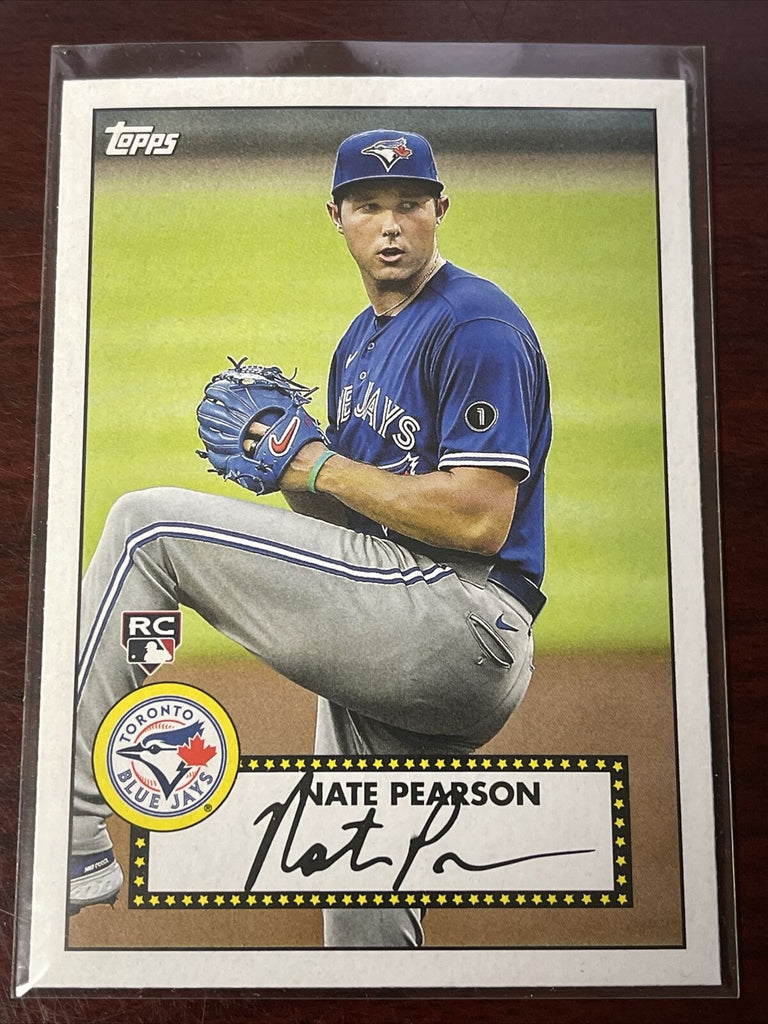
The appeal is visceral. Pearson’s rookie cards—particularly his 2021 Topps ‘52 Redux Series Mint Rookie Card—are more than collectibles; they’re talismans. They represent the intersection of raw athleticism and the romantic ideal of baseball’s future. For many, owning one is akin to holding a share in a prospect who could become the next face of the franchise. The psychological draw is akin to betting on a dark horse in a high-stakes race, where the payoff could be life-changing. But like all high-reward gambles, the risk is equally steep.
Rookie Card Rarity: The Scarcity Factor and Market Dynamics
In the world of sports memorabilia, scarcity is the lifeblood of value. Pearson’s rookie cards are no exception. The 2021 Topps ‘52 Redux Series card, for instance, is a limited print, a modern reimagining of the classic 1952 Topps design, which lends it an air of nostalgia. But it’s not just the design that matters; it’s the numbers. How many were printed? How many have survived unscathed? The answers to these questions are the difference between a card that appreciates like a blue-chip stock and one that languishes like a minor-league contract. The secondary market for Pearson’s cards is still in its adolescence, but early trends suggest a steady climb in demand, particularly for graded copies. A PSA 10 gem mint card, for example, has seen its value oscillate between $150 and $300 in recent months, a far cry from the stratospheric prices of Mike Trout or Juan Soto rookies, but a promising start for a player still writing his story.
The market dynamics here are fascinating. Unlike vintage cards, which derive value from nostalgia and historical significance, Pearson’s rookie cards are speculative assets. Their worth hinges on Pearson’s performance, durability, and marketability. A single dominant season could send values soaring, while a string of injuries or mediocrity could leave collectors holding the bag. It’s a high-wire act, where the wind is the unpredictable nature of baseball itself. The key for investors is to monitor Pearson’s workload, recovery from injuries, and, most importantly, his role in the Blue Jays’ rotation. A full season as a frontline starter would be the catalyst many collectors are waiting for.
Grading Grades: The Impact of Condition and Authentication
In the realm of trading cards, condition is king. A pristine Pearson rookie card, encased in a tamper-proof slab with a near-perfect grade, is a different animal from a well-loved copy with creases or corner wear. The grading process, handled by entities like PSA or BGS, transforms a card from a mere piece of paper into a certified piece of history. For Pearson’s cards, the difference between a 9 and a 10 can mean the difference between a $200 investment and a $2,000 windfall. The market for graded cards is still maturing, but the trend is clear: collectors are willing to pay a premium for perfection. This is where the savvy investor must tread carefully. Grading fees, authentication costs, and the risk of a card receiving a lower grade than expected can erode potential profits. It’s a game of patience and precision, where every imperfection is a strike against your portfolio.
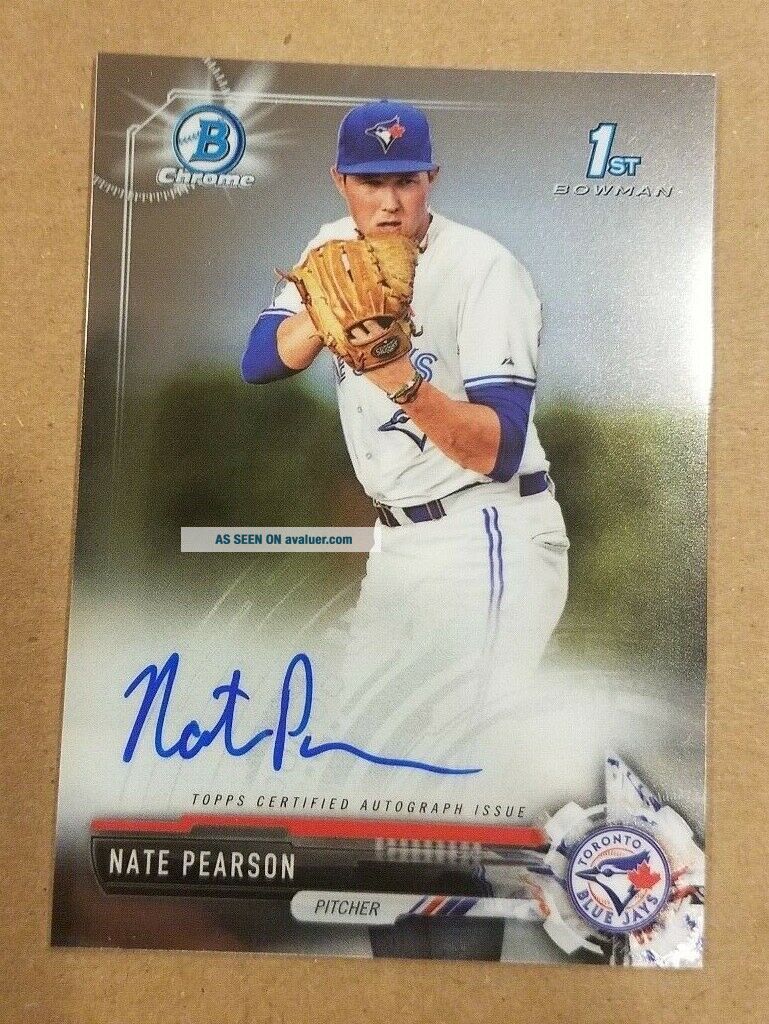
Consider the 2017 Bowman Draft Chrome Auto RC CDA card, a piece of Pearson’s early professional journey. In ungraded form, it might fetch $50. But a PSA 10 version? That could command $300 or more. The gradient of value is steep, and the climb is arduous. For those looking to enter the market, it’s often wiser to start with lower-grade copies and hold them in anticipation of future grading, rather than diving headfirst into high-end slabs. The latter is a strategy for seasoned collectors with deep pockets and a tolerance for risk.
Comparative Analysis: Pearson vs. Peers in the Rookie Card Arena
To understand Pearson’s potential, it’s instructive to look at his peers—rookies whose cards have already ascended to lofty heights. Shohei Ohtani’s rookie cards, for instance, have seen astronomical growth, driven by his dual-threat brilliance. Then there’s Fernando Tatis Jr., whose cards became instant blue chips after his breakout 2020-21 seasons. Pearson, while undeniably talented, lacks the crossover appeal of Ohtani or the headline-grabbing power numbers of Tatis. His rookie cards are still in the “prospect” phase of their lifecycle, where value is tied to potential rather than proven performance. This isn’t a flaw; it’s an opportunity. The market for Pearson’s cards is still undervalued relative to his peers, which makes them a compelling “buy low” proposition for those willing to take the risk.
The comparison isn’t about diminishing Pearson’s talent but about contextualizing his market position. Ohtani and Tatis were once rookies themselves, their cards appreciating in lockstep with their on-field heroics. Pearson’s cards could follow a similar trajectory, but the timeline is uncertain. The key difference is Pearson’s injury history, which introduces an element of volatility. While Tatis and Ohtani’s rookie cards benefited from sustained excellence, Pearson’s value hinges on his ability to stay healthy and dominant. For investors, this means the cards are a bet on resilience as much as talent. It’s a high-stakes wager, but one with asymmetric upside if Pearson fulfills his potential.
Timing the Market: When to Buy, Hold, or Sell
The art of trading card investment is, at its core, a study in timing. Buy too early, and you risk overpaying for unproven potential. Buy too late, and you miss the boat entirely. Pearson’s rookie cards are currently in a sweet spot: not yet fully priced in, but with enough momentum to suggest future growth. The optimal strategy for most collectors is to accumulate graded copies of his key rookies—particularly the 2021 Topps ‘52 Redux and the 2017 Bowman Chrome Auto—while prices remain accessible. Hold periods of 3-5 years are advisable, as Pearson’s career trajectory will dictate the cards’ long-term value. A dominant season, an All-Star appearance, or a playoff run could serve as the catalyst for a price surge.
Selling, however, is trickier. The market for Pearson’s cards is still niche, and liquidity can be an issue. Unlike stocks or cryptocurrencies, which can be traded with a click, selling a graded Pearson rookie card requires finding the right buyer—a collector willing to pay a premium for your asset. This is where patience becomes a virtue. Rushing to sell after a strong outing or a win could mean leaving money on the table. Conversely, holding too long risks missing the peak of the card’s value cycle. The sweet spot is to monitor Pearson’s performance closely, watching for milestones that could trigger broader market interest. A Cy Young-caliber season? That’s when you start thinking about taking profits.
The Emotional Quotient: Why Collectors Are Drawn to Pearson’s Cards
Beyond the cold calculations of ROI and market trends, there’s an emotional dimension to collecting Pearson’s rookie cards that can’t be ignored. Baseball is, at its heart, a game of stories—tales of underdogs, of comebacks, of players who defy expectations. Pearson’s journey, from a high school phenom to a Blue Jays ace (when healthy), is one such story. Collectors aren’t just buying a card; they’re buying into a narrative. The 2021 Topps ‘52 Redux card, with its retro design and Pearson’s intense gaze, feels like a time capsule of what could be. It’s a tangible connection to the future of the game, a way to feel invested in a player’s success without ever stepping onto a diamond.
This emotional pull is a powerful force in the collectibles market. It’s why vintage cards of Mickey Mantle or Willie Mays command such high prices—not just for their rarity, but for the stories they represent. Pearson’s cards are the modern equivalent: a bridge between the past and the future, a way for fans to feel like they’re part of the journey. For many, the decision to invest in Pearson’s rookie cards isn’t purely financial; it’s a labor of love, a way to celebrate the game they adore. And in a world where sports are increasingly commodified, that kind of passion is priceless.
The story of Nate Pearson’s rookie cards is still being written, a narrative that will unfold pitch by pitch, season by season. They are, at once, a gamble and a tribute—a bet on a player who could become a legend, and a keepsake for those who believe in the magic of baseball. The market for these cards is young, volatile, and full of potential, much like Pearson himself. For the patient collector, willing to weather the ups and downs of a pitcher’s career, the upside is tantalizing. For the cautious investor, Pearson’s rookie cards offer a rare opportunity to get in on the ground floor of a potential blue-chip asset. And for the fan, they’re a way to hold a piece of the future in their hands. Whether you choose to buy low, hold tight, or break out the cards for a quick profit, one thing is certain: Nate Pearson’s rookie cards are more than just cardboard and ink. They’re a promise—a promise of greatness, of heartbreak, and of the enduring allure of the game itself. In the end, the real value of these cards may not be measured in dollars, but in the stories they inspire and the dreams they ignite.