The legend of Shoeless Joe Jackson isn’t just confined to the annals of baseball history—it’s etched into the very fabric of vintage card collecting. Few names in the hobby carry the same mystique, controversy, and market intrigue as the Black Betsy’s prodigal son. But when a Shoeless Joe Jackson rookie card hits the auction block, the bidding wars aren’t just about cardboard and ink; they’re about myth, memory, and the intoxicating allure of baseball’s most enigmatic figure. The reality, however, is far more nuanced than the headlines suggest. What’s driving the stratospheric values of these cards? Is it the player’s tragic legacy, the scarcity of surviving specimens, or something far more elusive—collector psychology? Let’s peel back the layers of hype, examine the tangible factors at play, and separate the enduring appeal of Joe Jackson’s rookie cards from the fleeting fads that inflate their prices.
The Allure of the Black Sox Scandal: How Controversy Fuels Demand
Few athletes in history are as inextricably linked to scandal as Shoeless Joe Jackson. His involvement in the 1919 Black Sox World Series fix casts a long shadow over his legacy, transforming him from a mere ballplayer into a cultural archetype—the fallen hero, the misunderstood genius, the man whose talent was both his curse and his undoing. For collectors, this narrative isn’t just backstory; it’s the engine of demand. A Joe Jackson rookie card isn’t just a piece of sports memorabilia—it’s a tangible connection to one of baseball’s greatest moral quandaries. The controversy surrounding his banishment from the game (despite never being formally convicted) adds a layer of intrigue that transcends sports. It’s the same reason why memorabilia from figures like Al Capone or Bonnie and Clyde fetches premium prices: the public’s insatiable fascination with outlaws and underdogs.
This phenomenon isn’t lost on the market. Auction houses and private sellers alike lean into the drama, framing Jackson’s cards as relics of a bygone era where innocence and corruption collided on the diamond. The result? A self-perpetuating cycle where the more the scandal is discussed, the more valuable the cards become. But here’s the catch: while the Black Sox narrative drives interest, it doesn’t guarantee authenticity or condition. Many high-dollar Jackson cards sold in recent years have later faced scrutiny over grading discrepancies or provenance gaps. The myth, it turns out, is often more lucrative than the reality.
Grading Wars: The Battle Over Condition and Its Financial Impact
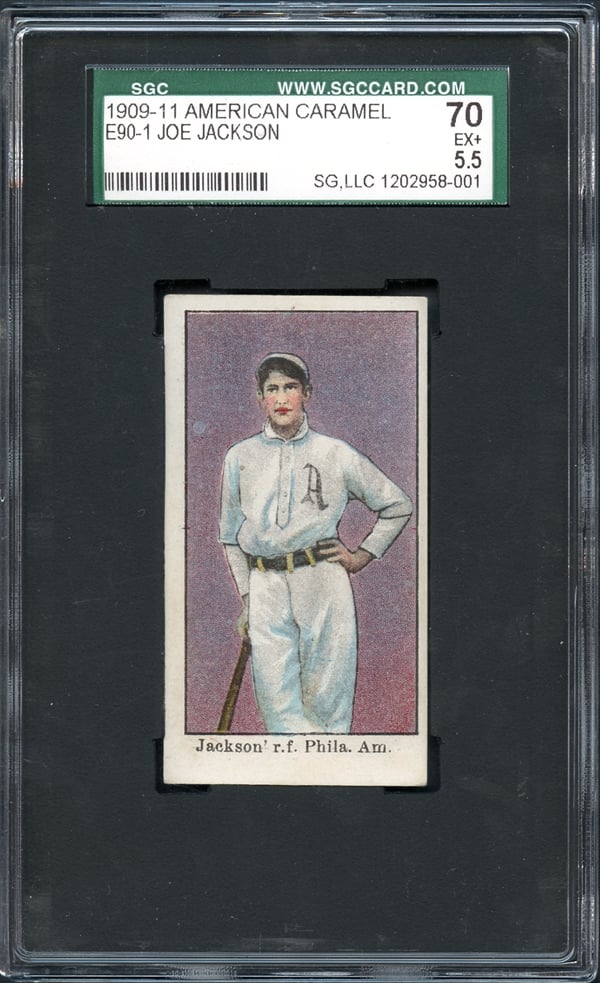
In the world of vintage baseball cards, condition isn’t just a detail—it’s the difference between a life-changing sale and a yard sale. Shoeless Joe Jackson’s rookie cards, particularly his 1909-11 American Caramel and 1914-15 Cracker Jack issues, are no exception. A PSA 8 or SGC 80 might fetch six figures, while a PSA 4 or lower could linger in the triple digits. The grading process, however, is where the rubber meets the road—and where the myths start to unravel. Grading companies like PSA, BGS, and SGC have faced criticism over inconsistent standards, with some collectors alleging that certain Jackson cards receive inflated grades due to market pressure.
Consider the 1909-11 American Caramel Jackson rookie. In 2021, a PSA 8 sold for over $1 million, a record at the time. Yet, only a handful of examples have achieved that grade, and even fewer have been re-submitted for verification. The scarcity of high-grade Jackson cards isn’t just a function of age; it’s a function of survival. Many of these cards were handled roughly in the early 20th century, stored in attics, or subjected to the wear and tear of a century. The idea that a pristine Jackson rookie exists is, for many, a collector’s fantasy. The reality is that most surviving examples show edge wear, creases, or surface abrasions—flaws that dramatically suppress value. The grading wars, then, aren’t just about condition; they’re about perception. A high-grade card isn’t just a piece of cardboard—it’s a status symbol, a trophy for the elite few who can afford to chase perfection.
Rarity vs. Reputation: The Scarcity Paradox of Jackson’s Cards
If condition is the kingmaker, rarity is the gatekeeper. Shoeless Joe Jackson’s rookie cards are undeniably scarce, but scarcity alone doesn’t explain their astronomical values. The 1914 Cracker Jack set, for example, is one of the most iconic in baseball card history, yet Jackson’s card is far rarer than those of his contemporaries like Ty Cobb or Walter Johnson. Why? Because Jackson’s career was cut short by the Black Sox scandal, leaving fewer opportunities for his cards to be produced and preserved. The 1909-11 American Caramel set, meanwhile, is slightly more common, but high-grade examples are still elusive.
Yet, here’s where the paradox emerges: some of Jackson’s cards aren’t as rare as the market suggests. The 1914 Cracker Jack set, for instance, was mass-produced, and while Jackson’s card is less common than Cobb’s, it’s not a true “short print.” The scarcity narrative is often exaggerated to justify high prices. Collectors must ask themselves: Is the card genuinely rare, or is the market artificially inflating its value by framing it as a holy grail? The answer lies in the data. Auction records show that Jackson’s cards frequently trade hands in private sales, where prices are less transparent. Public auctions, meanwhile, often feature the same handful of high-grade examples, creating an illusion of extreme scarcity. The reality is that while Jackson’s cards are desirable, their rarity is more a product of demand than actual availability.
Autographed Cards: The Overlooked Wildcard in the Jackson Market
While most of the attention focuses on Jackson’s printed rookie cards, his autographed memorabilia presents a separate—and often overlooked—market. Autographed photos, bats, and balls from Jackson are highly sought after, but their value fluctuates wildly based on provenance and authenticity. Unlike his printed cards, which are graded by objective standards, autographed items rely heavily on the credibility of the seller and the chain of custody. A Jackson autograph on a photo from the 1910s might fetch $50,000, while a similar item with questionable paperwork could be worthless.
The market for Jackson autographs is also influenced by the same controversies that drive his card values. Collectors who believe in his innocence—or who are drawn to the outlaw mystique—are willing to pay premiums for items that feel “authentic” in a way that transcends traditional grading. This is where the line between myth and reality blurs most dangerously. A well-documented Jackson autograph from a reputable source might be worth its weight in gold, but a forged signature, even one that looks convincing, can crater in value overnight. The autograph market, then, is a high-stakes gamble—a test of trust in a hobby where fakes are rampant and expertise is paramount.

The Investment Angle: Are Jackson Cards a Safe Bet?
For many collectors, the appeal of Shoeless Joe Jackson’s rookie cards isn’t just emotional—it’s financial. The market for vintage baseball cards has exploded in recent years, with high-end Jackson cards appreciating at rates that rival fine art. But is this a sustainable investment, or a bubble waiting to burst? The answer depends on who you ask. Proponents point to the long-term track record of iconic cards, arguing that Jackson’s cards will only grow in value as the hobby’s demographics shift toward younger, wealthier collectors. Skeptics, however, warn that the market is overheated, with prices driven more by hype than fundamentals.
The key factor to watch is liquidity. High-grade Jackson cards, particularly those graded PSA 8 or higher, are liquid assets—they sell quickly and at high prices. Lower-grade cards, however, can be illiquid, sitting unsold for years. The investment appeal of Jackson’s cards also hinges on the broader vintage market. If the bubble bursts—whether due to economic downturns, grading controversies, or shifting collector tastes—Jackson’s cards could see significant corrections. For now, though, the demand remains strong, fueled by nostalgia, scarcity, and the enduring power of baseball’s most tragic hero.
Navigating the Market: What Collectors Should Know
If you’re considering adding a Shoeless Joe Jackson card to your collection, knowledge is your best defense against overpaying or buying a counterfeit. Start by familiarizing yourself with the key issues: the American Caramel and Cracker Jack rookies, as well as the less common 1915-16 Sporting News set. Study recent auction results, but don’t rely solely on them—private sales often tell a different story. Pay close attention to grading reports, and don’t be afraid to ask for additional photos or documentation. If a deal seems too good to be true, it probably is.
Another critical factor is provenance. A Jackson card with a documented history—such as one owned by a famous collector or featured in a reputable publication—will always command a premium. Conversely, a card with murky origins is a red flag. The market for Jackson memorabilia is rife with forgeries, so authentication should be your top priority. Work with trusted dealers, use third-party grading services, and, if possible, consult with experts who specialize in vintage baseball cards.
The Shoeless Joe Jackson rookie card market is a fascinating microcosm of the broader vintage collecting world—a place where history, emotion, and economics collide. The cards themselves are more than just collectibles; they’re artifacts of a bygone era, tangible links to a player whose legacy is as complicated as it is compelling. But while the myth of Joe Jackson may never fade, the reality of his cards is far more nuanced. Scarcity, condition, and controversy all play a role in driving value, but the market’s infatuation with his legend often outpaces the facts. For collectors, the challenge isn’t just finding a Jackson card—it’s separating the hype from the heart of the hobby. In the end, the most valuable cards may not be the ones that fetch the highest prices, but the ones that tell the most authentic story.