The 2010 Topps and Bowman rookie cards of Stephen Strasburg aren’t just pieces of cardboard—they’re time capsules of a career that once promised greatness. When Strasburg debuted in 2009, he was the phenom who made baseball fans forget the 2008 draft’s collective disappointment. His fastball cracked triple digits, his curveball looked like a buzzsaw, and the Washington Nationals handed him the keys to a franchise desperate for relevance. By the time his rookie cards hit shelves in 2010, Strasburg was already a household name, and the hobby reacted accordingly. Fast-forward to today, and those same cards are now the subject of heated debate: are they a boom investment waiting to explode, or a bust destined to gather dust in a shoebox? The answer isn’t as simple as checking a price guide. It’s a story of market psychology, condition rarity, and the unpredictable alchemy of baseball nostalgia.
The 2010 Topps RC: The OG Strasburg Card
The 2010 Topps Stephen Strasburg rookie card (#661) is the granddaddy of his cardboard legacy. Printed on standard Topps stock, it features Strasburg mid-windup, his cap slightly askew, a blur of motion in his right arm. The design is classic Topps—clean, uncluttered, with just enough flash to make it pop in a binder. But what makes this card truly fascinating isn’t its aesthetics; it’s its role as the first tangible link to Strasburg’s MLB arrival. Collectors who snagged this card in 2010 did so on pure hype, and for years, it traded hands at prices that reflected that optimism. Today, raw copies in Near Mint condition hover around $20–$40, while graded versions (PSA 9 or BGS 9.5) can fetch $100–$150. The real intrigue lies in the untapped potential of ungraded lots. A sealed box of 2010 Topps from that era might still hold a Strasburg card that could one day rival the value of a 1952 Mickey Mantle in pristine condition.

The card’s value trajectory is a study in hype decay. Early on, it was a hot commodity, but as Strasburg’s career hit its first major stumbling block—the infamous 2010 Tommy John surgery—demand waned. Yet, the card’s story didn’t end there. It became a time-stamp artifact, a relic of what could have been. For investors, that’s where the opportunity lies. The market for Strasburg’s early cards is still in its adolescence, and as his legacy evolves, so too will the perception of these pieces. A PSA 10 in a decade could be a $500 card—not because Strasburg’s stats demand it, but because the hobby will have rewritten the rules of what constitutes a “legendary” rookie card.
The 2010 Bowman Chrome Prospects: Where the Shine Meets the Speculation
If the 2010 Topps RC is the OG, then the 2010 Bowman Chrome Prospects #BCP1 is the high-octane variant—the card that separates the casual fan from the die-hard collector. Bowman Chrome, with its glossy finish and refractor parallels, was already a darling of the modern hobby, and Strasburg’s inclusion in the set made it a must-have. The base refractor version is the most accessible, trading in the $50–$80 range for a PSA 9, but the real action happens with the numbered parallels. A BGS 9.5 of the #/500 version has sold for over $300, and the elusive #/100 can push into four figures. The chrome treatment amplifies the card’s visual impact, making Strasburg’s intense gaze and the ball’s blur feel almost three-dimensional. But here’s the catch: chrome cards are notorious for their condition sensitivity. Scratches, fingerprints, and even minor centering issues can crater a grade, turning a $200 card into a $20 paperweight overnight.
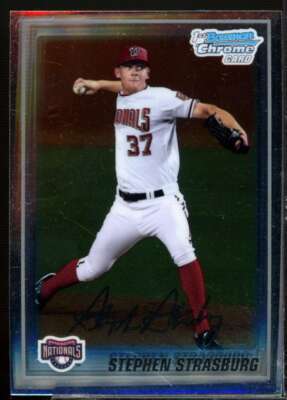
The Bowman Chrome Strasburg card is a speculator’s dream. Its value is tied less to Strasburg’s on-field résumé and more to the card’s scarcity and the hobby’s insatiable appetite for premium refractors. The #/100 version, in particular, is a blue-chip investment for those willing to take the risk. But like all high-end speculation, it’s a game of patience and timing. The market for Strasburg’s chrome cards is still relatively thin, meaning a single high-grade sale can send ripples through the entire tier. For investors, the key is to monitor grading trends and auction results closely. A PSA 10 of the #/100 could become the crown jewel of a vintage collection—or it could remain a niche item, coveted only by the most ardent Strasburg enthusiasts.
The Walmart Exclusive: The Underdog of the Strasburg Universe
Not all Strasburg rookie cards were born equal. The 2010 Bowman #bp1 AGS 10 GEM MT exclusive, sold exclusively at Walmart, is the red-headed stepchild of the set—a card that flew under the radar for years before slowly gaining cult status. AGS (Authenticated Grading Services) was a short-lived grading company that promised quick, affordable evaluations, and its Walmart-exclusive Strasburg card is one of its few lasting legacies. Raw copies in NM-MT condition can be found for under $20, but a graded AGS 10? That’s where things get interesting. Because AGS is no longer in operation, its grades are effectively frozen in time, making them a curiosity for collectors who value the quirks of vintage grading services. A BGS 10 of this card has sold for over $150, proving that even the most obscure cards can carve out a niche in the market.
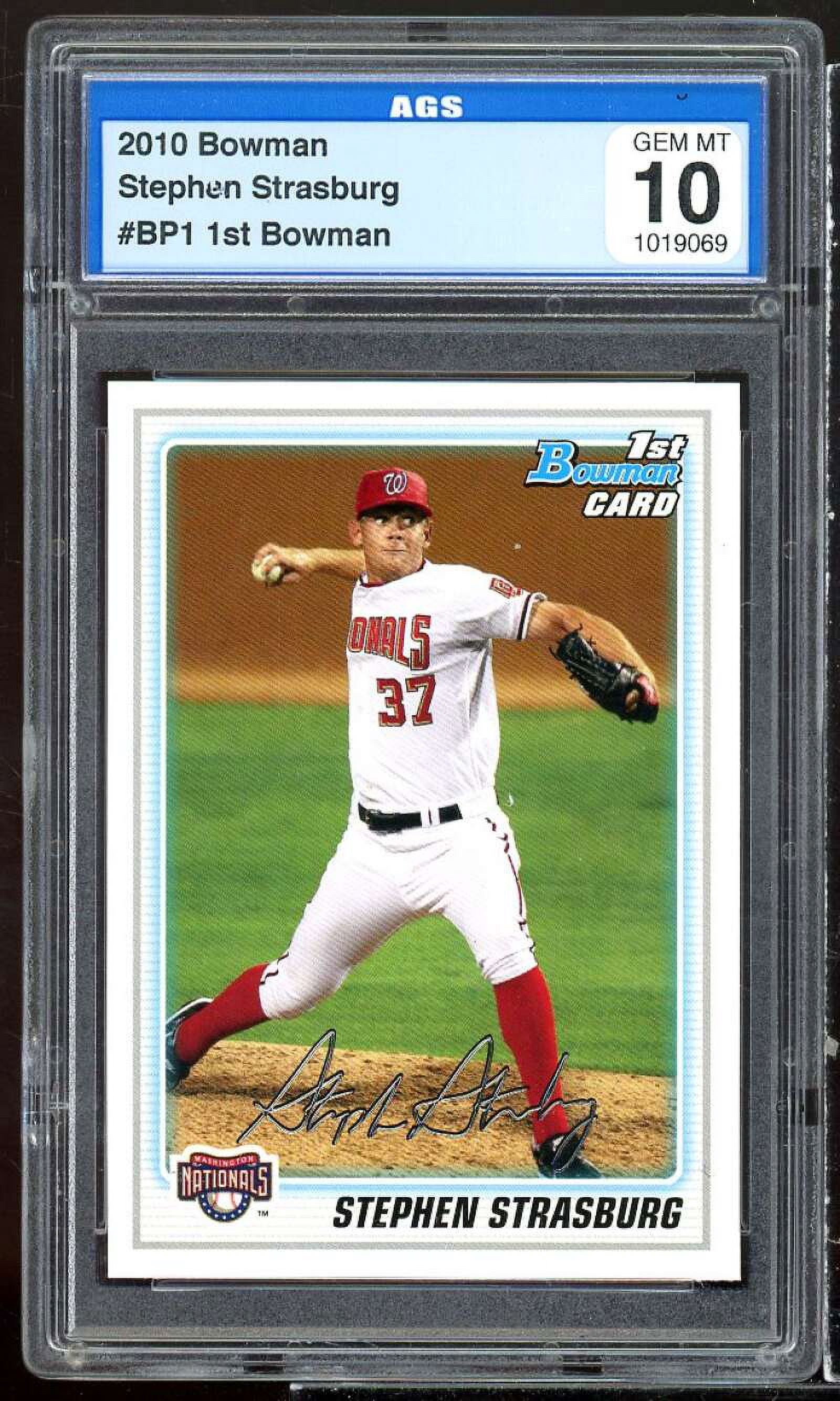
The Walmart exclusive’s value isn’t just about scarcity; it’s about storytelling. This card represents a moment when the hobby was still figuring itself out, when grading services popped up like weeds, and when big-box retailers tried to muscle their way into the baseball card market. For collectors who appreciate the archaeology of the hobby, the AGS Strasburg is a fascinating artifact. Its future value hinges on how aggressively the market embraces “vintage modern” cards—cards from the late 2000s and early 2010s that haven’t yet reached full historical status. If that trend gains traction, the AGS 10 could become a sought-after piece of cardboard history.
Investment Strategies: How to Play the Strasburg Rookie Card Market
So, you’re sold on the idea of Strasburg rookie cards as an investment. But where do you start? The first rule is to diversify your approach. Don’t put all your eggs in one basket—whether that’s the Topps RC, the Bowman Chrome, or the AGS exclusive. Instead, consider a tiered strategy. Allocate a portion of your budget to high-grade base cards (PSA 9 or BGS 9.5), another to parallels and numbered inserts, and a small slice to raw lots that might contain hidden gems. The goal isn’t to hit a home run on every purchase; it’s to build a portfolio that can weather the ups and downs of the market.
Next, master the grading game. The difference between a PSA 9 and a PSA 10 of the same card can be hundreds of dollars. Learn the quirks of each grading company—PSA’s strictness, BGS’s subgrades, SGC’s balanced approach—and decide which aligns best with your investment goals. For high-end Strasburg cards, BGS is often the preferred choice due to its higher thresholds for centering and corners. But don’t overlook the potential of SGC or even raw cards that might one day be submitted to a new grading service with a more lenient standard.
Finally, watch the auction houses. The Strasburg market is still in its formative years, meaning auction results can shift dramatically from month to month. Set up alerts for completed sales on eBay, Heritage Auctions, and Goldin. Pay attention to the story behind the sale—was the card part of a larger collection? Was it graded by a service with a strong reputation? These details can provide clues about where the market is headed. And don’t sleep on private sales. Sometimes, the best deals happen off-market, where sellers are motivated by factors beyond pure profit.
The Wild Card: Strasburg’s Legacy and the Market’s Whims
No discussion of Strasburg rookie cards would be complete without acknowledging the elephant in the room: Strasburg himself. His career has been a rollercoaster of brilliance and disappointment. The 2019 World Series heroics were a fleeting reminder of his potential, but the injuries, the inconsistency, and the abrupt retirement in 2024 have left many wondering: Is he a Hall of Famer, or just another “what if”? The answer will shape the Strasburg rookie card market for decades to come. If he’s enshrined in Cooperstown, expect a seismic shift in demand. If his legacy fades into the annals of “almost greats,” the market could stagnate or even contract.
But here’s the thing about baseball cards: they’re not just investments tied to a player’s résumé. They’re cultural artifacts, tied to the emotions of the era in which they were produced. Strasburg’s rookie cards capture the moment when baseball fans believed in miracles. They’re the cardboard embodiment of a time when a single pitcher could make a franchise relevant overnight. That emotional pull is what gives these cards their staying power. Even if Strasburg never reaches Cooperstown, his rookie cards will always have a place in the hobby’s collective memory.
The Strasburg rookie card market is a microcosm of the broader baseball card hobby—a place where nostalgia, speculation, and pure passion collide. It’s not for the faint of heart, and it’s not a get-rich-quick scheme. But for those willing to dig deep, to study the nuances, and to embrace the uncertainty, it’s a market brimming with opportunity. Whether you’re chasing the OG Topps RC, the flashy Bowman Chrome, or the underdog AGS exclusive, remember this: the real value of these cards isn’t just in their price tags. It’s in the stories they tell, the memories they preserve, and the way they connect us to the golden age of Strasburg’s rise. And in a hobby that’s constantly evolving, that’s priceless.