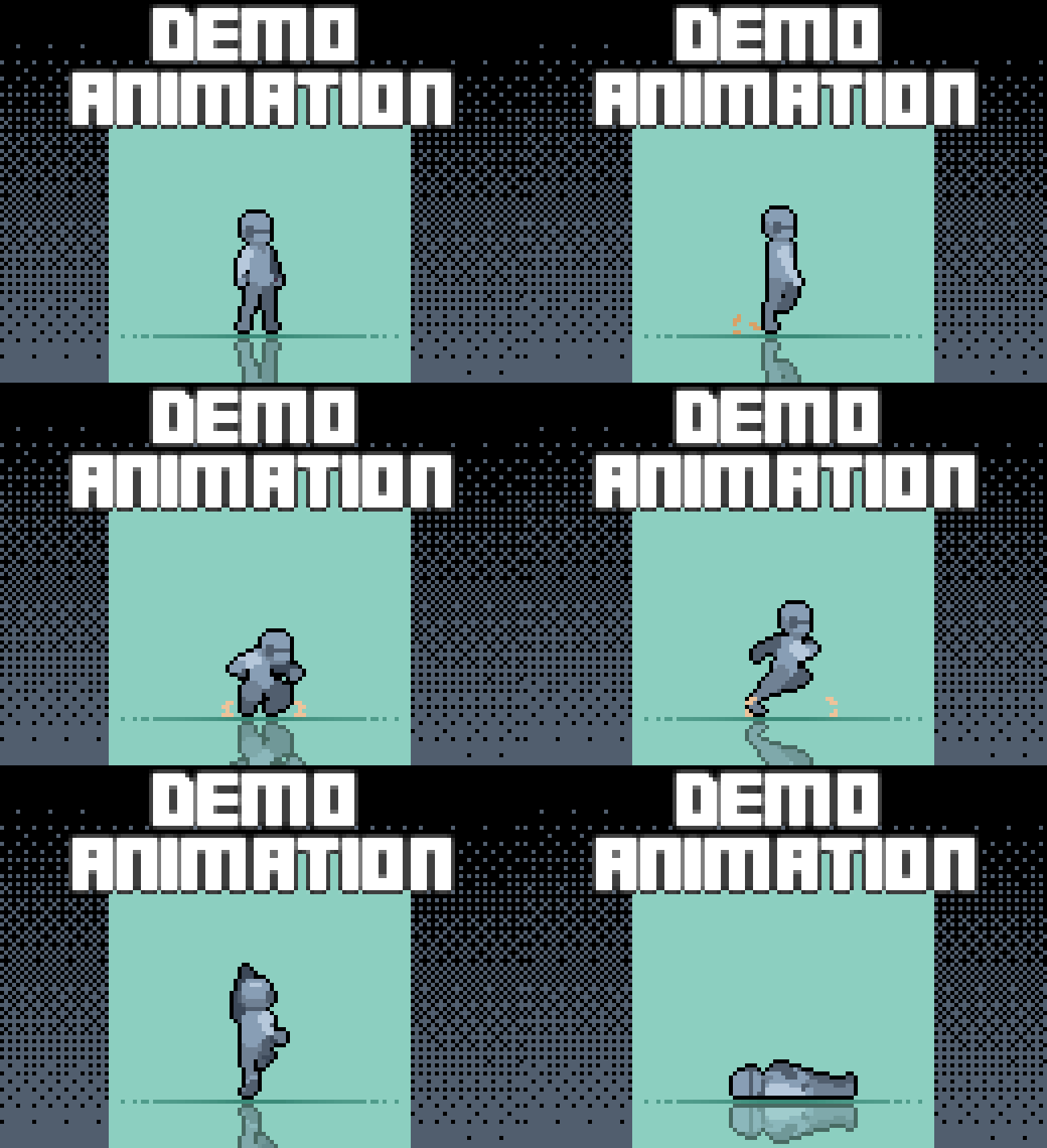
Imagine stepping onto the diamond, the crack of the bat echoing in your ears, the infield dirt crunching beneath your cleats. Every movement—from the first twitch of anticipation to the final lunge for a ground ball—feels like a dance between precision and instinct. Yet, what if I told you that the difference between a good player and a great one isn’t just raw talent or hours of practice? It’s the invisible language of movement, the subtle symphony of biomechanics that turns a fumble into a highlight reel and a hesitation into a game-winning play. This isn’t just about running faster or throwing harder. It’s about moving smarter. Welcome to the world of basic baseball movement animations—where the game slows down, and every step, stride, and slide becomes a calculated masterpiece.
The Hidden Physics of Baseball Movement: Why Animation Matters More Than You Think
At its core, baseball is a sport of split-second decisions, where milliseconds dictate outcomes. But beneath the surface, there’s an intricate web of physics governing every motion. The angle of a runner’s lead-off, the torque in a pitcher’s stride, the deceleration curve of an outfielder tracking a fly ball—these aren’t just athletic maneuvers. They’re kinetic choreographies, each designed to optimize energy transfer, balance, and reaction time. Traditional training often overlooks this layer of detail, focusing instead on brute force or repetitive drills. Yet, when you dissect the movement patterns of elite players, a pattern emerges: their actions aren’t just fast; they’re efficient. Animation, in this context, isn’t about flashy CGI or video game aesthetics. It’s about deconstructing motion into its fundamental components—the push-off angle of a sprint, the hip rotation in a throw, the weight shift during a pivot. By analyzing these elements frame by frame, players can identify inefficiencies that, when corrected, shave seconds off their times and add inches to their throws. The result? A player who doesn’t just move faster but moves with the calculated lethality of a predator.
From Novice to Pro: How Movement Animation Rewires Your Muscle Memory
Muscle memory is the silent architect of athletic performance, but it’s not infallible. If you’ve ever practiced a swing or a throw only to find your body reverting to old habits under pressure, you’ve experienced its double-edged nature. The problem isn’t effort—it’s neuromuscular misalignment. Movement animation acts as a corrective lens, exposing the gaps between intention and execution. When you see your lead foot plant a fraction too late in a slide or your throwing arm lag behind your body’s rotation, the revelation is immediate. Unlike vague coaching cues like “stay balanced” or “drive harder,” animation provides tangible, visual feedback. It’s one thing to be told your stride is too short; it’s another to watch your hips open prematurely on a pitch, leaving your upper body to play catch-up. Over time, this feedback reprograms your nervous system, replacing flawed patterns with optimized, repeatable motions. The transformation isn’t just technical—it’s psychological. Players who train with animation often report a newfound confidence, as their bodies finally move in harmony with their instincts.
The Three Pillars of Baseball Movement: Where Animation Transforms the Game
Not all movements in baseball are created equal. Three foundational pillars—base running, fielding transitions, and pitching mechanics—serve as the battlegrounds where animation can deliver the most dramatic improvements. Let’s break them down:
1. Base Running: The Art of Controlled Chaos
A stolen base isn’t just about speed; it’s about temporal precision. The gap between a pitcher’s leg kick and the ball crossing the plate is often less than 0.5 seconds. Animation reveals the optimal moment to explode off the bag, the ideal stride length to maintain momentum without overstriding, and the subtle weight shifts that keep your center of gravity low during a slide. Elite base runners don’t just run fast—they run with the rhythm of the game, turning what was once a gamble into a calculated risk.
2. Fielding Transitions: The Glide Path to Glory
Fielding isn’t a static skill—it’s a dynamic sequence of adjustments. Whether fielding a grounder or turning a double play, the difference between a clean transfer and an error often comes down to angular velocity. Animation highlights how your glove hand tracks the ball, how your feet pivot to align with your target, and how your throwing arm syncs with your lower body. A common flaw? Players who field the ball with their glove side too far from their body, forcing a rushed throw. Animation exposes this, allowing for drills that ingrain a more compact, efficient motion. The result? Fewer miscues and more outs.
3. Pitching Mechanics: The Kinetic Chain Unleashed
Pitching is the ultimate test of kinetic sequencing—the transfer of energy from the legs, through the torso, and into the arm. Animation dissects this chain, revealing inefficiencies like early trunk rotation or a stiff front leg that disrupts power. For pitchers, the goal isn’t just to throw harder but to throw smarter. By analyzing the timing of their stride, the angle of their shoulder tilt, and the pronation of their wrist, they can fine-tune their delivery to maximize velocity while minimizing injury risk. The best pitchers don’t just rely on arm strength; they orchestrate a symphony of movement where every joint plays its part.
Beyond the Drill: How Animation Turns Practice into Performance
Traditional training methods have a critical flaw: they treat movement as a series of isolated actions. You practice fielding grounders, then throwing, then running bases—separately. But baseball doesn’t happen in a vacuum. It’s a fluid, reactive sport where transitions dictate outcomes. Animation bridges this gap by simulating game-like scenarios. Imagine a shortstop fielding a grounder, pivoting, and throwing to first—all in a single, analyzable sequence. Animation allows players to practice these transitions in slow motion, identifying where their body breaks down under pressure. It’s not just about correcting flaws; it’s about building resilience. Players who train with animation develop an intuitive understanding of how their movements interact with the ball’s trajectory, the runner’s speed, and the field’s geometry. They stop thinking in terms of drills and start thinking in terms of game intelligence.
The Psychological Edge: How Visual Feedback Boosts Confidence and Reduces Errors
Confidence in baseball isn’t just mental—it’s embodied. When your body moves the way it’s supposed to, your mind follows. Animation provides the missing link between perception and reality. Players who struggle with fear of failure often do so because they can’t visualize success. Animation changes that. By seeing their movements perfected in real time, they internalize the mechanics of a flawless play. This isn’t just about aesthetics; it’s about neurological priming. The brain, when shown a correct motion repeatedly, begins to anticipate it, reducing hesitation and increasing reaction speed. For pitchers, this means fewer walks. For fielders, it means fewer errors. For base runners, it means more stolen bases. The psychological ripple effect is undeniable: players who train with animation report feeling more in control, more prepared, and more unstoppable.
Implementing Animation Training: A Step-by-Step Blueprint for Immediate Results
Ready to transform your game? Here’s how to integrate animation training into your routine:
Step 1: Capture Your Movements
Use high-speed cameras or motion-capture technology to record your actions from multiple angles. The goal isn’t just to see yourself move—it’s to deconstruct the motion into its atomic parts. Focus on the joints: hips, knees, shoulders, wrists. Note where energy leaks occur—where your body dissipates power instead of transferring it.
Step 2: Compare Against the Elite
Study the animations of professional players. Look for patterns in their stride length, arm angles, and weight distribution. The differences between a novice and a pro aren’t always about strength—they’re about efficiency. A minor league player might throw just as hard as a major leaguer, but the latter’s motion is optimized to sustain that velocity over 100 pitches.
Step 3: Drill the Corrections
Animation reveals flaws, but it’s the drills that fix them. If your lead leg is stiff during a pitch, practice exaggerated strides to ingrain flexibility. If your fielding transfer is slow, work on glove-to-hand transitions with weighted balls. The key is deliberate repetition—not just going through the motions, but sculpting them.
Step 4: Test Under Pressure
Animation training isn’t just for the offseason. Use it to simulate game scenarios: a runner on third with less than two outs, a bases-loaded count with a 3-2 pitch. The more you practice under these conditions, the more your body will default to the correct motion when it matters most.
Step 5: Refine and Repeat
Baseball is a sport of constant evolution. Even the smallest tweak—a 5-degree adjustment in hip rotation—can yield outsized results. Schedule regular animation reviews to track your progress. Celebrate the gains, no matter how incremental, because in this game, every millisecond counts.
The Future of Baseball Training: Why Animation Isn’t Just a Tool—It’s a Revolution
We’re standing on the precipice of a training revolution. Animation isn’t just another gimmick; it’s the next frontier in athletic development. As technology advances, we’ll see real-time feedback systems that adjust a player’s motion on the fly, AI-driven coaches that predict flaws before they happen, and virtual reality simulations that immerse players in game-like chaos. The players who embrace this shift won’t just outperform their peers—they’ll redefine what’s possible. Baseball has always been a game of inches. With animation, those inches become a chasm.