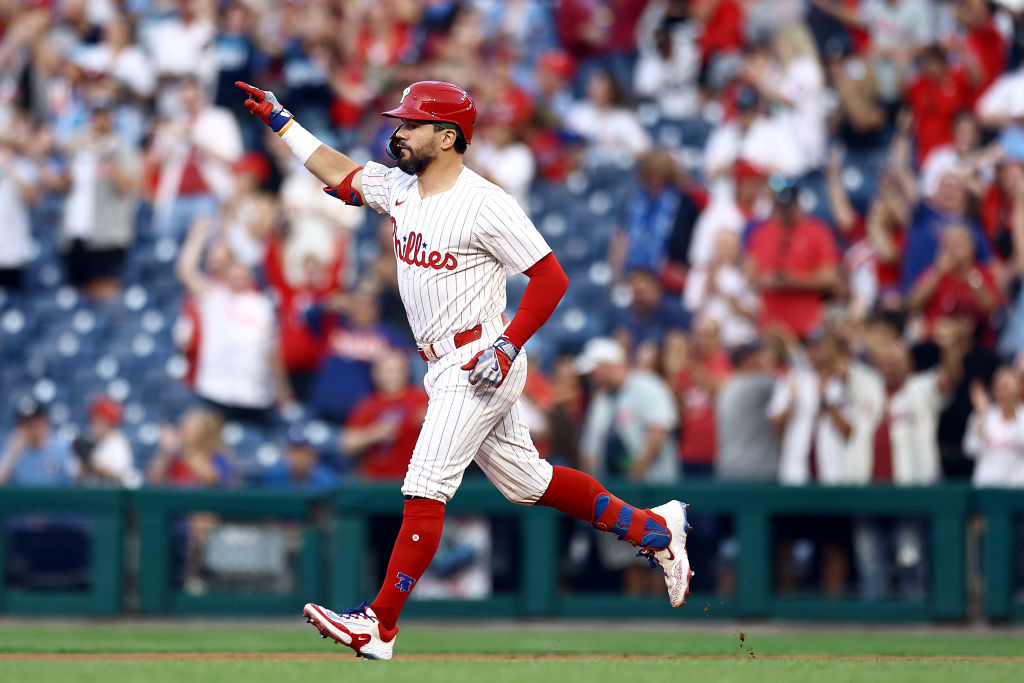
What happens when you take a power hitter and place him in the leadoff spot—a place traditionally reserved for speed and contact? The baseball world has rarely encountered such a juxtaposition, and Kyle Schwarber’s ascent as a leadoff hitter is rewriting the unwritten rules of the game. Is this an ingenious strategy that destabilizes pitching staffs, or does it invite chaos that ultimately undermines team dynamics? Delving into the kaleidoscopic nature of Schwarber’s leadoff experience reveals a fascinating blend of risk, reward, and unpredictability.
The Paradigm Shift: Redefining the Leadoff Role
Traditionally, the leadoff hitter is the quintessential table-setter—a nimble, contact-oriented player with the ability to get on base and create scoring opportunities without relying heavily on power. Schwarber’s emergence in this role, replete with prodigious power and a patient stance, recalibrates expectations. He embodies a paradox: a slugger upfront, willing to swing for the fences, juxtaposed against old-school wisdom preaching caution and speed.
Schwarber’s approach injects volatility into the lineup. Pitchers must grapple with an adversary who is patient but not tentative—he’ll take a base on balls, yet he won’t shy away from a deep drive. This duality forces pitchers into a constant mental chess match, undermining traditional pacing and sequencing. Such a configuration commands a rethinking of game strategy at a foundational level.
Power Meets Patience: Schwarber’s Plate Discipline
One might underestimate the finesse involved in Schwarber’s leadoff batting style. While many power hitters adopt an aggressive early-in-the-count approach, Schwarber exhibits an uncommon discipline. He employs an expansive strike zone tolerance, working deep counts to wear down pitchers. This patience catalyzes frustration among opposing pitchers and catchers, often leading to errant pitches or precipitous decisions.
By elevating his walk rate at the leadoff spot, Schwarber increases his on-base percentage—an invaluable asset for igniting rallies. His willingness to draw walks not only sets the tone but invites the opposing team to recalibrate their attack strategy early. The result is a leadoff experience that blends brute force with cerebral calculation.
Unleashing Chaos: The Psychological Impact on Opposing Teams
Pitching staffs often prepare meticulously for top-of-the-order hitters who are known commodities—whether it’s speed on the bases or consistent contact. Schwarber’s unconventional profile disrupts these preparations. His presence challenges the psychological bearings of pitchers, compelling them to confront constant uncertainty.
This ambiguity can manifest as a heightened mental burden. Will Schwarber chase pitches out of the zone early, or will he wait for a pitch to launch? This oscillation injects a subtle tension into each plate appearance, increasing the likelihood of mistakes. When the leadoff batter can transform a routine inning into a minefield of potential damage, chaos ensues—not just on the scoreboard but in mental poise.
Implications for Team Dynamics and Offensive Flow
Embracing Schwarber in the leadoff role inevitably influences how the rest of the lineup is constructed. Teammates following him must adjust to sporadic presence on the bases, balancing stolen base attempts with awareness of Schwarber’s slugging threat. This recalibration affects batting order strategies and on-field communication.
Moreover, Schwarber’s power potential in front spotlights the raw offensive firepower that can bat deeper in the lineup. Traditional lineups often hoard power hitters behind the leadoff slot, but here, Schwarber serves as a catalyst, capable of igniting early rallies or producing instant one-pitch changes in momentum.
This elevated power presence upfront throws a stone into the placid pond of baseball convention. Teams must decide whether the chaos birthed by such a configuration is a calculated gamble or an unwelcome disruption to offensive symmetry.
Statistical Insights: Performance Metrics in an Unconventional Role
When reviewing Schwarber’s performance as a leadoff hitter, a mosaic of statistics emerges. His on-base percentage, slugging percentage, and isolated power metrics paint a compelling picture of impact. While his stolen base attempts may not align with traditional leadoff expectations, his ability to reach base and drive runs early in games challenges the efficacy of speed-centric paradigms.
Advanced analytics also reveal that Schwarber’s slugging from the leadoff spot translates into increased run expectancy for his team. His presence forces the opposing defense into more aggressive alignments, sometimes creating exploitable gaps. Consequently, the metrics suggest that the havoc he wreaks yields tangible advantages despite defying norms.
Risk Versus Reward: Navigating the Chaotic Terrain
The adoption of Schwarber as a leadoff hitter is not devoid of inherent risks. Power hitters typically face a higher risk of early strikeouts, which can stall inning momentum. Schwarber himself is no stranger to strikeouts, and placing him first means the team occasionally starts innings with two quick outs if a strikeout ensues. This challenges the idea that a leadoff hitter should maximize plate appearances and ball-in-play opportunities.
Yet, the reward lies in the explosive potential to jumpstart a game with a home run or a timely extra-base hit. Schwarber’s ability to alter the underpinning of a game from the outset may outweigh the occasional stagnation. It is a delicate balance between embracing chaos and harnessing it effectively.
Looking Ahead: Is Schwarber’s Leadoff Experiment the Future?
As baseball continues to evolve, the archetypes that once defined player roles blur under the pressure of innovation. Schwarber’s leadoff experiment serves as a possible blueprint for a more dynamic offensive structure—one that values versatility and unpredictability over rigid adherence to tradition.
The question remains: Will other teams embrace this approach or retreat to safer, proven methodologies? Schwarber’s performance may inspire one of two outcomes—a trend towards more power at the top, or a reassertion of conventional wisdom. Regardless, the chaos he introduces symbolizes the fluidity of baseball’s strategic future.