In the grand pantheon of baseball card collecting, where the 1952 Topps Mickey Mantle and the 1986 Fleer Michael Jordan often steal the spotlight, there exists a hidden gem—one that whispers promises of both nostalgia and profit. The 1983 Topps Wade Boggs baseball card, a seemingly unassuming piece of cardboard, has quietly carved out a reputation as a sleeper contender in the world of vintage sports memorabilia. But is it merely an underrated relic of a bygone era, or does it hold the potential to become a bona fide investment goldmine? Let’s lace up our cleats and step into the batter’s box to examine this card’s place in the hobby, its historical significance, and whether it deserves a spot in your collection—or your portfolio.
The Card That Slapped Its Way Into History
Wade Boggs, the left-handed maestro of the diamond, was already a legend in the making by 1983. A seven-time batting champion and a perennial All-Star, Boggs was the kind of hitter who made pitchers weep into their gloves. His 1983 Topps card, featuring a classic action shot of him mid-swing, captures the essence of his disciplined, contact-first approach to the game. Unlike the flashy power hitters of the era, Boggs was the anti-steroid poster boy—a man who could carve up a baseball with the precision of a surgeon. This card, therefore, isn’t just a piece of cardboard; it’s a frozen moment in time, a visual ode to an era when batting averages still mattered more than exit velocities.
The design of the 1983 Topps set itself is a nostalgic time capsule. With its bold, primary-colored borders and the iconic Topps logo emblazoned in the corner, the card exudes the kind of retro charm that modern sets often lack. The back of the card, adorned with Boggs’ career stats and a playful cartoon, adds another layer of character. It’s the kind of card that makes you pause and appreciate the artistry of the era—a stark contrast to the sterile, hyper-digital designs that dominate today’s market.
Condition Conundrum: The Battle for Gem Mint Glory
If there’s one word that sends shivers down the spine of a collector, it’s “Gem Mint.” The 1983 Topps Wade Boggs card, like many of its contemporaries, is notoriously finicky when it comes to grading. The slightest crease, a rogue corner ding, or a fingerprint on the surface can plummet its value faster than a pop-up to the shortstop. This fragility makes it a card that demands respect—both in handling and in storage. A PSA 10 Gem Mint copy can command prices that make your wallet weep, while a lower-grade specimen might struggle to fetch even a fraction of its potential.

But here’s the rub: the chase for a pristine Boggs card is akin to hunting for a unicorn in the wild. The market is flooded with raw copies, many of which are far from the pristine condition required to command top dollar. This scarcity of high-grade examples has created a fascinating dynamic where the demand often outstrips the supply, driving prices upward in a way that feels almost gravitational. For those willing to invest the time, effort, and resources into finding a true Gem Mint specimen, the rewards can be substantial—but the journey is not for the faint of heart.
Investment Potential: A Sleeper with Legs
Let’s address the elephant in the room: is the 1983 Topps Wade Boggs card a sound investment? The answer, as with most things in the hobby, is nuanced. On one hand, Boggs’ legacy as one of the greatest pure hitters of his generation ensures that his cards will always have a baseline level of demand. His Hall of Fame induction and his status as a Boston Red Sox icon only amplify this appeal, particularly among fans of the team and the era. Cards of players with this kind of pedigree tend to hold their value well over time, making them a relatively safe bet for long-term collectors.
On the other hand, the 1983 Topps set as a whole hasn’t experienced the same meteoric rise in value as some of its contemporaries. While Boggs’ card is certainly one of the more desirable pulls from the set, it lacks the same cultural cachet as, say, the 1986 Fleer Michael Jordan or the 1952 Topps Mickey Mantle. This means that its investment potential is more of a slow burn than a rocket ship. For those looking to flip cards for quick profits, Boggs might not be the most exciting play. However, for patient collectors who believe in the long-term appreciation of classic baseball cards, he could be a diamond in the rough.
One factor that could propel Boggs’ card into the investment stratosphere is the growing trend of “set building.” As collectors seek to complete sets from the 1980s, high-grade copies of key cards like Boggs’ become increasingly sought after. This trend, combined with the natural scarcity of Gem Mint examples, could drive prices higher in the coming years. Additionally, as the hobby continues to attract younger collectors who weren’t around to witness Boggs’ prime, his card could benefit from a fresh wave of nostalgia-driven demand.
The Market’s Whims: What’s Driving the Boggs Bubble?
The baseball card market is a fickle beast, swayed by trends, nostalgia, and the occasional burst of speculative fervor. So, what’s currently fueling the interest in the 1983 Topps Wade Boggs card? For starters, the broader resurgence of interest in vintage baseball cards has created a rising tide that lifts all boats—even the less glamorous ones. Auction houses like Heritage and Goldin have seen record-breaking sales in recent years, and Boggs’ card has benefited from this renewed enthusiasm.
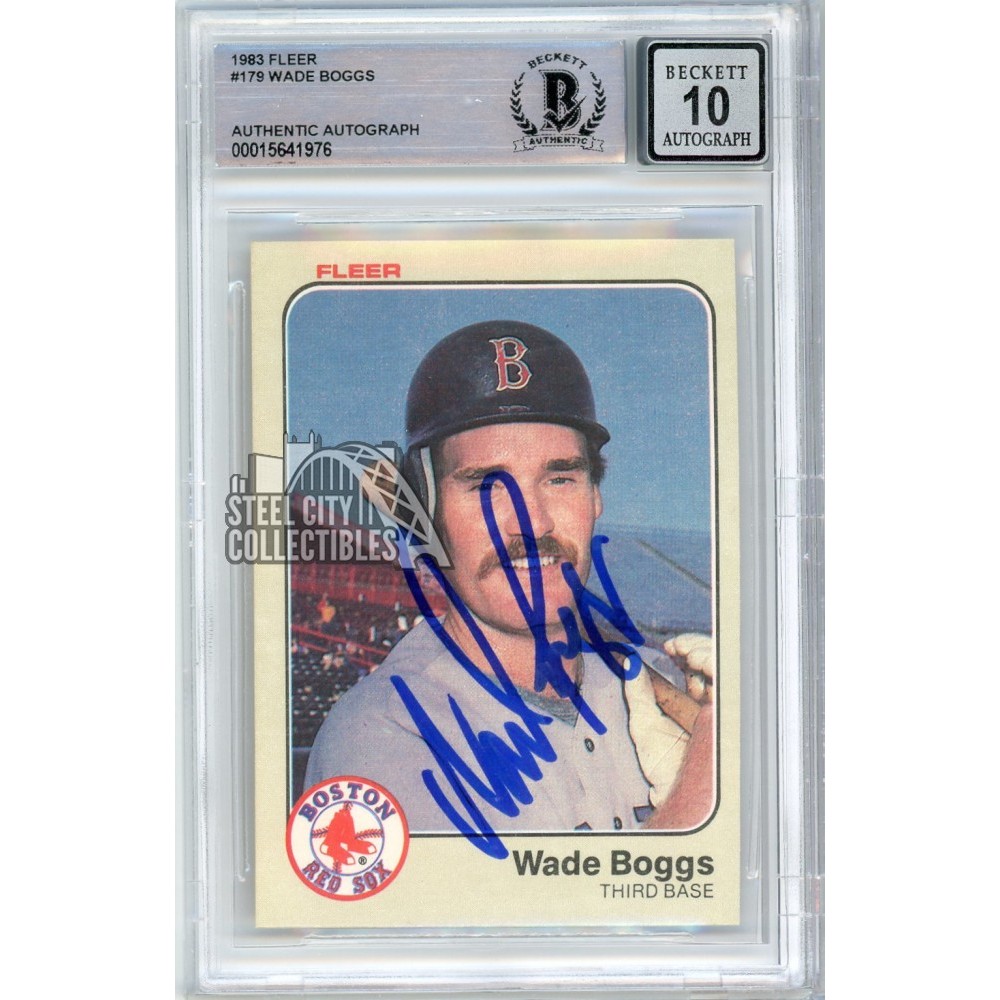
Another factor is the increasing recognition of Boggs’ place in baseball history. While he may not have the same mainstream appeal as a Derek Jeter or a Ken Griffey Jr., Boggs’ statistical dominance and his role in defining an era make him a compelling figure for collectors. His card, therefore, serves as a tangible connection to a time when baseball was still a pastoral game, untouched by the analytics revolution and the era of launch angles.
Of course, the market’s whims are unpredictable. A single high-profile sale or a viral moment on social media can send prices soaring—or crashing. For Boggs’ card, the key will be maintaining its relevance in a hobby that’s constantly evolving. If the next generation of collectors embraces the charm of 1980s baseball cards, Boggs could find himself in the spotlight. If not, he might remain a niche favorite, beloved by a dedicated few but overlooked by the masses.
The Collector’s Dilemma: Chase the Card or Chase the Dream?
For the average collector, the decision to pursue the 1983 Topps Wade Boggs card comes down to a simple question: what do you value more—the thrill of the chase or the potential financial reward? If you’re a die-hard fan of Boggs or the 1983 Topps set, the answer is obvious. Owning a piece of baseball history is its own reward, regardless of the card’s market value. The tactile joy of holding a well-preserved Boggs card, with its vibrant colors and classic design, is something that no spreadsheet can quantify.
But if you’re approaching the hobby from an investment standpoint, the calculus becomes more complex. The 1983 Topps Wade Boggs card is, at best, a moderate-risk, moderate-reward proposition. It’s not a guaranteed home run like a 1952 Topps Mickey Mantle, nor is it a complete dud like many of the commons from the same set. Instead, it occupies a middle ground—a card with enough historical significance and market demand to make it worth considering, but not one that’s likely to make you rich overnight.
For those willing to take the plunge, the key is to do your homework. Understand the grading process inside and out. Familiarize yourself with the market trends and the recent auction results. And, perhaps most importantly, set a budget and stick to it. The allure of a pristine Boggs card is strong, but it’s easy to get swept up in the excitement and overspend. Remember, the goal is to enjoy the hobby—not to mortgage your future on a cardboard rectangle.
Final Swing: Is Boggs the Card for You?
The 1983 Topps Wade Boggs card is a fascinating study in contrasts. It’s a card that’s both underrated and overhyped, a sleeper with the potential to wake the market from its slumber. Its value lies in its ability to bridge the gap between nostalgia and investment, between the past and the future. Whether it’s a true gem or merely a stepping stone on the path to greater riches depends entirely on your perspective.
If you’re a collector who appreciates the artistry of the game’s golden era, if you’re drawn to the challenge of hunting down a Gem Mint specimen, or if you simply love the idea of owning a piece of Wade Boggs’ legacy, then this card might just be the perfect addition to your collection. But if you’re looking for a quick flip or a guaranteed return, you might want to temper your expectations. The baseball card market is a wild ride, and not every card is destined for greatness.
At the end of the day, the 1983 Topps Wade Boggs card is more than just a collectible—it’s a story waiting to be told. It’s a reminder of a time when baseball was played with a sense of romance and tradition, when a player’s legacy was measured in batting titles and clutch hits rather than launch angles and spin rates. And in a hobby that’s constantly chasing the next big thing, sometimes the real treasure is the card that’s been sitting in the shadows all along.