There’s a quiet consensus among collectors that certain cards transcend their era, becoming more than just cardboard and ink—they become artifacts of a bygone golden age. The 1992 Topps Ken Griffey Jr. card sits squarely in that rarefied air. At first glance, it’s just another base card from the early ’90s boom era, a time when Topps churned out rookie cards like a printing press on overdrive. Yet, three decades later, it endures. Why does this particular card still command attention, even as countless others from the same vintage gather dust in shoeboxes? The answer lies not just in the player’s legacy, but in the alchemy of timing, aesthetics, and the intangible pull of nostalgia.
The 1992 Topps Ken Griffey Jr. card is often dismissed as “just another ’90s card,” but such a label undersells its significance. This was the year Griffey was already a supernova, fresh off his 1990 and 1991 campaigns where he cemented himself as baseball’s most electrifying young talent. By 1992, he had won a Gold Glove, a Silver Slugger, and finished second in MVP voting. The card captures him mid-swing, bat blurred in motion, a frozen moment of kinetic grace that feels almost cinematic. The design itself is unassuming—classic Topps layout with a white border, the player’s name in bold, blocky lettering at the bottom, and the team name in a smaller font above. But it’s the photograph that elevates it. Griffey’s stance is effortless, his uniform crisp against the muted background, a visual echo of the effortless dominance he brought to the diamond.
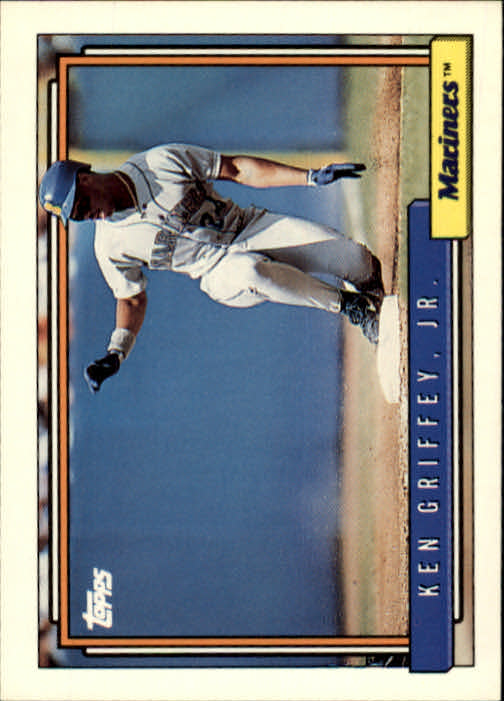
What makes this card particularly fascinating is how it reflects the broader cultural moment of the early ’90s. The Mariners, despite their perennial underdog status, were on the cusp of something special. Griffey’s arrival in Seattle in 1989 had already begun to shift the city’s baseball identity, transforming a franchise once synonymous with mediocrity into a team with swagger. The 1992 season would see the Mariners finish second in the AL West, their best showing in years. The card, in its own small way, encapsulates that rise—a visual time capsule of a franchise and a city finding its footing. For collectors who lived through that era, the card isn’t just about Griffey; it’s about the collective memory of a team that finally felt like it belonged.
Condition is everything in the world of vintage cards, and the 1992 Topps Griffey is no exception. A card graded PSA 10 is a unicorn, its pristine corners and vibrant colors a testament to both the player’s enduring appeal and the care of its original owner. But even mid-grade copies—PSA 7 or 8—retain a certain charm. The white borders, prone to chipping and wear, tell a story of their own. Each scratch, each crease, is a whisper from the past, a reminder that this card has lived, been held, and perhaps even autographed by the man himself. The market reflects this nuance. A raw, ungraded copy might fetch a few dollars, while a PSA 10 can command hundreds. The disparity isn’t just about rarity; it’s about the emotional resonance of owning a piece of history that still feels alive.
Yet, the card’s value isn’t solely tied to Griffey’s on-field heroics or its place in Mariners lore. There’s something deeper at play here, something almost mythological. Griffey wasn’t just a great player; he was a cultural icon. His boyish grin, his effortless style, and that iconic swing made him the face of baseball in the ’90s, a decade that desperately needed a hero. The 1992 Topps card is a visual shorthand for that era—a time when baseball was still America’s pastime, before the steroid era tarnished its luster and the rise of analytics began to strip away some of its romance. Collectors today aren’t just buying a card; they’re buying a slice of that innocence, a fleeting moment before the game became more complicated.
For newer collectors, the 1992 Topps Griffey card offers a gateway into the hobby’s golden age. It’s affordable enough to acquire without breaking the bank, yet it carries the weight of history. It’s a card that can sit comfortably in a modern collection, bridging the gap between vintage and contemporary. And for those who lived through the ’90s, it’s a trigger for memories—of summer afternoons spent watching Griffey launch moon shots, of trading cards with friends, of the sheer joy of a game that felt pure. The card’s enduring appeal is a testament to the power of nostalgia, but it’s also a reminder that greatness isn’t just measured in statistics or auction prices. Sometimes, it’s measured in the way a single image can evoke an entire era.
The 1992 Topps Ken Griffey Jr. card endures because it’s more than a collectible. It’s a relic of a time when baseball was as much about style as it was about skill, when a player’s charisma could outshine even his prodigious talent. It’s a card that rewards both the casual fan and the die-hard collector, offering something different with each glance. Whether you’re drawn to its historical significance, its aesthetic appeal, or the sheer joy it brings, one thing is clear: this card isn’t just worth collecting today. It’s worth treasuring.