Have you ever stumbled upon a baseball card that feels like a secret handshake among collectors? A card so underrated that even seasoned hobbyists overlook its charm? Meet the 1989 Score Randy Johnson rookie card—a cardboard gem that punches far above its weight in the world of vintage baseball collectibles. While the Upper Deck and Fleer rookies of the same year hog the spotlight, this unassuming Score issue quietly carves out its own legacy. But why does it fly under the radar? And what makes it a potential sleeper hit for those willing to dig deeper?
Let’s embark on a journey through the dusty corners of the hobby, where this card’s story unfolds like a well-kept secret. From its artistic quirks to its market potential, we’ll explore why the 1989 Score Randy Johnson rookie card deserves a spot in your collection—or at least a second glance.
The Card That Almost Wasn’t: A Brief History of 1989 Score
The 1989 Score set was a late bloomer in the baseball card boom of the late ’80s, arriving when the market was already saturated with flashier alternatives. Unlike the high-gloss perfection of Upper Deck or the nostalgic allure of Fleer, Score’s design leaned into a more subdued, almost utilitarian aesthetic. Their cards featured a matte finish, a stark contrast to the glossy sheen of competitors, and a layout that prioritized function over flair. Randy Johnson’s rookie card, in particular, captures this ethos perfectly—simple, straightforward, and devoid of the gimmicks that defined other sets.
Yet, this minimalism might be its greatest strength. In an era where collectors were bombarded with holograms, foil stamps, and other distractions, Score’s no-frills approach feels refreshingly honest. The 1989 Score set was also one of the last major releases before the industry’s shift toward premium pricing and limited editions. That makes Johnson’s rookie card a fascinating time capsule—a snapshot of baseball card collecting before it became big business.
Design Nuances: What Makes This Card Stand Out?
At first glance, the 1989 Score Randy Johnson rookie card appears unremarkable. The background is a muted gray, Johnson’s image is framed in a thin white border, and his name is printed in a bold, sans-serif font. But look closer. The card’s matte texture isn’t just a stylistic choice—it’s a tactile rebellion against the slick, almost slippery feel of other cards from the era. Run your fingers over it, and you’ll notice how the ink resists smudging, a subtle nod to durability in an age of flimsy cardboard.
The photo itself is a study in contrasts. Johnson, then a lanky left-handed pitcher for the Seattle Mariners, is captured mid-windup, his arm a blur against the static background. The lack of dynamic action shots in Score’s set makes this card feel like a deliberate choice—almost as if the photographer wanted to emphasize Johnson’s raw potential rather than his polished form. The absence of a flashy border or team logo keeps the focus squarely on the player, a rarity in an era where cards were often crammed with visual noise.
Even the back of the card plays into this minimalist narrative. The stats are presented in a clean, easy-to-read format, with no distracting graphics or player quotes. It’s the kind of card that rewards patience, appealing to collectors who appreciate subtlety over spectacle.
The Market’s Blind Spot: Why Is This Card Underrated?
If you’ve ever scrolled through eBay listings or browsed vintage card shops, you’ve likely noticed how the 1989 Score Randy Johnson rookie card is consistently overshadowed by its Upper Deck and Fleer counterparts. The Upper Deck version, with its pristine white borders and high-quality photography, is the poster child for Johnson’s rookie year. Meanwhile, the Fleer card—often graded PSA 10—commands premium prices at auctions. So, why does the Score card linger in the shadows?
Part of the answer lies in scarcity. While Upper Deck and Fleer produced millions of cards, Score’s distribution was more limited. The set wasn’t as widely available in hobby shops or convenience stores, meaning fewer copies were printed and even fewer survived in high-grade condition. Today, finding a 1989 Score Johnson in Near Mint or better is like stumbling upon a hidden gem in a thrift store—unexpected and delightful.
Another factor is the grading conundrum. Unlike the Upper Deck and Fleer cards, which have been scrutinized by collectors for decades, the Score issue hasn’t faced the same level of scrutiny. That means high-grade examples are rarer than their counterparts, and when they do surface, they often fly under the radar. For savvy collectors, this presents an opportunity: a chance to acquire a card with untapped potential before the market catches on.
A Playful Challenge: Can You Spot the Differences?
Here’s a thought experiment for you: Imagine holding three Randy Johnson rookie cards side by side—one from Upper Deck, one from Fleer, and one from Score. What would you notice first? The Upper Deck card’s sharp focus? The Fleer card’s vibrant colors? Or the Score card’s understated elegance? Now, consider this: Which one tells the most compelling story about Johnson’s rookie year?
The Upper Deck card is a masterclass in modern card design, but it lacks the raw, unfiltered charm of the Score issue. The Fleer card is a classic, but its popularity has driven up prices to stratospheric levels. The Score card, however, offers something different—a quiet confidence that grows on you. It’s the kind of card that makes you pause and think, “Why isn’t this more famous?”
For collectors willing to take the plunge, this presents a playful challenge: Can you build a Randy Johnson rookie card set that highlights the diversity of his early cards? Or perhaps focus on the Score issue as a standalone investment, betting on its future appreciation as the market wakes up to its charms?
Investment Potential: Is the 1989 Score Johnson a Sleeper?
If you’re a collector with an eye for undervalued assets, the 1989 Score Randy Johnson rookie card might just be your next project. While the Upper Deck and Fleer cards have already seen significant price appreciation, the Score issue remains a relative bargain. High-grade examples (PSA 9 or BGS 9.5) can be found for a fraction of the cost of their flashier counterparts, making it an accessible entry point for vintage collectors.
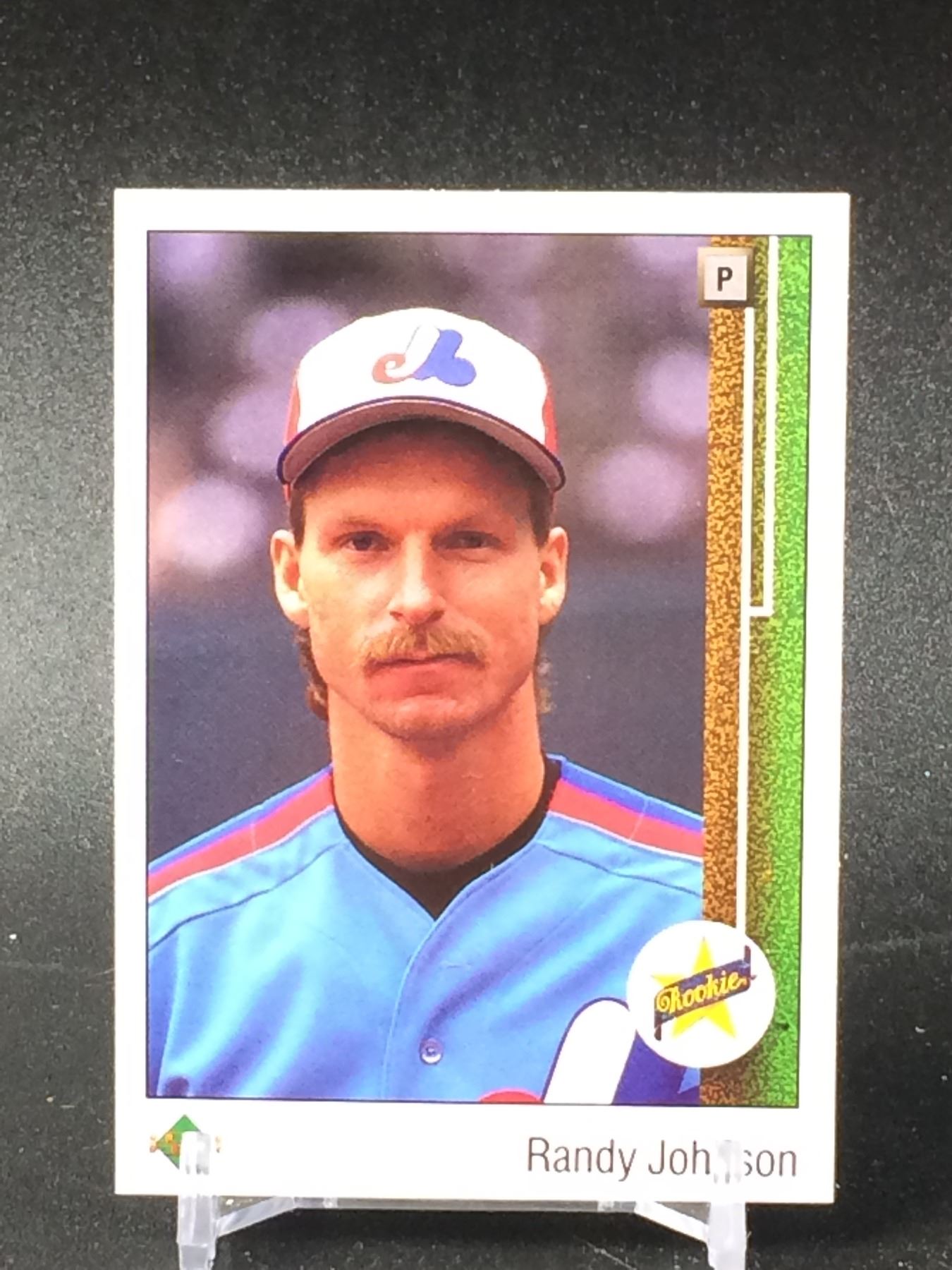
But here’s the kicker: The Score card’s value isn’t just in its rarity—it’s in its story. As the hobby evolves and collectors seek out unique, lesser-known issues, cards like this one could see a surge in demand. Imagine a future where the 1989 Score Randy Johnson rookie card is the crown jewel of a “hidden gems” collection, coveted for its authenticity and historical significance.
Of course, investing in vintage cards always carries risks. Condition is king, and even a slight crease or corner ding can drastically reduce a card’s value. But for those willing to do their homework and patiently hunt for the right copy, the Score Johnson could prove to be a shrewd addition to a long-term portfolio.
The Collector’s Dilemma: To Grade or Not to Grade?
One of the most debated topics among vintage collectors is whether to submit cards for grading. On one hand, a high-grade card (PSA 9 or BGS 9.5) commands a premium and offers liquidity in the marketplace. On the other, the grading process can be costly, and not all cards benefit from the investment. So, where does the 1989 Score Randy Johnson rookie card fit into this equation?
For starters, grading makes sense if you’re aiming for top-tier condition. The Score set’s matte finish is notoriously susceptible to wear, so a card in pristine condition is a true unicorn. If you’re lucky enough to find one, submitting it for grading could unlock its full potential, especially if the market for Score cards heats up.
However, grading isn’t always necessary. If you’re a collector who values the card’s raw, ungraded charm, there’s something to be said for keeping it in its original state. After all, part of the allure of vintage cards is their connection to the past—flaws and all. The choice ultimately comes down to your collecting philosophy: Do you prioritize investment potential, or do you cherish the card’s untouched authenticity?
Final Pitch: Why This Card Deserves Your Attention
The 1989 Score Randy Johnson rookie card is more than just a piece of cardboard—it’s a time capsule, a conversation starter, and a potential sleeper hit all rolled into one. In a hobby dominated by flashy designs and high-profile rookies, this card offers a refreshing dose of understated elegance. It’s the kind of issue that rewards patience, curiosity, and a willingness to look beyond the obvious.
So, the next time you’re browsing through a box of vintage cards or scrolling through an online auction, take a moment to consider the Score Johnson. Ask yourself: Could this be the hidden gem you’ve been searching for? And if so, are you ready to take the plunge before the rest of the market catches on?
Baseball cards are more than just collectibles—they’re stories waiting to be told. And the 1989 Score Randy Johnson rookie card? It’s a story that’s just beginning to unfold.