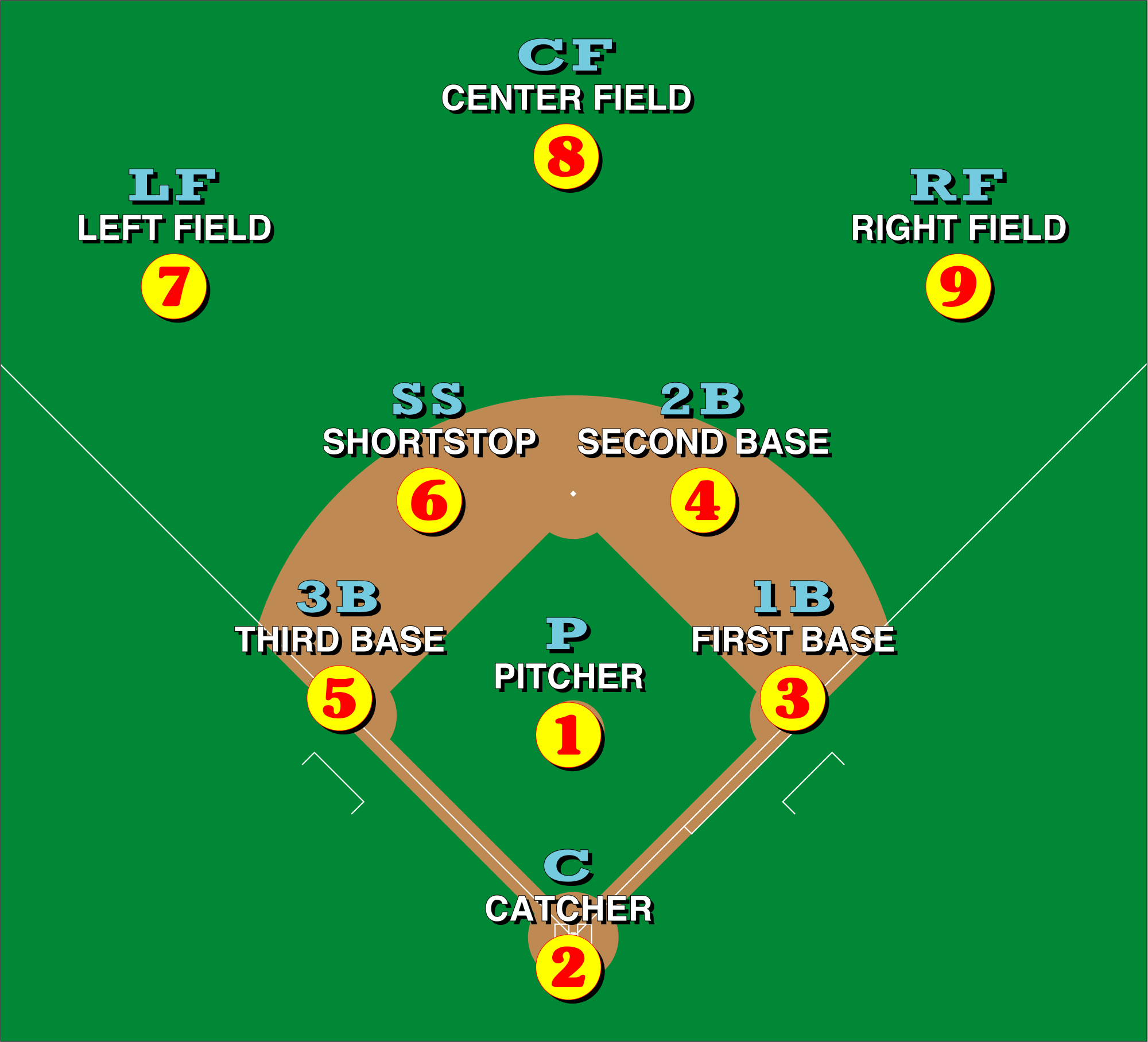
Baseball isn’t just a game of bat and ball—it’s a symphony of strategy, precision, and split-second decisions where every player’s position is a critical note in the grand composition. If you’ve ever watched a game and felt lost in the labyrinth of infielders, outfielders, and defensive alignments, you’re not alone. The diagram of baseball positions isn’t just a static illustration; it’s a roadmap to understanding the game’s hidden mechanics, where geometry meets athleticism in a dance as old as the sport itself. Whether you’re a newcomer eager to decode the field or a seasoned fan looking to refine your tactical insight, this guide will redefine how you see baseball—one position at a time.
The Infield: Where Geometry Meets Grit
The infield is the crucible where games are often won or lost, a compact battleground where speed, reflexes, and spatial awareness collide. At its heart lies the pitcher’s mound, a raised island of strategy from which 100-mph fastballs and deceptive sliders are unleashed. Flanking the mound are the four primary guardians: the first baseman, second baseman, shortstop, and third baseman. Each occupies a precise quadrant of the diamond, their positioning dictated by the batter’s tendencies, the count, and the game’s evolving narrative.
The first baseman, often the tallest and most agile of the infielders, stands sentinel at the corner of the diamond, a human bulwark against line drives and errant throws. His role transcends mere reception; he’s the final arbiter of outs, stretching for impossible catches while maintaining the illusion of effortless grace. Meanwhile, the second baseman and shortstop form a dynamic duo, their tandem dance a ballet of anticipation. The shortstop, typically the most athletic of the two, patrols the vast expanse between second and third, a roaming sentinel who must read the batter’s swing before the ball is even struck. His counterpart, the second baseman, anchors the keystone, a position that demands both brute force and surgical precision—especially when turning double plays, a maneuver so fluid it borders on alchemy.
Then there’s the third baseman, the infield’s lone wolf. Positioned closest to the hot corner, he faces the game’s most violent line drives, his reflexes tested by rockets screaming toward him at 90 mph. Unlike his counterparts, he often fields the ball barehanded, a testament to his courage and reflexes. The infield’s choreography is a study in contrasts: the first baseman’s patience, the second baseman’s versatility, the shortstop’s audacity, and the third baseman’s raw nerve. Together, they transform the diamond’s sharp angles into a fortress of defense.
The Outfield: The Vast Canvas of Possibility
Beyond the infield’s tight confines lies the outfield, a sprawling theater where fly balls become legends and outfielders morph into acrobatic heroes. The outfield is divided into three primary zones: left field, center field, and right field, each a world unto itself. The left fielder, often overlooked, must contend with the sun’s glare and the occasional walloping line drive from a left-handed power hitter. His counterpart in right field faces a different challenge: the sun’s glare in the late innings, coupled with the need to arm a cannon to gun down runners at third. But it’s the center fielder who bears the greatest burden—and the greatest glory. Positioned deepest in the outfield, he’s the last line of defense against extra-base hits, a human radar system who must cover more ground than any other player on the field.
The outfield’s geometry is deceptive. A shallow fly ball in left field might be a routine pop-up for a seasoned veteran, while the same ball could become a game-changing home run if it sails over the fence. Outfielders must master the art of the crow hop, a leaping stride that converts horizontal momentum into vertical lift, allowing them to snag towering flies that defy gravity. Their routes to the ball are a study in angles, with each step calculated to minimize distance and maximize reaction time. And when the moment arrives—when the ball is in the air and the crowd holds its breath—the outfielder’s leap becomes a fleeting masterpiece, a snapshot of athleticism frozen in time.
But the outfield isn’t just about defense. It’s a stage for offensive firepower, where sluggers like Mike Trout or Mookie Betts patrol the alleys, turning routine fly outs into highlight-reel catches. The outfield’s duality—defensive anchor and offensive catalyst—makes it the most unpredictable and thrilling part of the diamond.
The Catcher: The Quarterback of the Diamond
Nestled behind home plate, the catcher is the game’s unsung general, the only player who faces the entire field while orchestrating the defense’s every move. His role is a paradox: he must be both a brick wall and a nimble puppeteer, absorbing 100-mph fastballs one moment and firing laser beams to second base the next. The catcher’s position is a crucible of endurance; he squats for hours, his body contorted into an unnatural crouch, his mind a whirlwind of signals and strategy. He’s the only player who can see the entire field, making him the defensive maestro who adjusts positioning on the fly, calling for shifts or holding runners in check with a mere glance.
But the catcher’s influence extends beyond defense. He’s the pitcher’s closest confidant, a psychologist who must read the hurler’s body language and calm his nerves with a tap on the mound or a whispered word. In an era of advanced analytics, the catcher’s role has evolved into a hybrid of technician and strategist, blending raw instinct with data-driven precision. And when the game’s tension peaks—with runners on base and the count full—the catcher’s ability to frame pitches, block errant balls, and throw out would-be basestealers can tilt the balance between victory and defeat.
The Pitcher: The Architect of Chaos
At the heart of every pitch lies the pitcher, the game’s solitary architect of chaos. Perched atop the mound, he’s a study in controlled fury, his every motion a calculated gamble between speed and deception. The pitcher’s repertoire is a toolbox of terror: the four-seam fastball that hums like a freight train, the curveball that drops off a cliff, the changeup that mimics a fastball before dying in the strike zone. His positioning isn’t just about throwing strikes; it’s about exploiting weaknesses, disrupting timing, and turning batters into spectators of their own helplessness.
The pitcher’s relationship with the catcher is a silent symphony, a language of signs and signals that only they understand. A nod here, a shake of the head there—each decision is a chess move in a high-stakes game. And when the count reaches three balls and two strikes, the pitcher’s mental fortitude is tested like no other. Will he challenge the batter with a fastball up and in, or will he tempt him with a backdoor slider? The answer could mean the difference between a walk-off home run and a game-saving strikeout.
The Bench: The Unsung Symphony of Substitution
Baseball’s beauty lies not just in the starting nine but in the bench—a rotating cast of characters who enter the fray like stage actors stepping into the spotlight. The pinch hitter, a specialist with a bat in his hands and a mission in his eyes, steps to the plate with one goal: to alter the game’s trajectory with a single swing. The pinch runner, a blur of speed and daring, is sent in to steal a base or score a run, his presence a calculated risk that can shift momentum in an instant. And the defensive replacement, a defensive savant, trots onto the field to shore up a shaky infield or patrol the outfield’s depths with the instincts of a bloodhound.
The bench is baseball’s secret weapon, a chessboard of possibilities where managers play God with rosters and strategies. A well-timed substitution can turn a loss into a win, a nobody into a hero. It’s a world where preparation meets opportunity, where the players on the bench are just as vital as those on the field.
The Shifting Landscape: How Positions Evolve
Baseball is a game in constant flux, where positions adapt to the times. The rise of the shift—where infielders crowd one side of the diamond to counter a pull-heavy hitter—has redefined defensive alignments, turning traditional roles on their head. The shortstop, once a position of pure athleticism, now often slides into the outfield’s depths, while the third baseman might find himself playing shortstop on any given night. Even the pitcher’s role has evolved, with openers and bulk relievers reshaping the game’s narrative from the first pitch.
Technology has further blurred the lines. Statcast’s data-driven insights have turned the field into a laboratory, where defensive shifts are calculated with mathematical precision and pitchers adjust their arsenals based on a batter’s swing path. The game’s evolution is a testament to its enduring allure—a sport that bends to the times while remaining rooted in its traditions.
Why It All Matters: The Poetry of Positioning
At its core, baseball is a game of inches, where the difference between a hit and an out can hinge on a fielder’s positioning or a pitcher’s grip. The diagram of baseball positions isn’t just a static image; it’s a living, breathing blueprint of strategy, athleticism, and split-second decisions. It’s the reason why a game can be decided by a single play, why a team’s fortunes can shift in the blink of an eye. Whether you’re a player, a fan, or a casual observer, understanding the field’s geometry is the key to unlocking the game’s deepest secrets. So the next time you watch a game, look beyond the action. See the field as a canvas, the players as brushstrokes, and the positions as the masterpiece they create together.