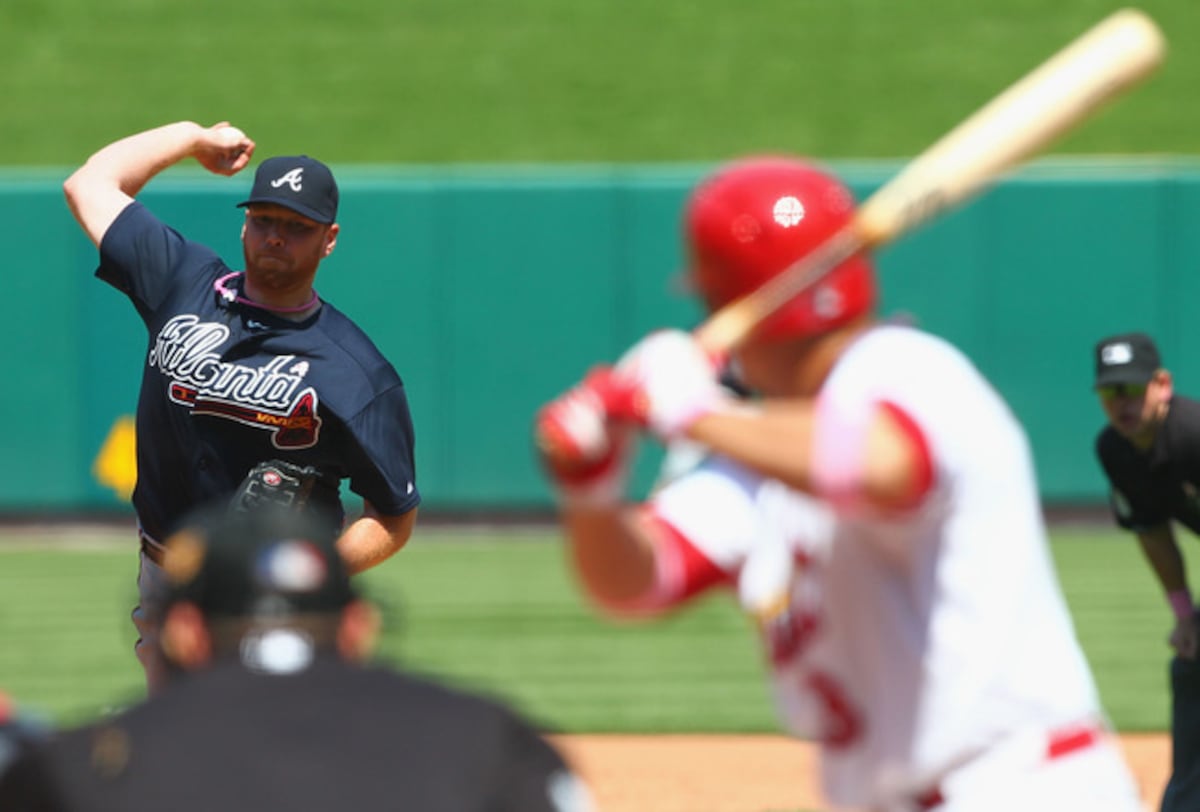
The 1990s were a golden era for the Atlanta Braves, a decade where their pitching rotation didn’t just dominate—it redefined excellence. While the team’s offensive firepower often stole the spotlight, it was the starting five that laid the foundation for their sustained success, a unit so formidable it became the stuff of legend. The Braves’ rotation wasn’t merely a collection of talented arms; it was a symphony of precision, endurance, and unshakable dominance that left an indelible mark on baseball history.
The Architects of Consistency: A Rotation Built to Last
The Braves’ pitching staff of the 1990s was a marvel of consistency, a rare alignment where every starter could be counted on to deliver at an elite level. At its core was a nucleus of pitchers who complemented each other in ways that transcended statistics. Greg Maddux, the cerebral technician, set the standard for control and command, while Tom Glavine brought a deceptive sinkerball that baffled hitters with its late movement. John Smoltz, the versatile workhorse, could dominate with a blazing fastball or a devastating slider, adapting his approach to any situation. Steve Avery, the left-handed stalwart, provided a steadying presence, and Kevin Brown, the late arrival, injected raw power into the mix. Together, they formed a rotation that was greater than the sum of its parts—a hydraulic system of arms that powered the Braves to unprecedented heights.
The Maddux Effect: Precision Over Power
Greg Maddux wasn’t just a great pitcher; he was a geometric genius on the mound. His ability to paint the corners with surgical precision made him the ultimate technician, a pitcher who could outthink hitters before they even stepped into the box. Maddux’s approach was a masterclass in efficiency, relying on location over velocity to induce weak contact and ground balls. His 1995 Cy Young season, where he posted a 1.63 ERA, wasn’t an anomaly—it was the culmination of a philosophy that prioritized intellect over brute force. The Braves’ rotation thrived in this environment, where Maddux’s mastery set the tone for a staff that valued finesse as much as firepower.
The Glavine Paradox: The Sinkerball Savant
Tom Glavine’s success defied conventional wisdom. In an era where power pitchers ruled the game, Glavine thrived by throwing a sinker that dove at the knees of right-handed hitters and a changeup that faded like a dying leaf. His ability to induce ground balls at an astronomical rate made him the perfect complement to Maddux’s finesse. Glavine’s two Cy Young awards in the decade weren’t just accolades—they were testaments to a pitching style that was as unorthodox as it was effective. The Braves’ rotation benefited immensely from this duality, where Glavine’s ground-ball machine worked in tandem with Maddux’s strikeout-inducing precision.
Smoltz’s Versatility: The Swiss Army Knife of the Rotation
John Smoltz was the ultimate chameleon, a pitcher who could adapt his arsenal to any scenario. Early in his career, he relied on a fastball-slider combination that struck fear into hitters. Later, as his arm aged, he transitioned into a closer role, where his splitter became one of the most devastating pitches in baseball. This versatility made Smoltz the glue that held the rotation together. Whether starting or relieving, he delivered in high-leverage moments, a testament to his unparalleled adaptability. The Braves’ rotation wasn’t just deep—it was dynamic, with Smoltz as the catalyst for its relentless success.
Avery and Brown: The Unsung Heroes of the Staff
Steve Avery and Kevin Brown may not have received the same accolades as Maddux, Glavine, or Smoltz, but their contributions were invaluable. Avery, the left-handed anchor, provided a stabilizing presence, his ability to eat innings and keep runs off the board crucial to the Braves’ postseason runs. Brown, the late bloomer, brought a raw power that the rotation had lacked in its early years. His fastball, clocked in the mid-90s, gave opposing hitters one more reason to fear the Braves’ rotation. Together, Avery and Brown rounded out a staff that was as balanced as it was dominant.
The Chemistry Factor: How a Team Became a Dynasty
What made the Braves’ rotation truly special wasn’t just the talent—it was the chemistry. These pitchers weren’t just teammates; they were brothers in arms, a group that thrived on competition and camaraderie. The bullpen, led by the likes of Mark Wohlers and John Rocker, fed off the rotation’s energy, creating a self-sustaining cycle of dominance. The Braves’ rotation wasn’t just a collection of individuals; it was a brotherhood, a unit that lifted each other up when the pressure mounted. This intangible bond translated into on-field success, a synergy that propelled the Braves to 14 consecutive division titles.
The Legacy: A Blueprint for Future Generations
The Braves’ rotation of the 1990s wasn’t just a relic of the past—it was a blueprint for future success. Its emphasis on control, adaptability, and team chemistry set a standard that modern rotations still strive to emulate. The lessons learned from this era—prioritizing intellect over velocity, valuing versatility, and fostering a culture of excellence—remain as relevant today as they were three decades ago. The Braves’ rotation wasn’t just a dominant force; it was a masterclass in how to build a championship-caliber staff.
The Enduring Fascination: Why the 90s Rotation Still Captivates
Decades later, the Braves’ rotation of the 1990s continues to captivate fans and analysts alike. It’s not just the numbers—though they are staggering—but the intangibles that make this group so fascinating. The way Maddux outsmarted hitters, Glavine’s sinkerball magic, Smoltz’s adaptability, Avery’s reliability, and Brown’s power—it’s a symphony of skills that feels almost mythical. This rotation wasn’t just great; it was transcendent, a reminder of a time when pitching wasn’t just about velocity but about artistry, strategy, and sheer will. The Braves’ rotation of the 90s wasn’t just a team within a team—it was a phenomenon, one that still resonates as a golden standard in baseball history.