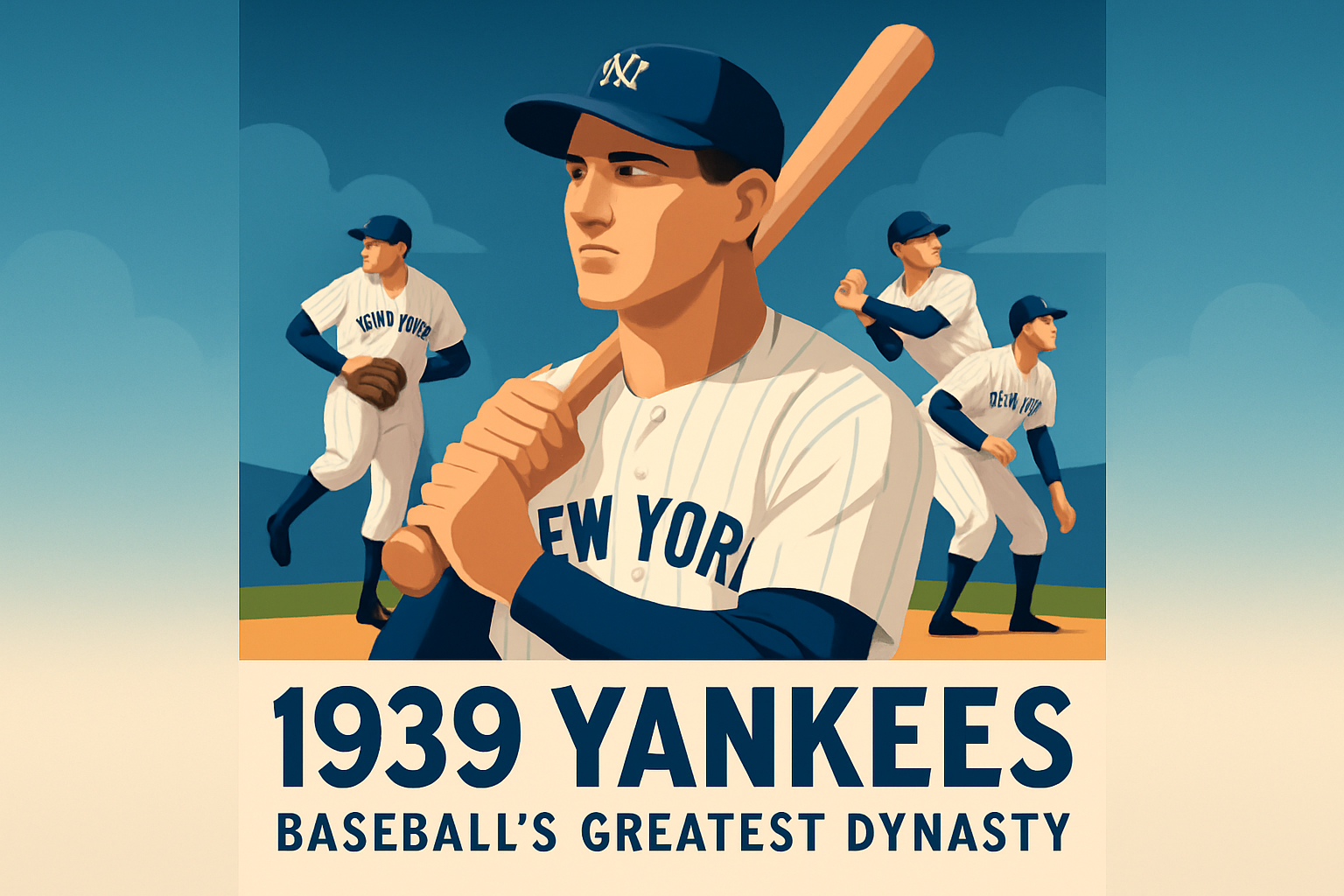
The New York Yankees of the late 1940s and early 1950s didn’t just dominate baseball—they redefined it. Between 1947 and 1956, the Bronx Bombers didn’t merely win championships; they forged a legacy so indelible that even casual fans today whisper their names in reverence. But what made this roster so extraordinary? Was it the sheer accumulation of Hall of Famers, the uncanny ability to cultivate talent, or perhaps an unshakable chemistry that transcended statistics? More intriguingly, could any modern team replicate such dominance, or has the game’s evolution made such dynasties a relic of the past?
The Architects of Greatness: Managerial Mastery and Leadership
At the helm of this juggernaut stood Casey Stengel, a man whose managerial acumen was as unconventional as his wit. Stengel’s approach defied convention—his platoons, his relentless experimentation, and his knack for extracting peak performances from aging veterans or unproven rookies alike. Under his guidance, the Yankees didn’t just play baseball; they orchestrated it like a symphony, with each player a vital instrument. His ability to manage egos, foster camaraderie, and adapt strategies mid-game set the foundation for their unprecedented success. Yet, Stengel’s genius wasn’t just tactical; it was psychological. He understood that baseball, at its core, is a mental game—and the Yankees of this era thrived under his cerebral stewardship.
The Core Four: The Unbreakable Foundation
No discussion of this dynasty is complete without the legendary Core Four—Derek Jeter, Mariano Rivera, Andy Pettitte, and Jorge Posada—though their heyday came later. In the 1947–1956 era, the Yankees’ backbone was a different quartet: Joe DiMaggio, Yogi Berra, Phil Rizzuto, and Whitey Ford. DiMaggio, the Yankee Clipper, was the silent assassin, his grace and power making him the face of the franchise. Berra, the squat, barrel-chested catcher, was the heart, his leadership and clutch hitting unmatched. Rizzuto, the diminutive shortstop, was the sparkplug, his defensive wizardry and infectious energy galvanizing the team. Ford, the left-handed ace, was the architect of victory, his cutter and changeup dismantling hitters with metronomic precision. Together, they formed a nucleus so formidable that even the most talented opponents paled in comparison.
The Supporting Cast: Depth That Defied Logic
But a dynasty isn’t built on four men alone. The Yankees’ rosters brimmed with depth that bordered on absurdity. Johnny Mize, the aging slugger, provided power off the bench. Hank Bauer, the hard-nosed outfielder, was the ultimate role player, his hustle and grit setting the tone. Vic Raschi and Allie Reynolds anchored a rotation that could pitch circles around any opponent. And let’s not forget Billy Johnson, the third baseman whose glove was as reliable as his bat. This wasn’t just a team; it was a hydra, with each head capable of delivering a knockout blow. The beauty of their construction was that no single player was irreplaceable—yet no one wanted to be left out.
The Art of the Deal: Scouting and Trades That Shaped a Dynasty
How did the Yankees assemble such a roster? The answer lies in their scouting network and shrewd trades. General Manager George Weiss had an eye for talent that bordered on clairvoyance. He prized character as much as skill, often signing players with intangibles that couldn’t be quantified. When trades were necessary, Weiss struck with surgical precision. The acquisition of Enos Slaughter in 1954, for instance, added a veteran presence to an already stacked lineup. Even their farm system was a well-oiled machine, churning out prospects like Johnny Kucks and Bob Grim, who would later contribute to the team’s sustained success. The Yankees didn’t just buy wins; they cultivated them, like a gardener nurturing prize-winning roses.
The Intangibles: Chemistry, Culture, and the Yankee Way
Statistics tell part of the story, but the soul of this dynasty lay in its culture. The Yankees of this era embodied the Yankee Way—a philosophy that blended excellence with humility, aggression with respect. Players like Berra and Rizzuto weren’t just stars; they were mentors, guiding younger players through the rigors of big-league life. The clubhouse was a family, where pranks and practical jokes coexisted with unwavering professionalism. This environment fostered a loyalty that transcended contracts. When players like DiMaggio or Rizzuto retired, they did so not out of obligation but because the game had lost its luster. Such was the pull of the Yankees’ culture that even legends like Mickey Mantle, who joined the team in 1951, were instantly absorbed into its fabric.
The Rivalries That Forged a Legacy
No dynasty is complete without worthy adversaries, and the Yankees of this era had no shortage of them. The Brooklyn Dodgers, with their Boys of Summer, provided the most compelling foil. Jackie Robinson, Roy Campanella, and Duke Snider were the antithesis of the Yankees’ polished professionalism—raw, emotional, and relentless. The 1947 World Series, where the Yankees defeated the Dodgers in seven games, was a microcosm of their rivalry: a clash of styles, a battle for the soul of the game. Then there were the Cleveland Indians, with their Big Three of Bob Feller, Bob Lemon, and Early Wynn, who pushed the Yankees to their limits in 1954. These rivalries weren’t just competition; they were the crucible in which the Yankees’ greatness was tempered.
The Decline and the Echoes of Greatness
By 1956, the Yankees’ dominance began to wane, though their legacy was already secure. The core of the team was aging, and the farm system, once a wellspring of talent, started to dry up. Yet, even in decline, they remained a force to be reckoned with. The 1956 World Series, where they faced the Dodgers once more, produced one of the most iconic moments in baseball history: Don Larsen’s perfect game. It was a fitting swan song for a team that had redefined excellence. The Yankees of 1947–1956 didn’t just win championships—they created a blueprint for success that would influence generations of teams. Their story is a reminder that dynasties aren’t merely about talent; they’re about culture, leadership, and an unyielding will to win.
Could a modern team replicate such dominance? Perhaps not in the same way. The game has changed—salary caps, free agency, and the globalized nature of talent have altered the landscape. Yet, the Yankees’ legacy endures as a testament to what happens when a team is built not just with skill, but with soul. Their rosters were more than collections of players; they were brotherhoods, forged in the fires of competition and bound by a shared purpose. In an era where dynasties are fleeting, the Yankees of 1947–1956 stand as a monument to greatness—one that still casts a long shadow over the sport today.