When it comes to structural engineering and construction, selecting the appropriate beam type is paramount for ensuring stability, durability, and cost-effectiveness. Among the myriad of beam configurations, H-beams and I-beams dominate the discourse due to their widespread use and distinctive characteristics. Understanding which beam is stronger is not a straightforward determination; it requires a nuanced exploration of their geometric profiles, mechanical properties, applications, and load-bearing capabilities. This article will delve deep into the fundamental differences between H-beams and I-beams, dissect their structural advantages, and elucidate which type is superior in various contexts.
Understanding the Geometric Distinctions of H-Beams and I-Beams
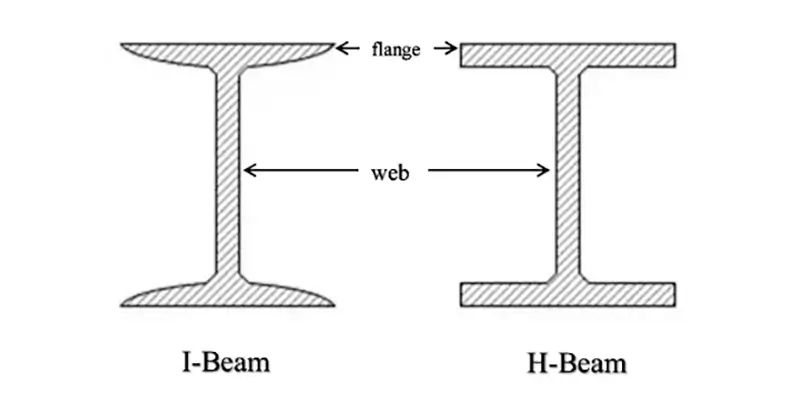
At first glance, H-beams and I-beams might appear deceptively similar, as their profiles both feature a central web and two flanges. However, the differences lie in subtle yet significant geometrical nuances. The H-beam, often referred to as a wide flange beam, has flanges that are nearly equal in width to the height of the web, creating a profile that resembles the capital letter ‘H’. This design ensures that the flanges are broad and thick, merging smoothly into the web with less tapering. Conversely, the traditional I-beam displays thinner flanges relative to the web height, generating a more tapered, slender profile akin to the letter ‘I’.
The wider flanges of H-beams increase the cross-sectional surface area, which directly influences their moment of inertia and resistance to bending stresses. By contrast, I-beams present a more economized use of material, which makes them lighter but potentially less robust under certain load conditions. These geometric traits are the inception points of their comparative analysis regarding strength.
Load-Bearing Capacities and Strength Factors
Strength in beams encompasses multiple facets including bending resistance, shear strength, and deflection characteristics. The structural supremacy between H-beams and I-beams pivots largely upon the type and distribution of loads encountered.
H-beams exhibit superior bending resistance due to their wider flanges. The increased flange area distributes stress more effectively, allowing them to withstand heavier vertical loads with less deformation. This makes H-beams highly suitable for applications that involve significant bending moments, such as large building frameworks and heavy bridge constructions.
In comparison, I-beams, with their slimmer flanges and deeper webs, offer excellent resistance against shear forces for medium to light loading scenarios. Their shape concentrates strength along the vertical axis while economizing on material, which is ideal for structures requiring high strength-to-weight ratios, such as residential buildings or smaller industrial projects.
Applications and Usage Scenarios: When to Choose Each Beam
The ultimate decision between H-beams and I-beams often rests on the specificity of the construction application, environmental considerations, and economic factors. H-beams are prevalent in large-scale infrastructure projects where maximum load capacity and minimal deflection are critical. The wider flange surfaces also facilitate easier welding and bolting, which expedites the assembly of steel frameworks.
I-beams are favored in settings where weight savings are essential without compromising fundamental strength. Their streamlined design suits scenarios like floor joists, roof supports, and light industrial structures where medium load capacity suffices. Additionally, I-beams’ standardization makes them widely available and often more cost-efficient.
Another subtle yet important distinction comes in the fabrication and installation phases. H-beams, due to their heavier weight, may demand more robust handling equipment, influencing the logistics planning and overall project timeline. I-beams, being lighter, are generally more manageable for transportation and on-site adjustments.
Material Efficiency and Economic Considerations
Structural efficacy is intrinsically linked to material utilization. H-beams allocate more steel mass to the flanges, which augments their load-bearing capacity but at the expense of increased material consumption and weight. This exponential rise in weight can translate to higher transportation costs and more intensive labor requirements for erection.
I-beams epitomize material economy by concentrating mass along the web to resist shear forces and reducing flange thickness where possible. This approach achieves a remarkable balance, providing adequate strength for many applications at a lower cost and weight. Nonetheless, when subjected to heavy or eccentric loads, the I-beam’s slender flanges can be a limiting factor, potentially necessitating additional reinforcement or design alterations.
Resistance to Buckling and Lateral Torsional Stability
Another pivotal aspect in beam selection is how well each profile can resist buckling and maintain lateral torsional stability under load. Buckling occurs when compressive stresses exceed the material’s critical threshold, causing sudden structural failure, especially in long, slender elements.
Due to their wide flanges and robust web, H-beams demonstrate enhanced stability against lateral torsional buckling. The greater flange width acts as a stiffening element, minimizing deformation and increasing the beam’s elastic reserve. This characteristic makes H-beams more reliable in long-span girders and complex construction where lateral forces are prominent.
In contrast, I-beams, with their narrower flanges, have less inherent lateral stability. They are often prone to lateral deflection under specific load conditions and typically require bracing or stiffeners to mitigate such vulnerabilities, adding complexity to the design and construction process.
Compatibility with Modern Construction Technologies
The evolution of construction techniques and welding technologies has influenced the market viability of both beam types. H-beams’ broad, flat flanges offer a convenient surface for attaching secondary elements or integrating with pre-fabricated modular systems. This versatility complements the increasing trend of steel modular construction where precision and ease of assembly are paramount.
I-beams retain their value in traditional construction methods and prefabricated elements; however, their reduced surface area on flanges can pose challenges for attaching additional fittings without specialized connectors or adapters. The compatibility factor thus subtly sways choice depending on project scale and technological integration.
Environmental Factors Influencing Beam Performance
The environmental context—such as exposure to wind loads, seismic activity, and corrosive atmospheres—can decisively influence the beam selection. The superior flange-to-web ratio in H-beams offers redundancy and resilience, especially in seismic zones where ductility and toughness are critical. Their profile can better accommodate dynamic stresses and deformations, enhancing safety margins.
I-beams, although fully capable of performing admirably in many environmental conditions, often require additional protective treatments or design enhancements to match the durability of H-beams under aggressive climatic or seismic influences. This consideration influences lifecycle costs and maintenance scheduling profoundly.
Conclusion: Determining Which Beam Is Stronger
Determining the “stronger” beam between H-beams and I-beams depends on defining the criteria of strength relevant to the application at hand. H-beams excel in scenarios demanding higher bending strength, lateral stability, and robust performance under heavy or distributed loads. Their geometric breadth translates to increased moment of inertia, optimized for large-scale infrastructural projects and dynamic environmental stresses.
I-beams serve effectively in environments where material efficiency, reduced weight, and moderate load capacity guide the design philosophy. Their slender form factor provides an economical choice for numerous standard construction needs without compromising baseline structural integrity.
Ultimately, the distinction is not binary but contextual. Engineers and architects must meticulously evaluate load types, span lengths, construction logistics, economic constraints, and environmental factors to select the beam best suited for a given structure. Each profile wields distinct strengths, and understanding these enables strategic, informed decisions rather than simplistic judgments of superiority.