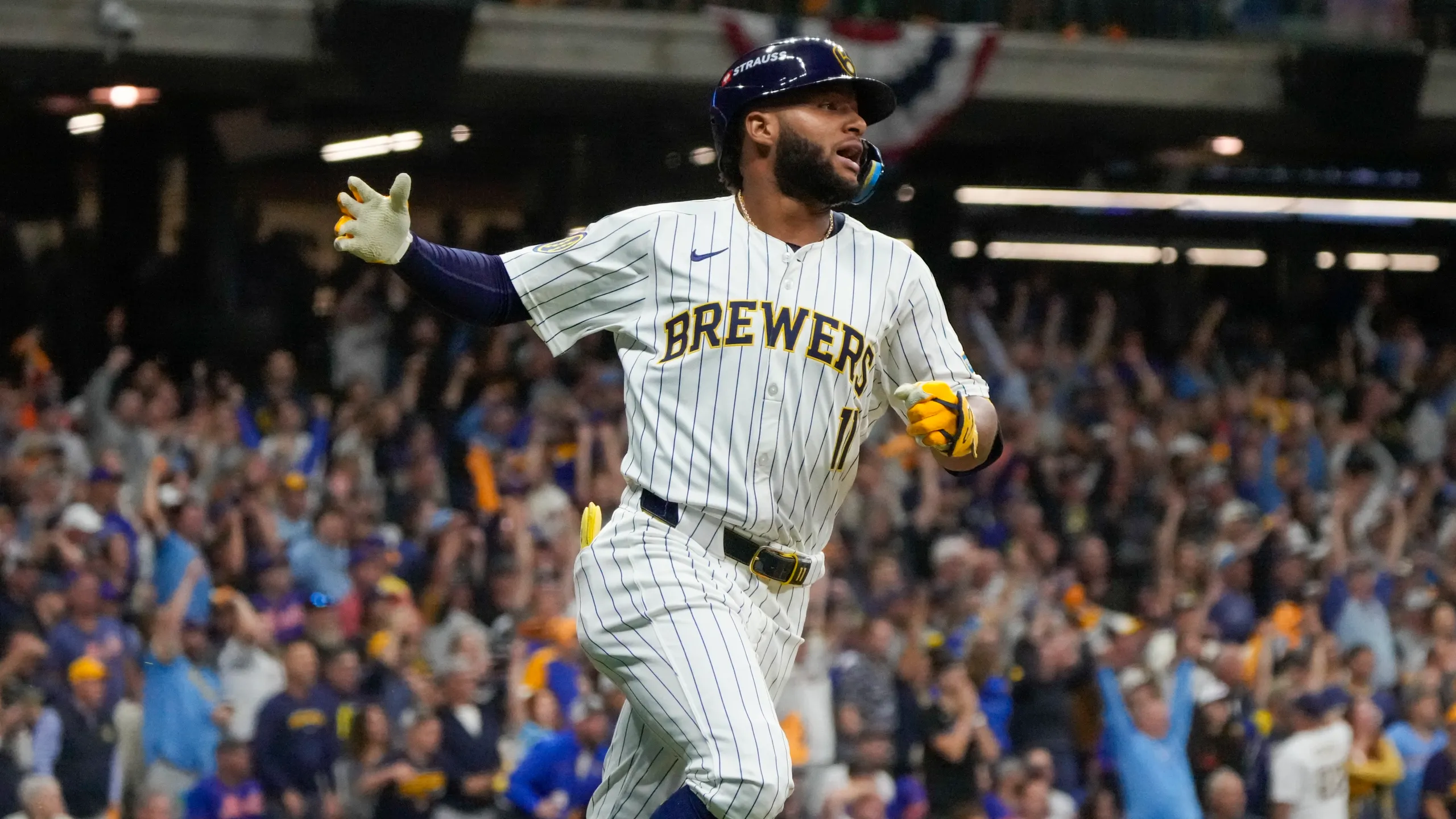
The debate between Jackson Chourio and Jackson Holliday in Major League Baseball isn’t just about statistics or draft pedigrees—it’s a collision of futures, a clash of archetypes, each carrying the weight of expectation like a comet hurtling toward destiny. One is a tempest of raw power, a whirlwind of speed and aggression that seems to defy the very physics of the diamond. The other is a metronome of precision, a cerebral force whose every swing is a calculated masterstroke, a symphony of mechanics played out in the batter’s box. To choose between them is to weigh the romance of unbridled talent against the elegance of refined craftsmanship. But who, in the long game, will leave the deeper mark on the sport?
The Lightning Bolt: Jackson Chourio and the Allure of Unfettered Talent
Jackson Chourio is baseball’s answer to a supernova—brief, dazzling, and impossible to ignore. His game is a spectacle of kinetic energy, a blur of motion that leaves pitchers disoriented and outfielders scrambling. Speed is his calling card, not the cautious, calculated variety, but the kind that turns a routine grounder into a footrace where the ball is always the underdog. Chourio doesn’t just run the bases; he *haunts* them, a spectral presence that materializes in scoring position with the inevitability of a storm front.
Yet his appeal transcends mere velocity. There’s a primal, almost mythic quality to his swing—a whip-crack of the bat that generates exit velocities that flirt with the impossible. Scouts speak of his bat speed in hushed tones, as if describing a natural phenomenon rather than a measurable skill. This isn’t the product of years of meticulous refinement; it’s the raw output of a body wired for destruction, a genetic lottery win that grants him the ability to turn any pitch into a highlight reel moment.
But lightning, as the saying goes, is fleeting. The question that lingers is whether Chourio’s game can evolve beyond the raw spectacle. Can he harness his power to become a complete hitter, or will he remain a one-dimensional force, a human highlight reel whose value is tied to the box score’s most superficial metrics? The long game demands adaptability, and while Chourio’s ceiling is stratospheric, his floor remains a mystery wrapped in potential.
The Maestro: Jackson Holliday and the Art of Controlled Chaos
Jackson Holliday, by contrast, is the conductor of baseball’s most intricate orchestra. His game is a study in geometry, a dance of angles and timing where every movement is a deliberate brushstroke on the canvas of the diamond. Where Chourio is a force of nature, Holliday is a force of *precision*—a hitter who doesn’t just make contact but *dictates* the terms of engagement. His swing is a metronome, a flawless loop of mechanics that turns even the most erratic pitches into line drives.
What sets Holliday apart is his baseball IQ, a trait that elevates him from mere prospect to potential legend. He doesn’t just see the field; he *reads* it, anticipating defensive shifts before they happen, exploiting a pitcher’s tells with the patience of a chess grandmaster. This is the hallmark of a player who understands the game at a cellular level, who views baseball not as a series of plays but as an endless puzzle to be solved.
Yet for all his cerebral advantages, Holliday lacks the immediate, visceral impact of Chourio. His game is refined, yes, but refinement often comes at the cost of spectacle. Will fans flock to see a hitter who turns doubles into singles through sheer guile, or will they crave the fireworks that only Chourio can provide? The long game for Holliday hinges on whether his methodical approach can captivate audiences as thoroughly as Chourio’s raw power.
The Clash of Philosophies: Power vs. Precision
The duel between Chourio and Holliday is, at its core, a philosophical divide—a clash between two visions of what a baseball player should be. Chourio embodies the romantic ideal of the game: the player who makes you gasp, who turns the ordinary into the extraordinary with a single play. He’s the kind of athlete who makes scouts giddy with possibility, the kind of star who can single-handedly shift the momentum of a franchise.
Holliday, meanwhile, represents the evolution of the sport itself. In an era where analytics reign supreme, he’s the embodiment of the “smart” player—the one who leverages data, situational awareness, and mechanical perfection to outthink his opponents. His game is a testament to the modern baseball ethos, where the home run is no longer the be-all and end-all, but merely one tool in a vast arsenal.
Yet this clash isn’t just about aesthetics. It’s about the future of the game. Will MLB continue to celebrate the Chourio-style phenom, the player whose sheer talent demands attention? Or will the league increasingly favor the Holliday model, where success is measured not in highlight reels but in the quiet, relentless accumulation of small advantages?
The X-Factor: Durability and Adaptability
Any discussion of the long game must confront the specter of durability. Baseball’s graveyard is littered with prospects whose careers were derailed by injuries or the inability to adapt. Chourio’s game, with its explosive athleticism, carries inherent risks. The same speed that makes him a defensive asset could, over time, wear down his body. Can he maintain his edge without sacrificing the very traits that make him special?
Holliday, with his methodical approach, might seem the safer bet. But safety is a relative term in a sport where even the most polished prospects can falter under pressure. The minor leagues are a crucible, and not all diamonds emerge unscathed. Holliday’s challenge will be to prove that his game can translate against the best of the best, that his precision isn’t just a product of weaker competition.
Then there’s the matter of adaptability. Baseball is a game of adjustments, where the difference between success and failure can hinge on a single tweak. Chourio will need to refine his plate discipline, to prove he can lay off pitches outside the zone without sacrificing his aggressive approach. Holliday, meanwhile, must demonstrate that his game can evolve beyond the theoretical, that he can hit for power when the situation demands it.
The Fan’s Dilemma: Whose Story Resonates?
At the end of the day, baseball is a story-driven sport. Fans don’t just follow teams; they invest in narratives. Chourio’s tale is one of destiny fulfilled, a Cinderella story where the underdog rises to claim the crown. His journey is cinematic, a narrative arc that writes itself with every stolen base and tape-measure home run.
Holliday’s story, by contrast, is a slow burn—a tale of patience and perseverance, where the payoff is measured in incremental gains rather than seismic moments. It’s the kind of narrative that appeals to the purists, the fans who appreciate the beauty of a well-executed sacrifice bunt or a perfectly placed bunt single.
Which story will resonate more deeply? That’s the million-dollar question. The long game isn’t just about statistics or accolades; it’s about legacy. Will Chourio be remembered as a comet that burned bright but briefly, or will he evolve into something more enduring? Will Holliday’s legacy be one of quiet dominance, a player whose contributions are felt more in the standings than in the highlight reels?
The Verdict: A Tale of Two Futures
The truth is, there may be no definitive answer. The long game in baseball is a labyrinth, a maze of variables where even the most meticulous projections can be upended by a single curveball. Chourio and Holliday represent two paths forward, two visions of what the sport could become.
If the game craves spectacle, if it yearns for the kind of transcendent talent that can shift the balance of power in an instant, then Chourio is the answer. His ceiling is limitless, his potential a siren call that could redefine what it means to be a five-tool player.
But if the game values the steady, the reliable, the player who can be counted on to deliver day in and day out, then Holliday is the safer bet. His floor is high, his impact measurable, and his legacy one of craftsmanship rather than chaos.
Perhaps the most intriguing possibility is that both players defy expectations. Maybe Chourio refines his approach, becoming the complete hitter who combines power, speed, and plate discipline into a package that’s impossible to counter. Or perhaps Holliday’s bat catches up to his brain, transforming him into a perennial MVP candidate whose name is synonymous with excellence.
In the end, the debate between Chourio and Holliday isn’t just about who will win the long game—it’s about what the long game will look like. Will it be a symphony of precision, or a thunderstorm of raw power? The answer, as with all things in baseball, remains unwritten.