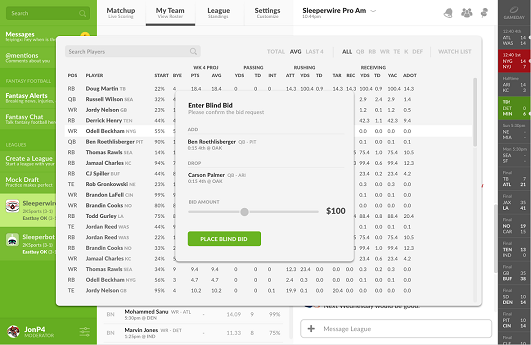
In the labyrinthine world of fantasy baseball, where strategy and instinct collide, few mechanisms embody the collective psyche of managers quite like the Free Agent Acquisition Budget (FAAB) bidding system. Unlike the rigid drafts or the whims of the waiver wire, FAAB introduces a psychological battleground where herd mentality reigns supreme. It’s a dance of perception, where the value of a player isn’t just measured in stats but in the feverish consensus of the crowd. To understand FAAB is to peer into the mirror of human behavior, where rationality often bows to the siren call of the majority.
The Psychology of the Crowd: Why We Follow the Herd in FAAB Bidding
At its core, FAAB bidding is a study in behavioral economics, where the fear of missing out (FOMO) and the illusion of safety in numbers converge. When a breakout player emerges from the minor leagues or an underrated veteran stumbles into a favorable matchup, the initial bids are often modest—just enough to test the waters. But as the bidding war escalates, so too does the psychological pressure. Managers, driven by the herd instinct, begin to outbid one another not because the player’s projected value justifies it, but because the fear of being left behind outweighs rational calculation.
This phenomenon isn’t unique to fantasy baseball; it mirrors the dynamics of stock market bubbles or the frenzy of limited-edition sneaker releases. The difference here is the immediacy of the feedback loop. In FAAB, every bid is a public declaration, a digital hand raised in the auction hall of the internet. The moment one manager overpays, others feel compelled to match or exceed, lest they be branded as the fool who let a gem slip through their fingers. The herd moves as one, and the auctioneer’s gavel falls with a finality that echoes through the league like a collective gasp.
The Illusion of Value: How Perception Distorts Reality in FAAB Auctions
Value in FAAB bidding is a slippery concept, often more about narrative than numbers. A player’s perceived worth is shaped by recent performances, injury reports, and the whims of social media hype. When a reliever suddenly strings together three flawless outings, the bidding frenzy begins not because his ERA is sustainable, but because the story of his resurgence has taken on a life of its own. Managers, swept up in the zeitgeist, begin to see him as a late-round gem rather than a volatile asset.
This distortion is exacerbated by the lack of real-time data. Unlike traditional auctions where bids are shouted in a room, FAAB operates in the liminal space of the internet, where time zones blur and decisions are made in isolation. The absence of immediate feedback amplifies the herd mentality; without seeing the reactions of others, managers default to the safest assumption—that if others are bidding, the player must be worth it. It’s a self-fulfilling prophecy, where perception becomes reality, and the auction’s outcome is dictated by the loudest voices rather than the most discerning ones.
The Domino Effect: How One Bid Can Trigger a Bidding War
The first bid on a hot free agent is rarely the highest, but it’s the spark that ignites the inferno. When Manager A submits a $1 bid on a sleeper reliever, they’re not just claiming a player—they’re signaling to the league that the player is on their radar. Manager B, seeing the bid, might counter with $3, not because the reliever is worth three dollars, but because they refuse to let Manager A have the last laugh. Manager C, now sensing blood in the water, jumps in with $5, and suddenly the auction has spiraled into a bidding war that bears no resemblance to the player’s actual value.
This domino effect is the heartbeat of FAAB’s herd mentality. Each bid is a vote of confidence, a public endorsement that others feel compelled to honor. The irony is that the player at the center of the storm is often a pawn in a larger game, their fate decided not by their own merits but by the psychological warfare of the managers around them. In this way, FAAB bidding becomes less about acquiring talent and more about asserting dominance in the league’s social hierarchy.
The Aftermath: When the Dust Settles and the Herd Moves On
Once the bidding war ends and the gavel falls, the herd’s attention shifts like a flock of birds changing direction mid-flight. The player who was once the belle of the ball is now just another roster spot, their value plummeting as quickly as it rose. Managers who overpaid are left to grapple with the consequences, their rosters burdened by dead weight while others reap the rewards of restraint. The cycle then repeats itself with the next breakout player, the next viral sensation, the next fleeting moment of collective delusion.
Yet, there’s a strange beauty in this chaos. FAAB bidding is a microcosm of the human experience—full of irrational exuberance, fleeting triumphs, and the relentless march of the herd. It’s a reminder that in fantasy baseball, as in life, the most compelling stories aren’t written by the most rational actors but by those who dare to follow the crowd, even when it leads them off a cliff.
The Strategic Paradox: How to Win by Defying the Herd
For those who seek to break free from the herd mentality, FAAB bidding offers a tantalizing paradox: the path to victory often lies in doing the opposite of what feels instinctive. While the majority chases the latest hot name, the shrewd manager looks for undervalued assets, bidding just enough to secure a player before the frenzy begins. It’s a high-wire act, requiring patience, discipline, and the willingness to be labeled a contrarian in a league that rewards conformity.
History has shown that the most successful FAAB bidders are those who resist the urge to chase trends. They understand that the herd’s enthusiasm is a tide that lifts all boats, but it also leaves wreckage in its wake. By focusing on long-term value rather than short-term hype, they turn the herd mentality into a tool rather than a trap. In doing so, they prove that in the world of fantasy baseball, the most powerful bid isn’t the highest—it’s the one that defies the crowd.