The crack of the bat, the roar of the crowd, the rhythmic sway of emerald vines—Wrigley Field is more than a ballpark. It is a living canvas where history and heartbreak intertwine, where the ivy-clad outfield walls don’t just frame the action; they swallow it whole. Among the many legends etched into the brick and foliage, few stories resonate as deeply as that of a baseball lost in the ivy. Not merely a misplaced sphere, but a symbol of fleeting glory, a fleeting moment of athletic triumph swallowed by the very greenery meant to adorn the outfield. This is the tale of a ball lost in the ivy at Wrigley Field—a narrative woven into the fabric of baseball lore, where the outfield becomes both a stage and a silent witness to the ephemeral nature of victory.
The Outfield as a Stage: Where Drama Unfolds in Green and Gold
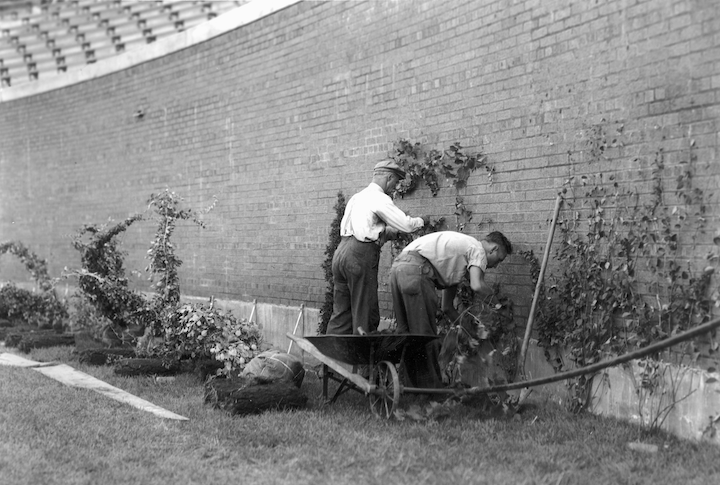
Wrigley Field’s outfield is not merely a stretch of grass and ivy—it is a character in its own right. The verdant walls, meticulously maintained since the late 1930s, serve as both a visual spectacle and a functional challenge for outfielders. Unlike the sterile expanse of modern ballparks, Wrigley’s outfield is alive. The ivy, a living organism, climbs the brick walls in a slow, deliberate embrace, its tendrils curling around mortar and steel. This organic backdrop transforms every fly ball into a high-stakes drama. A ball that just clears the ivy becomes a home run; one that disappears into the foliage is lost to the ages. The outfield is where baseball’s poetry meets its unpredictability—a place where the line between triumph and tragedy is drawn in shades of green.
The Ivy’s Hunger: A Maw That Swallows Legends
The ivy at Wrigley does not merely obscure a ball; it consumes it. There is something almost predatory in the way the vines sway when a ball vanishes into their depths. Players, fans, and even broadcasters have recounted the eerie silence that follows such an event—a moment suspended in disbelief. The ivy does not return the ball gently. It holds it, sometimes for hours, sometimes forever. Some balls are retrieved by groundskeepers with long poles, their surfaces scuffed and stained by the elements. Others remain entombed, buried in the foliage, becoming part of the field itself. This hunger of the ivy lends a mythic quality to the outfield, turning it into a kind of natural archive where baseball’s fleeting moments are preserved—or lost—in the embrace of green.
Fleeting Glory: The Ball That Could Have Been a Star
Every baseball lost in the ivy represents a near-miss, a moment of athletic brilliance that teetered on the edge of immortality. Consider the line drive that just clears the ivy, arcing toward the bleachers before vanishing into the foliage. Had it traveled a few feet farther, it would have been a game-winning home run. Instead, it becomes a cautionary tale—a reminder that in baseball, glory is often a matter of inches. The lost ball is not just an object; it is a ghost of what could have been. It haunts players, fans, and even the ivy itself, a silent testament to the fragility of athletic achievement. In this way, the ivy becomes a metaphor for the fleeting nature of success, where triumph and defeat are separated by the thinnest of margins.
The Ritual of Retrieval: Groundskeepers as Unsung Heroes
When a ball disappears into the ivy, it is the groundskeepers who step into the role of mythic rescuers. Equipped with long poles and a deep understanding of the ivy’s labyrinthine structure, they venture into the outfield like explorers navigating an uncharted wilderness. The retrieval process is a blend of art and science—part patience, part precision. Sometimes, the ball is lodged deep within the vines, requiring careful disentanglement. Other times, it is resting precariously on a ledge, just out of reach. The groundskeepers’ work is not merely functional; it is ceremonial. Each retrieval is a small victory, a restoration of order in a world where chaos often reigns. Their efforts ensure that the ivy’s hunger does not consume the game entirely, preserving the integrity of the field and the memories it holds.
Fans and the Mythology of the Lost Ball
For fans, a ball lost in the ivy is more than an incident—it is a story to be told and retold. It becomes a shared experience, a moment of collective memory that binds generations of spectators. The lost ball is immortalized in anecdotes, in photographs, and in the collective consciousness of the fanbase. It is the subject of post-game discussions, of social media posts, of late-night debates about whether the ball would have been a home run if not for the ivy’s interference. The lost ball transcends its physical form, becoming a symbol of the unpredictable nature of baseball itself. It reminds fans that the game is not just about statistics and strategy; it is about the raw, unscripted moments that defy logic and leave an indelible mark on the soul of the sport.
The Ivy as a Time Capsule: Preserving Baseball’s Ephemera
Over the decades, the ivy at Wrigley Field has become a de facto time capsule, preserving not just baseballs but the very essence of the game’s history. Balls lost in the ivy are often relics of pivotal moments—game-winning hits, milestone achievements, or simply the ordinary magic of a well-struck ball. Some of these balls are later retrieved, their surfaces etched with the patina of time, their stitches frayed by years of exposure to the elements. Others remain lost, buried in the foliage, waiting to be discovered by future generations. In this way, the ivy serves as a living archive, a place where baseball’s ephemera is preserved in a state of suspended animation. It is a reminder that history is not just recorded in books or museums; it is also hidden in the crevices of a ballpark’s outfield walls.
The Psychology of Loss: Why the Ivy’s Hunger Resonates
The sadness of a ball lost in the ivy is not merely about the loss of an object; it is about the loss of a moment. Baseball is a game of memories, of moments that define players and fans alike. A lost ball represents a memory that will never be fully realized—a home run that never was, a milestone that slipped through the fingers of fate. This psychological weight is what makes the ivy’s hunger so resonant. It is a tangible reminder of the impermanence of athletic achievement, of the way in which even the most glorious moments can slip away, leaving only echoes behind. The ivy, in its quiet, unassuming way, becomes a mirror for the human experience—a place where triumph and tragedy coexist in the same breath.
The Future of the Ivy: A Living Legacy
As Wrigley Field evolves with the times, the ivy remains a constant—a living link to the ballpark’s storied past. New generations of players and fans continue to experience the drama of the outfield, where a ball lost in the ivy is as much a part of the game as the crack of the bat or the roar of the crowd. The ivy’s legacy is not just in the balls it has swallowed, but in the way it has shaped the identity of the ballpark itself. It is a reminder that baseball is not just a sport; it is a tradition, a ritual, a living thing that grows and changes with each passing season. The ivy, with its quiet hunger, ensures that the soul of Wrigley Field remains intact—a place where history is not just remembered, but lived.