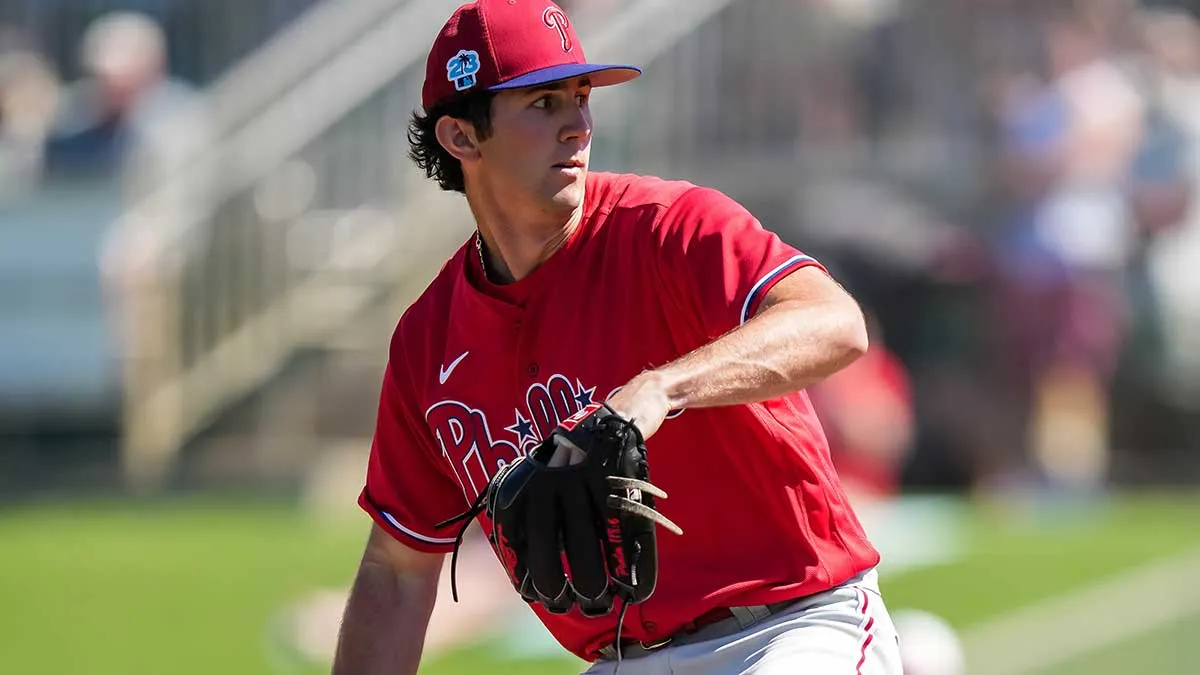
The Philadelphia Phillies’ pitching pipeline has long been a source of both hope and heartache, a paradox that defines eras of fandom. Andrew Painter, once hailed as the crown jewel of that system, now finds himself at a crossroads as the 2025 season looms. The narrative surrounding his struggles isn’t just about missed fastballs or errant sliders—it’s about the collision of expectation and reality, the kind that reshapes careers and redefines legacies. What went wrong? And more intriguingly, what lies beneath the surface of his current challenges?
The Weight of the Moniker: When a Prospect Becomes a Brand
Andrew Painter’s ascent was meteoric, a trajectory so steep it bordered on mythic. Drafted in 2021 with the 13th overall pick, he was immediately anointed as the Phillies’ next ace, a monolith of potential wrapped in a 6’7” frame that seemed to defy the laws of pitching physics. The hype wasn’t just local; it was national, a chorus of analysts and scouts declaring him a generational talent before he’d even thrown a professional pitch. This isn’t just pressure—it’s the burden of being a walking, talking investment, a human IPO where every outing is scrutinized for ROI.
The problem with such lofty expectations isn’t just the scrutiny; it’s the erosion of the joy in the craft. When every pitch is dissected for its “big league readiness,” the game shifts from passion to performance, from artistry to algebra. Painter’s struggles may not stem from a sudden loss of skill but from the suffocating embrace of a narrative he never asked to carry. The Phillies, desperate for a savior in a division where the Braves and Mets loom large, may have accelerated his timeline before he was ready to handle the psychological toll of being the franchise’s white knight.
The Mechanics of Misfire: Where Did the Dominance Go?
At his peak, Painter’s arsenal was a symphony of deception. His fastball, a mid-90s missile with late life, was complemented by a slider that broke like a question mark and a changeup that vanished into the catcher’s mitt. But in 2025, that symphony has devolved into a cacophony of mistimed deliveries and flinched follow-throughs. The most glaring issue? A sudden inability to command the zone. Pitches that once painted the black are now dotting the corners of the backstop—or worse, the backstop itself.
Mechanically, the culprit may lie in an overhaul of his delivery. Pitchers often tinker with their mechanics in pursuit of an edge, but Painter’s adjustments—whether in stride length, arm slot, or timing—have introduced inconsistencies that were previously absent. His once-fluid motion now resembles a Rube Goldberg machine: too many moving parts, each dependent on the other for precision. The result? A fastball that tails instead of cuts, a slider that hangs instead of darts, and a changeup that floats like a beach ball. The Phillies’ pitching coaches are no doubt dissecting every frame of his delivery, searching for the flaw that turned a weapon into a liability.
Yet, mechanics alone don’t tell the full story. The human body is a marvel of adaptability, and when a pitcher’s mind isn’t in sync with his body, the breakdown is inevitable. Painter’s struggles may be as much mental as they are physical—a case of overthinking, of trying to force outcomes rather than letting the game come to him. In an era where analytics dictate every pitch, the freedom to throw with reckless abandon has been replaced by the paralysis of perfection.
The Phantom of the Innings: Durability or Decline?
One of the most perplexing aspects of Painter’s 2025 campaign is his inability to string together consistent innings. In an era where workload management is gospel, Painter’s outings have been marred by early exits, as if an invisible hand is yanking him from the mound before he’s allowed to find his rhythm. This isn’t just a matter of pitch counts or innings limits; it’s a psychological barrier. The fear of failure has become a self-fulfilling prophecy, with each short outing reinforcing the narrative that he’s not ready for the grind of a major league season.
The Phillies’ rotation, already thin on proven arms, has been forced to rely on stopgaps and reclamation projects, a stark contrast to the high-flying offenses they face. Painter’s absence from the rotation isn’t just a tactical misstep; it’s a symbol of the franchise’s broader struggles to develop pitching talent. The irony? The Phillies have invested heavily in their farm system, yet Painter’s struggles highlight the chasm between potential and performance. It’s a reminder that talent alone doesn’t guarantee success—it’s the ability to adapt, to persevere, and to outlast the doubts that define greatness.
The Shadow of the Past: Comparing Painter to Phillies’ Pitching Ghosts
Philadelphia has a long and tortured history with pitching prospects who never quite lived up to the hype. Names like Adam Eaton, J.A. Happ, and Vince Velasquez echo through the annals of Phillies lore as cautionary tales of promise unfulfilled. Painter’s struggles invite an inevitable comparison to these ghosts, each a reminder that the city’s love affair with pitching prospects is as fickle as it is fervent. What separates Painter from these predecessors, however, is the scale of the expectations placed upon him. He wasn’t just another prospect; he was the one who could finally deliver on the promise of a rotation that had long been the Achilles’ heel of the franchise.
Yet, the past may hold the key to Painter’s future. The Phillies’ pitching development has historically been plagued by a lack of patience, a tendency to rush prospects to the majors before they’re ready. Painter’s struggles may be the universe’s way of forcing the organization to slow down, to invest in his development rather than his deployment. The minor leagues, often dismissed as a purgatory for prospects, may be the crucible he needs to refine his craft and rediscover the joy in pitching.
The Road Ahead: Rebuilding the Narrative
The path forward for Andrew Painter isn’t just about fixing mechanics or rebuilding confidence—it’s about reconstructing the narrative that has defined his career. The Phillies must decide whether to double down on him as the future of their rotation or to explore alternatives, whether through trade or internal development. The decision will be fraught with risk, but it’s a risk the organization must take if it hopes to avoid repeating the mistakes of the past.
For Painter, the road ahead will require a return to fundamentals. He must strip away the layers of expectation and rediscover the simplicity of the game—the joy of painting corners, the thrill of fooling a hitter, the satisfaction of a well-executed pitch. The minor leagues offer a chance to rebuild his confidence, to prove to himself and to the organization that he’s more than the sum of his struggles. It’s a humbling process, one that will test his resolve and redefine his legacy.
The Phillies’ 2025 season is a microcosm of Painter’s journey—a story of potential, struggle, and the relentless pursuit of greatness. Whether he emerges from this crucible as a champion or a cautionary tale remains to be seen, but one thing is certain: the narrative of Andrew Painter is far from over. It’s merely entering its most critical chapter.