The 1985 Topps Andy Van Slyke rookie card isn’t just another piece of cardboard tucked between the wax packs of your childhood. It’s a time capsule of a player who, despite his understated brilliance, carved out a niche in baseball history that collectors still debate today. Is this card a hidden gem, lurking in bargain bins with untapped potential? Or does it belong in the pantheon of collector’s must-haves, a cornerstone of any serious vintage baseball card portfolio? To answer that, we need to peel back the layers of Van Slyke’s career, the card’s production nuances, and the market forces that shape its legacy.
The story of Andy Van Slyke begins not in the spotlight, but in the shadows of baseball’s minor leagues. Drafted by the St. Louis Cardinals in 1983, Van Slyke spent his early years toiling in the bushes before a mid-season trade in 1987 sent him to the Pittsburgh Pirates. It was there, under the tutelage of manager Jim Leyland and alongside future Hall of Famers like Barry Bonds, that Van Slyke’s talents finally flourished. By 1988, he had become the Pirates’ everyday center fielder, a position he would hold with distinction for nearly a decade. His 1985 Topps card, however, captures him in the embryonic stages of that journey—fresh-faced, unproven, and brimming with potential.
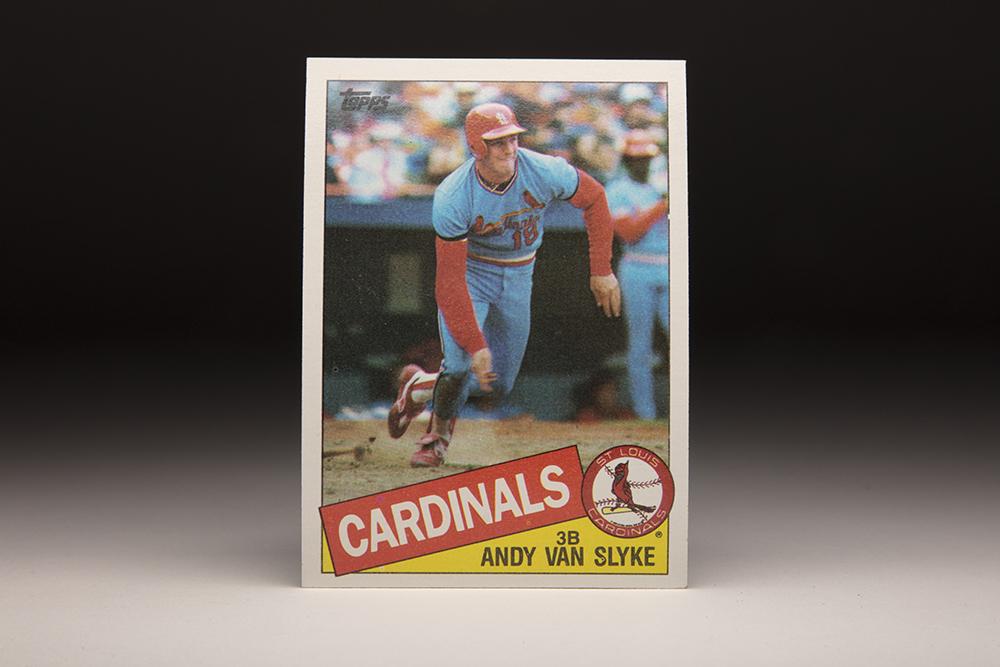
For collectors, the allure of a rookie card lies in its ability to tell a story. The 1985 Topps Van Slyke card does just that, but with a twist. Unlike the iconic cards of players like Ken Griffey Jr. or Derek Jeter, Van Slyke’s rookie card wasn’t produced in massive quantities. Topps’ 1985 set is often overshadowed by the 1984 Donruss and Fleer boom, which flooded the market with high-gloss, high-production cards. Van Slyke’s card, by comparison, feels almost understated—printed on the standard Topps stock of the era, with a simple design that prioritizes clarity over flash. The front features a clean, headshot-style photo of Van Slyke in his Cardinals uniform, his gaze fixed somewhere beyond the frame, as if already calculating the trajectory of a fly ball. The back, meanwhile, offers a concise snapshot of his minor league stats, a reminder of the player’s humble origins.
But what makes this card truly intriguing is its dual identity. To the casual fan, it’s a relic of a bygone era, a piece of cardboard that pales in comparison to the modern, high-tech autographs and memorabilia flooding the market. To the astute collector, however, it’s a puzzle piece—a fragment of a larger narrative that speaks to the evolution of the game itself. Van Slyke’s career, after all, was defined by versatility. He was a five-tool player before the term became cliché: a .274 career hitter with power, speed, and a glove that earned him three Gold Gloves. His rookie card, in many ways, encapsulates that versatility. It’s not a card that screams for attention, but one that rewards patience and discernment.
For those who appreciate the nuances of vintage cardboard, the 1985 Topps Van Slyke card offers a treasure trove of collecting angles. First, there’s the condition factor. Unlike the high-grade commons of the 1950s or 1960s, which often suffer from paper loss or print defects, the 1985 Topps set is relatively resilient. The card’s borders are thin, the colors vibrant, and the centering—while not always perfect—tends to be more forgiving than earlier issues. A well-preserved Van Slyke rookie can still be found in raw form for under $50, making it an accessible entry point for collectors looking to dip their toes into vintage without breaking the bank. Graded examples, particularly those slabbed by PSA or BGS in Near Mint or higher, command premiums, but even then, the prices remain reasonable compared to the stratospheric figures of modern stars.
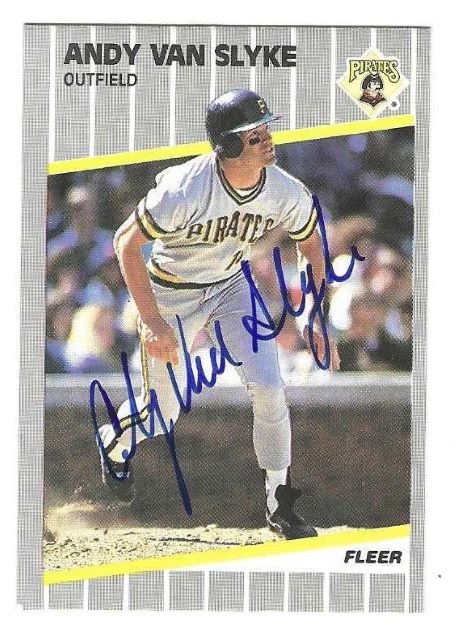
Then there’s the autograph market. While the 1985 Topps Van Slyke card isn’t an autograph card itself, it’s a prime canvas for collectors seeking personalized touches. Van Slyke, now retired, remains a gracious signer, and his autograph on a vintage card adds a layer of authenticity that’s hard to replicate. The challenge, of course, lies in finding a card that hasn’t been over-signed or defaced by less scrupulous collectors. A clean, single-signature Van Slyke on his rookie card can elevate its value significantly, turning a humble commons into a conversation piece. For those willing to hunt, the payoff can be substantial—especially if the card is paired with a provenance story or a certificate of authenticity.
But perhaps the most compelling aspect of the 1985 Topps Van Slyke rookie card is its role as a gateway to deeper collecting themes. For instance, consider the regional variations of the 1985 Topps set. While the standard issue is the most common, there are unopened wax boxes from certain regions—particularly in the Midwest—that occasionally surface with pristine Van Slyke cards still inside. These “factory fresh” copies, untouched by human hands, offer a glimpse into the past, a moment frozen in time when the card was as new as the player’s rookie status. For collectors obsessed with the idea of owning a piece of history in its original state, these regional gems are the holy grail.
Another angle to explore is the card’s connection to Van Slyke’s teammates. The 1985 Topps set features several Pirates and Cardinals players who would later become household names. A collector could assemble a mini-set centered around Van Slyke’s rookie year, pairing his card with those of his contemporaries like Barry Bonds, Bobby Bonilla, or Ozzie Smith. This approach transforms a simple commons into a curated collection, one that tells a broader story about the 1980s Pirates and the era’s baseball landscape. It’s a reminder that collecting isn’t just about chasing the rarest cards—it’s about curating a narrative.

Of course, no discussion of the 1985 Topps Van Slyke rookie card would be complete without addressing its investment potential. The vintage baseball card market has seen explosive growth in recent years, with commons from the 1980s and 1990s now fetching surprising sums at auction. While Van Slyke’s card isn’t yet a blue-chip investment, its relative affordability and the player’s strong reputation among sabermetricians could position it as a sleeper pick. The key, as with any investment, is patience. The market for 1980s rookies is still maturing, and cards like Van Slyke’s could see increased demand as new generations of collectors discover the era’s underrated stars.
Ultimately, the 1985 Topps Andy Van Slyke rookie card is a study in contrasts. It’s a card that demands to be seen but doesn’t shout for attention. It’s a relic of a player’s humble beginnings, yet it carries the weight of a career defined by excellence. For the casual collector, it’s a nostalgic trip to the card aisle of yesteryear. For the serious hobbyist, it’s a canvas for storytelling, a building block for a larger collection, or even a speculative play on the vintage market’s future. Whether it’s a hidden gem or a collector’s must-have depends entirely on the eye of the beholder.
In a hobby often dominated by the flashiest names and the rarest cards, the Van Slyke rookie stands as a testament to the beauty of the overlooked. It’s a reminder that sometimes, the most rewarding collections aren’t built on hype or headlines, but on the quiet stories waiting to be uncovered—one card at a time.