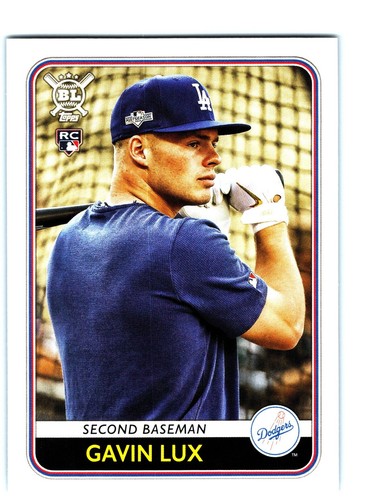
The Gavin Lux rookie card isn’t just another piece of cardboard—it’s a time capsule of a player whose trajectory has been as unpredictable as a ninth-inning rally. When Topps unleashed the 2020 series featuring the Los Angeles Dodgers’ infield prospect, few could have predicted the rollercoaster that would follow. Now, as the dust settles on his career thus far, collectors and fans alike are left wondering: is this the moment to pull the trigger on a Gavin Lux rookie card, or has the ship already sailed? The answer isn’t as simple as checking the box scores. It’s a question of legacy, market timing, and the intangible allure of a player who could still rewrite his own narrative.
For those who’ve watched Lux’s journey, the appeal is undeniable. A first-round pick in 2016, he arrived in the majors with the kind of hype reserved for phenoms who could anchor a lineup for a decade. His 2020 debut was electric, a glimpse of the power and plate discipline that made him a top prospect. But like a pitcher who struggles with command, Lux’s early career was marked by flashes of brilliance amid stretches of inconsistency. Injuries, positional shifts, and the cruel mathematics of baseball’s development cycles have left his legacy hanging in the balance. Yet, for collectors, that uncertainty is part of the charm. A rookie card isn’t just an investment; it’s a bet on a story, and Lux’s story is far from over.
The Rookie Card Landscape: Varieties and Their Nuances
Not all Gavin Lux rookie cards are created equal. The 2020 Topps flagship set is the most ubiquitous, but it’s just the tip of the iceberg. The base card, with its clean design and bold Dodgers colors, is the gateway drug for most collectors. It’s affordable, widely available, and serves as a canvas for autographs and relics. But for those seeking distinction, the parallels and refractors offer a different kind of allure. Parallels, with their limited print runs and shimmering surfaces, cater to the aesthetic-driven collector. Refractors, with their mirror-like finish, are the showstoppers—pieces that catch the light and the eye in equal measure.
Then there are the autographed variants. The on-card autograph is the holy grail for purists, a direct imprint of Lux’s signature on the same card that made him famous. But the autographed parallels and refractors? Those are the unicorns. Their scarcity and the premium attached to them make them the kind of cards that could appreciate exponentially if Lux’s career takes a turn for the legendary. And let’s not forget the relic cards. A piece of a game-used jersey or bat embedded in the card adds a tactile connection to the player’s journey, turning a collectible into a relic of history.

Market Dynamics: Is Now the Right Time to Buy?
The secondary market for Gavin Lux rookie cards is a microcosm of the broader baseball card ecosystem—a place where sentiment and speculation collide. Prices have seesawed like a pitcher’s duel, with peaks during his hot streaks and valleys during slumps. Right now, the market feels like it’s caught between two worlds. On one hand, Lux’s potential is undeniable. A player who can hit for power and average, with the defensive chops to stick at shortstop or second base, is the kind of talent that could anchor a franchise for years. On the other hand, the reality of his production to date leaves room for doubt. Is he a future All-Star, or a cautionary tale of unfulfilled promise?
For the risk-averse collector, the base rookie card remains a safe harbor. It’s liquid, relatively inexpensive, and unlikely to crater in value. But for those willing to gamble on upside, the parallels and refractors present an opportunity. The key is timing. Buying during a slump—when the market is bearish and prices are depressed—could yield significant returns if Lux’s career regains its footing. Conversely, waiting for a breakout season could mean paying a premium when the hype machine revs up. The sweet spot might be right now, when the market is neither frothy nor despondent, and Lux’s next move could be the catalyst that shifts the narrative.
Another factor to consider is the broader market trends. Baseball cards, like the sport itself, are cyclical. The 2020-2021 boom saw rookie cards of even middling prospects soar to stratospheric heights. Now, the market is correcting, and prices are stabilizing. In this environment, a Gavin Lux rookie card isn’t just a bet on him—it’s a bet on the market’s appetite for Dodgers players, for infielders, and for players with his specific skill set. If the market rebounds, as it inevitably will, Lux’s cards could ride the wave higher.
Grading and Authentication: The Devil in the Details
No discussion of baseball cards is complete without addressing grading. A PSA 10 Gavin Lux rookie card is a different animal than a raw or ungraded version. The premium for a top-grade card can be staggering, but it’s not without reason. A PSA 10 represents the pinnacle of condition, a card that’s been scrutinized under a microscope and deemed flawless. For investors, this is critical. A graded card is more liquid, more desirable, and more likely to appreciate over time. But grading comes at a cost—both in terms of the grading fee and the risk of a lower score. A card that’s only a few points away from a 10 could see its value plummet if it’s bumped down to a 9.
Authentication is another layer of complexity. The market is rife with fakes, and a counterfeit Gavin Lux rookie card can look convincing to the untrained eye. Professional authentication services like PSA, BGS, and SGC provide a layer of security, but they’re not infallible. The best defense is knowledge. Familiarize yourself with the card’s design, the font used in the text, and the subtle variations in color and print quality. A quick comparison with a known authentic copy can save you from a costly mistake. For high-value cards, consider having them graded and authenticated before making a purchase—it’s an investment in peace of mind.
Long-Term Potential: What’s the Upside?
The million-dollar question: could a Gavin Lux rookie card become a blue-chip investment? The answer depends on how you define “blue-chip.” If you’re looking for a card that could one day fetch five or six figures, the odds are long—but not impossible. Lux’s path to superstardom isn’t guaranteed, but neither was Corey Seager’s when he was a prospect. Seager’s rookie cards have appreciated dramatically, not just because of his success, but because of the timing and the market’s hunger for Dodgers stars. Lux could follow a similar trajectory if he rediscovers his form and stays healthy.
Consider the intangibles. Lux’s rookie card isn’t just a piece of cardboard; it’s a piece of history. It captures a moment in time when he was the next big thing, before injuries and inconsistency tempered expectations. For collectors who appreciate the narrative, that’s invaluable. A card like this could become a conversation piece, a centerpiece in a collection that tells a story. And in a hobby where nostalgia and storytelling are currency, that’s a powerful draw.
But let’s be realistic. The upside isn’t without risk. Lux could become a journeyman, a player who flashes brilliance but never puts it all together. In that scenario, his rookie cards might appreciate modestly, but they won’t become the stuff of legend. The key is to view the purchase as part of a larger strategy. If you’re building a Dodgers-centric collection, Lux’s rookie card is a must-have. If you’re chasing pure investment returns, you might want to hedge your bets with cards of players who’ve already proven themselves.
Alternatives and Diversification: Don’t Put All Your Cards in One Binder
Even the most ardent Gavin Lux fan should consider diversifying. The baseball card market is vast, and there are plenty of other rookie cards that offer compelling value. For Dodgers fans, Mookie Betts’ rookie cards are a no-brainer. For power hitters, Shohei Ohtani’s rookie cards remain a wild card with massive upside. And for collectors who love the underdog narrative, players like Gavin Lux’s former teammate, Corey Seager, offer a blueprint for what could be.
Diversification isn’t just about spreading risk; it’s about capturing different market segments. A portfolio that includes base rookie cards, parallels, autographs, and relics is more resilient than one that’s laser-focused on a single player. It also allows you to capitalize on trends. If the market suddenly shifts toward Dodgers players, you’re positioned to benefit. If autographed cards become the next big thing, you’ve got a piece of that pie.
Another strategy is to look at Lux’s peers. Players drafted in the same year, like Gleyber Torres or Brandon Phillips, have rookie cards that offer a point of comparison. How have their cards performed? What’s their career trajectory been? These aren’t perfect proxies, but they provide a data-driven way to assess Lux’s potential. If his peers’ cards have appreciated despite inconsistent careers, there’s a case to be made that Lux’s could follow a similar path.
The Gavin Lux rookie card is a study in contrasts—a blend of potential and uncertainty, of nostalgia and speculation. It’s a card that asks more questions than it answers, and that’s what makes it so compelling. For collectors, it’s an opportunity to own a piece of a story that’s still being written. For investors, it’s a gamble on a player whose best days might still be ahead. And for fans, it’s a tangible connection to a player they’ve watched grow, struggle, and fight his way back to relevance.
So, is it too late to buy? The answer depends on what you’re looking for. If you’re chasing a quick flip, the window might be closing. But if you’re in it for the long haul, if you believe in the power of a comeback story, then now might be the perfect time to add a Gavin Lux rookie card to your collection. The market is stable, the prices are reasonable, and the player’s future is as open-ended as a walk-off home run. One swing could change everything—and that’s the kind of thrill that makes baseball cards so irresistible.