In the grand theater of baseball card collecting, where legends are immortalized in cardboard and ink, few names resonate as deeply as Joey Votto’s. The Cincinnati Reds’ first baseman, a man whose swing was poetry in motion, left an indelible mark on the diamond. But as the years roll on, and the hobby evolves, one question lingers like a fastball down the middle: Is Joey Votto’s rookie card still undervalued in 2025? It’s a query that dances on the edge of heresy in a market where vintage cards often command astronomical prices. Yet, here we are, daring to ask—because sometimes, the most underrated gems hide in plain sight.
To answer this, we must first acknowledge the paradox of modern collecting. The hobby thrives on nostalgia, yet it’s also a forward-looking beast, hungry for the next big thing. Votto’s rookie card, a relic from the early 2000s, exists in this liminal space—neither fully vintage nor modern, but a bridge between eras. And bridges, as any architect will tell you, are often overlooked until the weight of traffic forces a second look.
The Card That Started It All: A Glimpse into the 2002 Bowman Chrome Draft
The crown jewel of Votto’s rookie card portfolio is the 2002 Bowman Chrome Draft Joey Votto RC. Released as part of the Bowman Chrome Draft set, this card captures the rookie in his nascent glory, bat poised, eyes locked on an imaginary pitch. The chrome finish gives it a mirror-like sheen, a nod to the era’s obsession with flash and futurism. But what makes this card truly special isn’t just its aesthetic—it’s the story it tells.
Votto was a third-round pick in the 2002 MLB Draft, a selection that, at the time, felt like a gamble. The Reds were in the throes of a rebuild, and the minor leagues were a proving ground for untested talent. When this card hit shelves, Votto was just another prospect with a bat that could flat-out rake. Fast forward to 2025, and that bat has carved out a Hall of Fame-worthy career. Yet, the card’s value hasn’t kept pace with his on-field legacy. Why?
Part of the answer lies in the card’s production. Bowman Chrome sets from the early 2000s were printed in staggering numbers, and Votto’s rookie wasn’t a superstar at the time. The market for his card was niche, confined to Reds fans and prospect collectors. Today, that scarcity is relative. While not as rare as a 1952 Mickey Mantle, the 2002 Bowman Chrome Votto RC is far from common. High-grade examples (PSA 9 or 10) can still be found for under $200, a pittance compared to the $1,000+ tags on comparable cards from the same era.
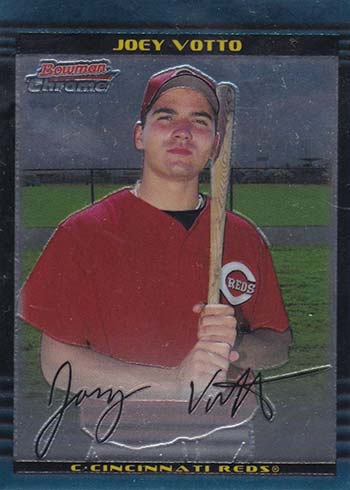
But here’s where the plot thickens. The modern collecting landscape is a beast of its own making. Graded cards, once a niche, are now the gold standard. Raw copies, once the domain of flippers and speculators, are increasingly seen as risky investments. The 2002 Bowman Chrome Votto RC, in high-grade, is a card that checks all the right boxes: iconic player, iconic set, iconic era. Yet, it’s still trading hands at prices that feel almost too reasonable for a player of Votto’s stature.
The Autograph Angle: When the Signature Transforms the Card
No discussion of Votto’s rookie card would be complete without addressing the autograph variant. The 2002 Bowman Chrome Draft set included an autographed version of Votto’s rookie, a parallel that adds a layer of intrigue. Autographed cards are the Holy Grail for many collectors, and Votto’s isn’t an exception. But here’s the twist: the autograph version isn’t necessarily more valuable than the base card.
Why? Because the autograph market is a fickle beast. While some collectors chase signatures like treasure hunters, others see them as a gimmick. The 2002 Bowman Chrome Votto autograph RC can be found for under $300 in high grade, a far cry from the $1,000+ tags on autographed rookies from the same era. Part of this stems from the card’s relative obscurity at the time of issue. Votto wasn’t a top prospect, and his autograph wasn’t in high demand. Today, that lack of hype works in the card’s favor—it’s undervalued precisely because it never got the chance to overinflate.
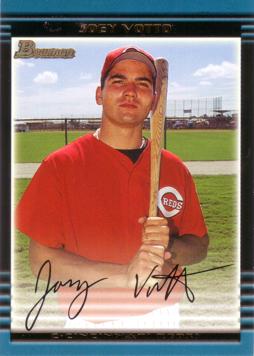
Yet, there’s a counterargument to be made. As the hobby matures, autographed cards are becoming more sought-after. The rise of autograph authentication services and the decline of in-person signings have made signed cards a rare commodity. Votto’s autograph RC, with its clean design and chrome finish, is a prime candidate to ride this wave. If the market for signed rookies continues to grow, Votto’s card could be one of the last great bargains in the genre.
The Hall of Fame Halo: How Votto’s Legacy Could Redefine His Cards
Joey Votto’s Hall of Fame induction in 2024 wasn’t just a personal milestone—it was a seismic shift in the collecting world. For years, Votto’s legacy was debated. Was he a first-ballot Hall of Famer? A borderline candidate? The BBWAA’s decision to enshrine him changed the calculus for his cards. Suddenly, the narrative around Votto’s rookie card isn’t just about his rookie season—it’s about his entire career.
This is where the undervaluation argument gains traction. Hall of Fame players see their rookie cards appreciate not just for their on-field success, but for their historical significance. Take Derek Jeter’s 1992 Bowman Chrome rookie, for example. In 2000, it was a $50 card. Today, it’s a $500+ card, not because of its scarcity, but because of Jeter’s legacy. Votto’s Hall of Fame induction could trigger a similar reevaluation.
But there’s a catch. The market for Hall of Fame rookies is already crowded. Cards from players like Mike Trout, Ken Griffey Jr., and Albert Pujols dominate the conversation. Votto, despite his accolades, doesn’t have the same cultural cachet. His card isn’t a “must-have” in the way that a Mantle or a Mays rookie is. This lack of hype could be both a blessing and a curse. On one hand, it means there’s room for growth. On the other, it means the card lacks the built-in demand that drives prices higher.
The key to Votto’s card’s future value lies in its ability to transcend the Reds fanbase. For that to happen, the hobby needs to recognize Votto not just as a great Reds player, but as one of the game’s all-time great hitters. His .962 OPS, 354 home runs, and 1,139 RBIs speak for themselves. If the market starts to view his rookie card as a piece of baseball history rather than a regional collectible, the value could skyrocket.
The Grading Gamut: Why High-Grade Copies Could Be the Next Big Thing
In the modern collecting world, grading is everything. A PSA 10 can be worth ten times a PSA 7, and the difference often comes down to the whims of a few graders. The 2002 Bowman Chrome Votto RC is no exception. High-grade copies (PSA 9 or 10) are the holy grail, but they’re also the most elusive. The chrome finish, while beautiful, is prone to scratches and wear, making pristine copies a rarity.
For collectors willing to take the plunge, high-grade Votto rookies represent a unique opportunity. The market for graded cards is still expanding, and the demand for “modern vintage” cards (those from the late 1990s and early 2000s) is growing. A PSA 10 Votto rookie could easily double or triple in value over the next five years, especially if the card gains traction among non-Reds fans.
But grading isn’t without its risks. The cost of grading a card can eat into potential profits, and the grading companies themselves are under scrutiny for inconsistent standards. A card that receives a PSA 9 today might be a PSA 10 tomorrow—if the graders change their minds. For Votto’s rookie, this uncertainty is part of the appeal. It’s a gamble, but one with high upside.
The Market’s Mood: Why 2025 Could Be the Year of the Underrated Gem
The collecting market is a living, breathing entity, shaped by trends, nostalgia, and the occasional burst of irrational exuberance. In 2025, the market is at a crossroads. The vintage boom of the past decade is slowing, and collectors are looking for fresh opportunities. Enter the “modern vintage” era—the late 1990s and early 2000s, a time when cards were mass-produced but players were on the cusp of greatness.
Votto’s rookie card fits perfectly into this narrative. It’s not old enough to be vintage, but it’s not new enough to be ignored. It’s a card that bridges the gap between eras, and in 2025, that bridge could become a highway. The rise of social media platforms like TikTok and Instagram has given collectors a platform to share their finds, and Votto’s rookie card is the kind of hidden gem that thrives in the age of digital hype.
Imagine a collector stumbling upon a high-grade Votto rookie in a shoebox, only to post it online and watch the bids roll in. That’s the power of the underrated card—it’s a story waiting to be told. And in a hobby where stories drive value, Votto’s rookie could be the next big thing.
Of course, the market is unpredictable. A single viral post, a Hall of Fame induction, or a surge in Reds nostalgia could send prices soaring. But for now, Votto’s rookie card remains a sleeping giant, undervalued and underappreciated. And sometimes, the best investments are the ones that no one else sees coming.
So, is Joey Votto’s rookie card still undervalued in 2025? The answer, as with all things in collecting, depends on who you ask. But if history has taught us anything, it’s that the cards we overlook today often become the treasures of tomorrow. And in the grand tapestry of baseball cards, few names shine as brightly as Joey Votto’s. His rookie card may not be the flashiest, but it’s a piece of the game’s history—and that’s something no price tag can truly capture.