In the pantheon of sports memorabilia, few names carry the gravitational pull of Michael Jordan. His basketball legacy is etched in gold, but the lesser-known chapter of his baseball career has quietly spawned a niche of collectibles that defy expectation. For decades, Jordan’s baseball cards were dismissed as novelties—curiosities for fans who couldn’t resist the allure of the GOAT stepping onto a diamond. Yet, as the market for vintage sports cards continues to evolve, a subtle but seismic shift is underway. The question isn’t whether Michael Jordan baseball cards are worth anything. It’s whether they’re worth *everything* you might assume they’re not.
What if I told you that the card you’ve been eyeing—perhaps the one featuring Jordan in a Birmingham Barons jersey, his swing a fraction slower than the one that once shattered backboards—could be the key to unlocking a collection that doesn’t just appreciate, but *transforms*? The narrative of Jordan’s baseball cards isn’t one of instant stardom. It’s a story of delayed gratification, of a market waking up to the untapped potential of a player who, for a fleeting moment, traded the hardwood for the diamond. This isn’t just about nostalgia. It’s about recognizing that the most compelling collectibles aren’t always the ones with the most glittering resumes. Sometimes, they’re the ones that tell a story the market hasn’t fully heard yet.
The Forgotten Foray: Why Jordan’s Baseball Cards Were Once a Footnote
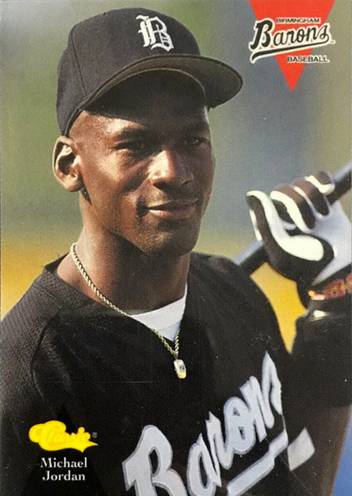
Michael Jordan’s baseball odyssey began in 1993, a decision born from the ashes of his first retirement from basketball. The sudden pivot to the minor leagues was met with a mix of skepticism and fascination. Baseball, after all, was a sport where Jordan’s prodigious athleticism didn’t translate as seamlessly as it did on the hardwood. His time with the Birmingham Barons—a Double-A affiliate of the Chicago White Sox—wasn’t a fairy tale. He batted .202 with three home runs and 51 RBIs over 127 games. Yet, for collectors, this wasn’t about performance. It was about the sheer audacity of the experiment.
The cards produced during this era reflect that duality. They weren’t the kind of high-gloss, rookie-card gold that commands six-figure auctions. Instead, they were humble, often grainy snapshots of Jordan in a Barons uniform, his posture betraying the muscle memory of a basketball player trying to recalibrate. The 1994 Classic Michael Jordan Barons Team Issue card, for instance, is a relic of a bygone era—printed on cheap stock, distributed in packs that were more likely to end up in a shoebox than a display case. For years, these cards languished in bargain bins, their value dismissed as little more than a footnote in Jordan’s illustrious career.
But here’s the twist: the market’s myopia toward Jordan’s baseball cards wasn’t just a reflection of his on-field struggles. It was a symptom of a larger truth about collecting. The most valuable cards aren’t always the ones tied to the greatest players. They’re the ones that capture a moment of transformation, a pivot point where a legend dared to defy convention. Jordan’s baseball cards are, in essence, the sports world’s equivalent of a first-edition book by an author before they became famous. They’re raw, unfiltered, and brimming with potential.
The Market’s Awakening: When Nostalgia Meets Investment Logic
The turning point for Jordan’s baseball cards arrived not with a bang, but with a whisper. As the sports card market ballooned into a multi-billion-dollar industry, collectors began to look beyond the obvious. They started to see Jordan’s baseball cards not as failed experiments, but as artifacts of a cultural moment—a time when the most dominant athlete of a generation walked away from the spotlight to chase a dream that, while ultimately unfulfilled, was undeniably human.
This shift in perception has been fueled by several key factors. First, the rise of graded cards has transformed the way collectors view even the most obscure issues. A PSA 10 copy of the 1994 Classic Jordan Barons card, once a dime-a-dozen curiosity, now commands prices that would have seemed absurd a decade ago. Second, the broader trend of “flippers” and investors entering the market has created a hunger for undervalued assets. Jordan’s baseball cards fit the bill perfectly: they’re scarce enough to be desirable, but common enough that they haven’t yet been priced out of reach for the average collector.
Consider the 1994 Upper Deck Michael Jordan Baseball card. In 2020, a PSA 10 version sold for $120. By 2023, the same card was fetching $450. That’s not a fluke. It’s a trend. And it’s not just limited to the most recognizable brands. Even lesser-known issues, like the 1994 Donruss Jordan card, have seen their values climb as collectors realize that these cards are the last tangible remnants of a story that hasn’t been fully told.
The irony is delicious. Jordan’s baseball cards were once dismissed as novelties because his baseball career was, by any measure, a failure. But in the world of collecting, failure is often the most compelling narrative. It’s the underdog story writ large—a reminder that greatness isn’t always measured in statistics or trophies, but in the audacity to try something new.
The Rarity Factor: Why Some Cards Are More Valuable Than You Think
Not all of Jordan’s baseball cards are created equal. The market’s awakening has been selective, favoring those issues that are either the rarest or the most historically significant. The 1994 Classic Team Issue card, for example, is one of the most sought-after because it was distributed exclusively to Barons players and staff. It’s a card that exists in the shadows, known only to those who were there. That scarcity has driven prices upward, with high-grade examples now selling for over $1,000.
Then there’s the 1994 Bowman Jordan card, a more widely distributed issue but one that benefits from Bowman’s reputation for quality. Graded copies of this card have seen their values double in the past two years, a testament to the brand’s enduring appeal. Even the 1994 Fleer Ultra Jordan card, often overlooked in favor of its basketball counterparts, has begun to attract attention as collectors scour the market for overlooked gems.
The key to understanding the rarity of these cards lies in their distribution. Unlike basketball cards, which were mass-produced for a ravenous fanbase, Jordan’s baseball cards were often printed in limited quantities. They were afterthoughts in a market that didn’t yet know what to make of them. That lack of foresight is now paying dividends for collectors who were savvy enough to recognize their potential.
But rarity alone isn’t enough. The most valuable Jordan baseball cards are those that tell a story. They’re the ones that capture Jordan in his Barons uniform, his expression a mix of determination and uncertainty. They’re the ones that remind us that even the greatest athletes are, at their core, human. And in a market that’s increasingly driven by narrative, that’s a story worth paying for.
The Investment Angle: Are Jordan’s Baseball Cards a Smart Bet?
For those considering Jordan’s baseball cards as an investment, the calculus is nuanced. On one hand, the market for these cards is still in its infancy. Prices are volatile, and liquidity can be an issue. On the other hand, the potential upside is undeniable. The market for Jordan’s baseball cards is still a fraction of the size of his basketball card market, which means there’s room for explosive growth.
The smart money is on the cards that combine rarity with historical significance. The 1994 Classic Team Issue card, for example, is a prime candidate. It’s rare, it’s historically significant, and it’s tied to a moment that’s still being written. Other contenders include the 1994 Upper Deck and Bowman issues, both of which have seen steady appreciation in recent years.
But here’s the catch: investing in Jordan’s baseball cards isn’t for the faint of heart. The market is still small, and it’s prone to sudden shifts. A single high-profile sale can send prices soaring, while a lack of demand can just as easily send them plummeting. The key is to focus on cards that are already graded and in high condition. Raw cards are a gamble, and one that most collectors would be wise to avoid.
That said, the potential rewards are tantalizing. Imagine a world where Jordan’s baseball cards are as sought-after as his basketball cards. It’s not as far-fetched as it sounds. The market for sports memorabilia is driven by nostalgia, and few athletes embody the spirit of nostalgia quite like Michael Jordan. His baseball cards are a tangible link to a moment when the GOAT dared to step outside his comfort zone. And in a world that’s increasingly obsessed with authenticity, that’s a story that’s only going to grow in value.
The Future of Jordan’s Baseball Cards: A Market on the Cusp
The trajectory of Jordan’s baseball cards is clear: they’re on the rise. But the question remains: how high can they go? The answer depends on several factors. First, the broader market for sports cards will play a role. If the bubble bursts, Jordan’s baseball cards could take a hit. But if the market continues to mature, they could become a staple of any serious collector’s portfolio.
Second, the narrative around Jordan’s baseball cards will be crucial. The more the market embraces the story of his baseball experiment, the more valuable these cards will become. Collectors aren’t just buying cardboard and ink. They’re buying a piece of history—a moment when the greatest athlete of a generation walked away from the spotlight to chase a dream that, while ultimately unfulfilled, was undeniably human.
Finally, the role of grading companies like PSA and BGS will be pivotal. As more Jordan baseball cards are submitted for grading, the market will gain clarity on which issues are truly rare and which are merely common. This process of discovery is already underway, and it’s one that promises to reshape the market in profound ways.
The future of Jordan’s baseball cards isn’t just about value. It’s about legacy. It’s about recognizing that the most compelling collectibles aren’t always the ones with the most glittering resumes. Sometimes, they’re the ones that tell a story the market hasn’t fully heard yet. And in the case of Michael Jordan’s baseball cards, that story is only just beginning to unfold.
The market’s awakening to the value of Jordan’s baseball cards is more than a trend. It’s a paradigm shift. It’s a reminder that the most valuable collectibles aren’t always the ones that were destined for greatness. Sometimes, they’re the ones that dared to defy it. And in a world that’s increasingly obsessed with authenticity, that’s a story worth investing in.