Ever held a Mike Schmidt autographed baseball in your hands and wondered, “What’s this piece of history really worth?” The answer isn’t as simple as checking a price guide—it’s a puzzle wrapped in leather, stitches, and the ghost of 548 home runs. In 2025, the market for Schmidt’s signed baseballs is more vibrant than a late-inning rally at Veterans Stadium. But here’s the kicker: not all Schmidt signatures are created equal. Some are pristine, some are faded, and some come with a side of provenance that could make a Hall of Fame curator weep. So, what are collectors really paying for these treasures this year? Buckle up, because we’re diving into the high-stakes world of Mike Schmidt memorabilia—where the gloves come off, and the prices don’t.
The Signature Spectrum: From “Nice” to “National Treasure”
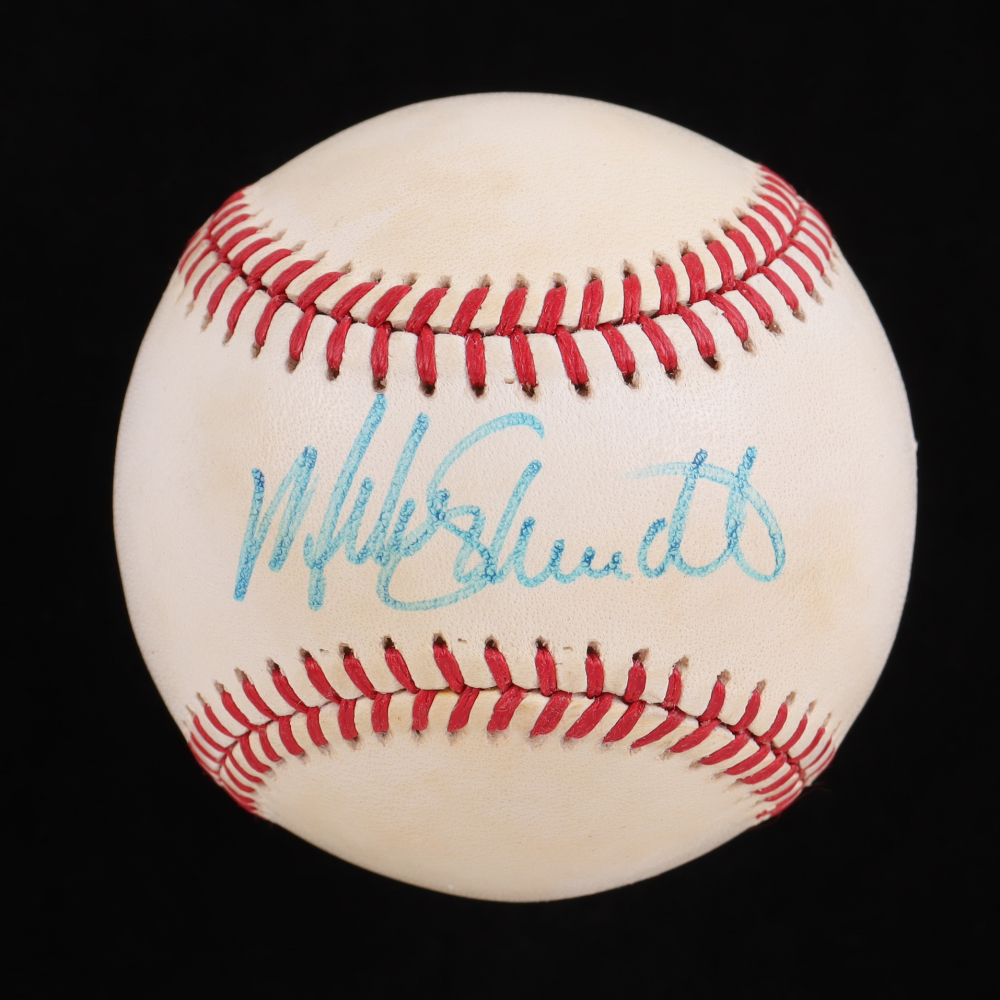
Not all Mike Schmidt autographs are stamped with the same authority. The market divides them into tiers, like the batting order of a championship team. At the bottom rung, you’ll find clubhouse signatures—those quick, often rushed autographs on baseballs or photos given to teammates or staff during his playing days. These rarely fetch more than $200–$400, even in 2025, unless they come with a compelling backstory. Then there are the game-used baseballs, signed during actual MLB contests. These are the mid-tier stars, typically trading between $800 and $2,500 depending on the era and the ball’s condition. But the real heavy hitters? The special event signatures—think Hall of Fame inductions, charity auctions, or private signings with authenticated provenance. These can soar past $5,000, especially if Schmidt used a Sharpie or a high-quality ink that hasn’t bled over the years.
Provenance is the secret sauce. A Schmidt ball signed in 1995 at a Phillies fan fest in Clearwater might look identical to one from his 1980 MVP season, but the latter carries the weight of history. Collectors in 2025 are increasingly demanding certified authenticity—preferably from a reputable third-party grader like PSA or JSA. Without it, even the most pristine signature risks being dismissed as a clever forgery. The market has spoken: if it doesn’t have a hologram or a COA, it’s just a baseball with ink on it.
Condition: The Unseen MVP of Value
Imagine two Mike Schmidt signed baseballs side by side. One gleams like it was signed yesterday, its stitches tight and its leather supple. The other looks like it survived a decade in a shoebox under a teenager’s bed. The difference in value? Staggering. In 2025, a Gem Mint 10 Schmidt ball—graded by PSA or BGS—can command $3,000 to $6,000, while a Very Good 4 might scrape by at $300–$600. The devil, as always, is in the details: ink clarity, panel alignment, and the absence of scuffs or discoloration.
But here’s where it gets tricky. Schmidt’s signature has evolved over time. His early-career autographs (pre-1980s) often feature a loopy, almost whimsical “M” in “Mike,” while his later signatures tighten into a more controlled, almost mechanical script. Collectors in 2025 are split: purists chase the vintage, free-flowing style, while modern buyers prefer the crisp, consistent autographs from his post-retirement years. The market reflects this divide, with older signatures commanding a premium—sometimes 20–30% more—if they’re in top condition.
The Provenance Paradox: When History Outweighs the Signature
What if the baseball isn’t just signed by Schmidt, but used by him in a legendary moment? In 2025, game-used items are the darlings of the memorabilia world, and Schmidt’s bats, jerseys, and balls are no exception. A ball he signed *and* used in a game—say, his 500th home run ball—could fetch $20,000 or more. But here’s the catch: these artifacts are rarer than a no-hitter in the 1990s Phillies bullpen. Most Schmidt balls in circulation are signed post-career, during autograph shows or private events.
The provenance paradox deepens when you consider team-signed balls. A 1980 Phillies World Series ball featuring Schmidt’s signature alongside Garry Maddox, Steve Carlton, and others might sell for $10,000–$15,000, even if Schmidt’s autograph isn’t the most prominent. The collective history of the team amplifies each signature’s value. Conversely, a lone Schmidt ball with no context might struggle to crack $1,000, no matter how perfect the ink. The lesson? In 2025, a Schmidt autograph isn’t just a signature—it’s a chapter in a larger story.
The Auction Wildcard: When Prices Go Nuclear
Every few months, the memorabilia world holds its breath as a Mike Schmidt signed baseball hits the auction block. In 2025, these events are less like routine games and more like walk-off grand slams in the bottom of the ninth. Take, for example, the PSA 10 Schmidt ball signed in 1993 at a Phillies old-timers’ game. In January, it sold for $4,200. By June, a nearly identical ball—same year, same event—fetched $5,800. What changed? Scarcity. The first ball had a clean provenance; the second came with a letter of authenticity from Schmidt’s personal assistant. The market doesn’t just react to condition—it reacts to emotion.
Then there are the blockbuster lots, where Schmidt’s signature is just one star in a constellation of Hall of Famers. A 1970s-era team-signed ball featuring Schmidt, Johnny Bench, and Tom Seaver might start at $15,000 and rocket past $30,000 in under 10 minutes. The thrill of the chase, the fear of missing out—it’s all part of the game. But beware the shill bids. In 2025, auction houses are cracking down on fake bidding rings, but the occasional phantom bidder still inflates prices beyond reason. Do your homework, or you might end up paying $8,000 for a Schmidt ball that’s worth $3,500.
The Future: What’s Next for Schmidt’s Market?
As we look beyond 2025, the Schmidt market faces a pivotal question: Will his legacy continue to appreciate, or has it peaked? The answer lies in three factors: scarcity, demand, and the next generation of collectors. Schmidt retired in 1989, meaning the well of his autographs is drying up. Fewer opportunities to obtain his signature mean higher prices for the remaining pieces. But here’s the twist: younger collectors, raised on digital autographs and NFTs, may not prioritize physical memorabilia the way Baby Boomers do. Will Schmidt’s market plateau, or will it become a niche obsession for die-hard vintage fans?
One trend to watch is the rise of digital collectibles. Companies like Topps and Fanatics are experimenting with authenticated digital versions of Schmidt’s autograph. While these won’t replace physical balls, they could siphon off some demand from traditional collectors. Another wildcard is Schmidt’s health and public appearances. If he remains active in the memorabilia circuit, his signature supply could briefly spike—but if he steps back, prices may surge. The safest bet? High-grade, well-provenanced Schmidt balls will always hold value, but the real winners in 2025 and beyond will be those who buy not just the signature, but the story behind it.
The final pitch lands with a thud in the mitt. Mike Schmidt’s signed baseballs aren’t just collectibles; they’re time capsules, each stitch a thread connecting us to one of the greatest third basemen to ever lace up cleats. In 2025, the prices reflect that legacy—sometimes fairly, sometimes feverishly. But no matter the cost, one truth remains: a Schmidt autograph isn’t just ink on a ball. It’s the echo of a crack of the bat, the roar of Veterans Stadium, and the quiet pride of a man who redefined what it meant to be a Phillie. And that, dear collector, is priceless.