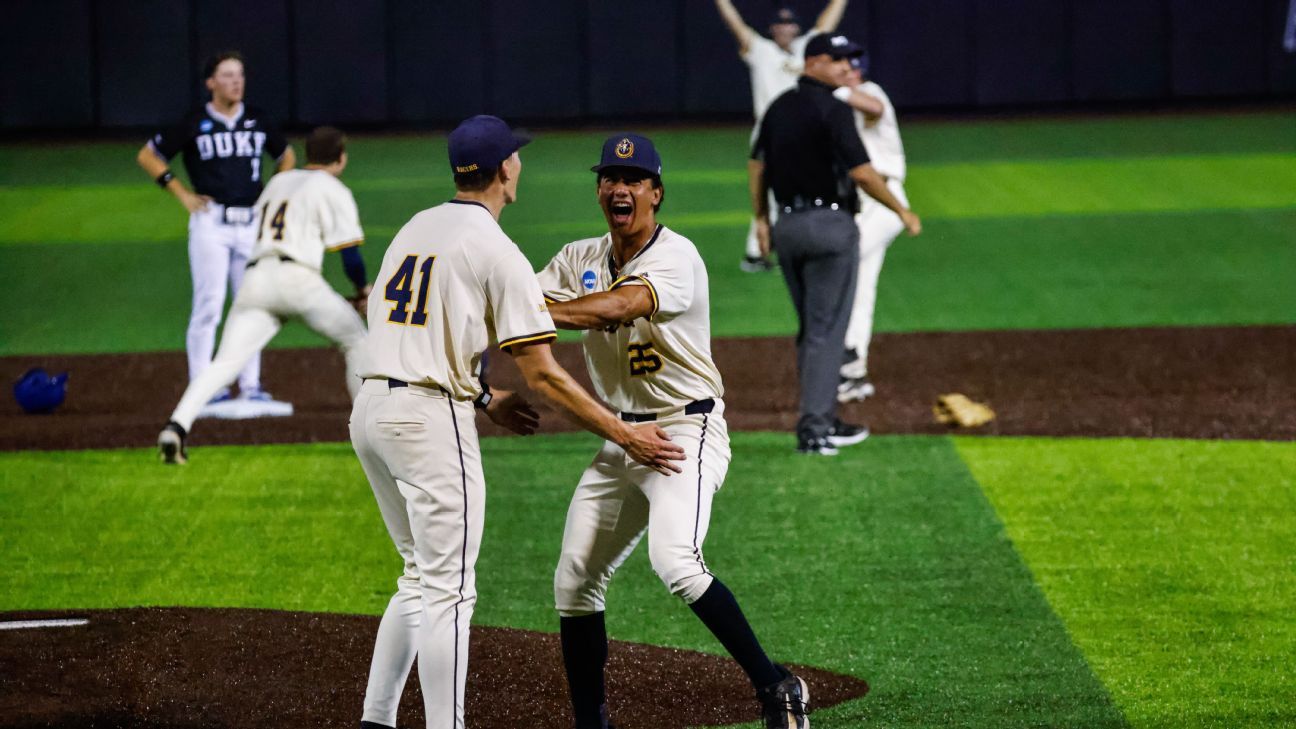
Every June, the College World Series descends upon Omaha like a baseball tempest, churning through the dreams of collegiate sluggers while catapulting one team into the pantheon of legends. Yet, when Murray State’s baseball team stepped onto the hallowed grounds of Charles Schwab Field in 2025, they weren’t just another underdog—they were a full-blown Cinderella, a squad plucked from the shadows of obscurity and thrust into the blinding spotlight of national prominence. But is their journey to Omaha a fairy tale in the making, or merely a fleeting mirage, a mirage that could shatter under the weight of postseason pressure? The question lingers, tantalizing and unanswered, like a curveball hanging in the strike zone.
The Unlikely Ascent: From Ohio Valley to Omaha’s Doorstep
Murray State’s path to Omaha was anything but conventional. Nestled in the rolling hills of Kentucky, the Racers had long been a fixture in the Ohio Valley Conference, a league known more for its basketball pedigree than its diamond prowess. Yet, beneath the radar of casual fans, a quiet revolution was brewing. Under the guidance of a coaching staff that valued fundamentals over flash, Murray State transformed from a plucky underdog into a disciplined, high-octane offensive machine. Their secret? A relentless approach to plate discipline, a pitching rotation that baffled hitters with its precision, and a defense that turned would-be extra-base hits into outs with the flick of a wrist.
Their regular season was a masterclass in consistency, punctuated by a 42-16 record that left even the most skeptical observers whispering their name. But it was in the postseason where the Racers truly announced themselves. A dominant Ohio Valley Conference tournament run, capped by a championship-clinching victory, sent them careening into the NCAA Regionals. From there, they navigated a gauntlet of elite programs with the poise of seasoned veterans, silencing doubters with each clutch performance. By the time they punched their ticket to Omaha, Murray State had not just arrived—they had arrived with a swagger, a swagger that suggested they belonged among the sport’s elite.
The Cinderella Label: A Double-Edged Sword
To call Murray State a Cinderella story is to acknowledge both their improbable rise and the fragility of their newfound status. The term itself carries a whimsical charm, conjuring images of glass slippers and midnight deadlines, but in the cutthroat world of college baseball, it’s also a label that can suffocate. For every Butler or Loyola Chicago that captures the nation’s imagination, there are a dozen other underdogs who flame out in the first round, their dreams of glory reduced to a footnote in the annals of tournament history. Murray State now faces a paradox: the more they’re celebrated, the more they’re expected to deliver, and the more the pressure mounts.
Already, the narratives are taking shape. Sports pundits dissect their every move, searching for cracks in the armor. Will their pitching staff, which thrived on guile and location over sheer velocity, crumble against the thunderous bats of top-seeded programs? Can their offense, which relied on small-ball tactics and timely hitting, adapt when the stakes are measured in runs instead of outs? The Cinderella label isn’t just a badge of honor—it’s a target, one that could turn into a millstone if the Racers aren’t careful. The question isn’t just whether they can win in Omaha; it’s whether they can win *as* the underdogs, without the luxury of anonymity.
The Challenge of the Moment: Playing with House Money
There’s an undeniable allure to being the team with nothing to lose. When Murray State steps onto the field in Omaha, they’ll do so without the weight of expectations that crushes so many traditional powerhouses. For the first time in their season, they’re not chasing a ranking or a bid—they’re playing with house money, and that freedom can be intoxicating. Yet, this very advantage could become their Achilles’ heel. The psychological edge of having no pressure is a double-edged sword; it can inspire fearless play or breed complacency. The Racers must strike a delicate balance between embracing their role as the tournament’s darlings and remembering that the diamond doesn’t care about backstories.
Their first opponent in Omaha will likely be a team that has spent the entire season ranked in the top 10, a squad that views the College World Series as a coronation rather than a proving ground. Murray State’s challenge isn’t just to compete—they must impose their will, to force the favored opponent to play *their* game. That means executing on defense, manufacturing runs when needed, and trusting their bullpen in high-leverage situations. It means silencing the noise, both from the crowd and the commentators, and treating each pitch as if it were Game 7 of the World Series. The beauty of their story hinges on this: can they turn their underdog status into a weapon, or will it become a distraction?
The Ghost of Cinderellas Past: Lessons from Omaha’s Forgotten Heroes
History is littered with teams that arrived in Omaha with fanfare, only to be humbled by the cold reality of postseason baseball. In 2019, for instance, the Auburn Tigers stormed into Omaha as the tournament’s most electric offense, their lineup brimming with future MLB talent. Yet, they were eliminated in two games, their dreams of a title evaporating under the weight of a single-elimination format. Similarly, the 2016 TCU Horned Frogs entered Omaha as the nation’s top-ranked team, only to be ousted in their first game by an unheralded squad from Texas Tech. These cautionary tales serve as a reminder that Omaha is no respecter of reputations—it’s a crucible where legends are forged and fairy tales are rewritten.
Murray State’s players and coaches are undoubtedly aware of these precedents. They know that the College World Series is a different beast, one where the margin for error is razor-thin and the stakes are measured in inches. Their preparation must extend beyond the physical—it must delve into the mental, into the art of compartmentalizing failure and embracing the chaos. The Racers’ coaching staff will drill them on situational awareness, on the importance of staying in the moment, and on the dangers of looking ahead. Because in Omaha, the past is prologue, and the only thing that matters is the next pitch.
A Story Still Unfolding: The Racers’ Chance to Etch Their Names in History
The College World Series is more than a tournament; it’s a crucible where legacies are cemented and futures are decided. For Murray State, the opportunity to compete on this stage is a once-in-a-generation chance to redefine what it means to be a mid-major program. They’ve already defied the odds by reaching Omaha—now, they must defy them again, this time against the best teams in the country. Their journey is a testament to the beauty of college baseball, where David can slay Goliath, where a team’s heart can outweigh its statistical profile, and where a single game can rewrite a season’s narrative.
Yet, the question remains: Is their run a Cinderella story in the making, or merely a surprise that will fade like a summer sunset? The answer lies not in the recaps of their past performances, but in the outcomes of the games they’re about to play. Will they rise to the occasion, their improbable journey culminating in a championship parade through the streets of Murray, Kentucky? Or will they, like so many before them, be remembered as a team that came so close, only to fall short when it mattered most? The stage is set. The players are ready. The story is still being written.