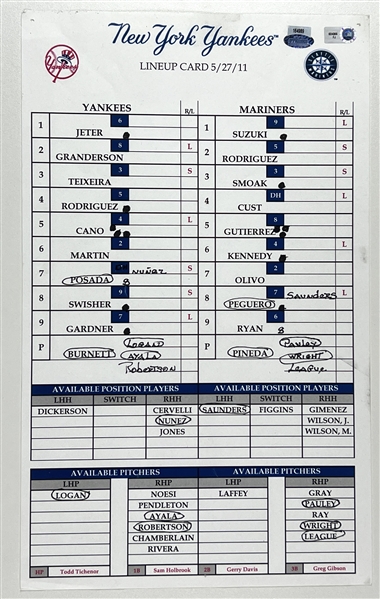
The New York Yankees have long been revered as one of Major League Baseball’s most iconic franchises. Over the years, their lineup has undergone numerous transformations, each reflecting shifts in strategy, player development, and organizational philosophy. Focusing on the 2011 and 2015 iterations of the Yankees’ lineup presents a fascinating examination of how the team evolved in response to competitive pressures and internal dynamics. From personnel changes to tactical adjustments, these two distinct lineups embody the nuanced progression of a storied franchise striving to blend veteran prowess with emergent talent.
Contextual Overview: Team Dynamics in 2011 vs. 2015
The 2011 New York Yankees were navigating the twilight of one competitive era while clinging fiercely to postseason aspirations. The team was laden with elite veterans who had cultivated a winning culture, including marquee names synonymous with franchise legacy. In contrast, the 2015 Yankees represented a period marked by transition — one where rapid turnover and youth integration sought to rejuvenate the team’s core. These contrasting contexts shaped the complexion of the lineup in profound ways, influencing management’s approach to both offensive firepower and defensive reliability.
In 2011, the Yankees retained a robust mix of seasoned sluggers and proven clutch performers. Their lineup was designed to maximize run production through patience and power, making them a formidable opponent during tight playoff races. Meanwhile, the 2015 edition leaned more heavily on emerging prospects and role players stepping into elevated roles amid a period of organizational recalibration. This era embraced a more dynamic and versatile approach, though often at the cost of consistency and veteran leadership.
Core Offensive Philosophy and Batting Order Structure
Analyzing the batting orders reveals a stark contrast in offensive philosophies. The 2011 lineup epitomized an old-school, power-centric approach. The core hitters were positioned to capitalize on their slugging abilities, with a focus on drive-and-gap hitting to generate runs efficiently. Speed was less emphasized, as the team relied on patience at the plate and substantial on-base percentages to fuel big innings.
Conversely, the 2015 Yankees adopted a more eclectic batting order. The lineup integrated aggressive baserunners alongside power hitters, reflecting contemporary trends that favored versatility. The top of the order often featured younger players capable of applying pressure through speed, while middle-order slots were reserved for sluggers, albeit with a generally lower collective slugging percentage than in prior years. This resulted in a more balanced yet less formidable offensive output.
Key Personnel Shifts and Player Development Trajectories
The personnel evolution between 2011 and 2015 highlights the Yankees’ strategic recalibration. The 2011 lineup boasted stalwarts like Derek Jeter, Mark Teixeira, and Robinson Cano—players who not only contributed significantly to offensive production but also embodied leadership and experience. The stability in their roles facilitated consistent output despite aging curves.
By 2015, several of these players had departed or were no longer in their prime. The lineup incorporated newer faces such as Brett Gardner and Jacoby Ellsbury, whose speed and defensive acumen added new dimensions. Additionally, there was a greater presence of homegrown prospects attempting to establish themselves, including notable contributions from young talents trying to fill the void left by departing veterans. This infusion of youth brought energy but also inconsistency, underscoring the challenges inherent in championship window transitions.
Defensive Alignment and Its Impact on Lineup Configuration
Beyond offensive statistics, defensive considerations played a vital part in the Yankees’ lineup construction. The 2011 team emphasized defensive reliability, favoring experienced players known for their fielding prowess, particularly in the infield and outfield corners. This defensive strength complemented their offensive approach, ensuring tight ball control and run prevention, which was critical in narrow postseason contests.
In contrast, the 2015 edition sought to enhance speed and range defensively, replacing some traditional power roles with players capable of expansive coverage. While this initially created improved defensive metrics in certain positions, it occasionally compromised offensive production, compelling lineups that sometimes staggered hits and runs more unpredictably. Balancing defensive upgrades with offensive needs became a perpetual managerial puzzle during this season.
Roster Stability and Managerial Influence
Stability within a team influences chemistry and performance, and this factor markedly differed between the two periods. The 2011 Yankees benefited from a relatively stable roster, which allowed the manager to develop consistent hitter alignments and in-game strategies based on well-known player tendencies. This contributed to seamless offensive execution and the ability to leverage clutch situations effectively.
By 2015, roster turnover and injury concerns introduced a more fluid environment. The frequent adjustments to the lineup required a flexible managerial tactic, balancing development opportunities for young players with the immediate desire to remain competitive. The manager’s role expanded to one of constant experimentation, seeking the optimal mix amidst evolving personnel — a challenge that underscored the transitional nature of the team.
Statistical Comparisons and Performance Outcomes
Examining core offensive metrics between the 2011 and 2015 lineups reveals nuanced differences. The 2011 lineup generally outperformed in terms of runs batted in (RBIs), slugging percentage (SLG), and on-base plus slugging (OPS), attesting to their potent run generation ability. Their ability to string hits together and manufacture runs was a hallmark of that era’s approach.
The 2015 Yankees, however, showed improvements in stolen bases and defensive metrics that, while not directly contributing to runs batted in, underscored a more well-rounded if less explosive lineup. Their offensive inconsistency, however, was reflected in a reduction in walk rates and fewer high-impact power moments. This statistical juxtaposition epitomizes the lineup’s transitional identity — one emphasizing evolution over immediate dominance.
Legacy and Impact on Franchise Direction
The lineup evolution from 2011 to 2015 had lasting implications for the Yankees’ franchise trajectory. The 2011 team’s composition reaffirmed a commitment to traditional baseball fundamentals balanced with star power, which appealed to fans’ expectations of championship pedigree. It was a lineup that symbolized a final chapter of a competitive cycle anchored by MLB luminaries.
The 2015 team, in contrast, signaled a pivot toward regeneration and adaptability. The infusion of youth and the experimentation with lineup roles foreshadowed broader organizational changes that would later influence scouting, player development, and free agency strategies. This era’s lineup, while less lauded for immediate success, laid groundwork for the sustained competitiveness seen in subsequent seasons.
Conclusion
Comparing the 2011 and 2015 New York Yankees lineups offers an insightful window into how a premier sports franchise navigates shifting internal and external landscapes. The former exudes the polish of a veteran, battle-hardened squad focused on maximizing its remaining window, while the latter represents a team in flux, balancing legacy with reinvention. Each lineup, with its distinct strengths and shortcomings, tells a story not just of players and statistics but of strategic vision and adaptation within the ever-evolving realm of Major League Baseball.