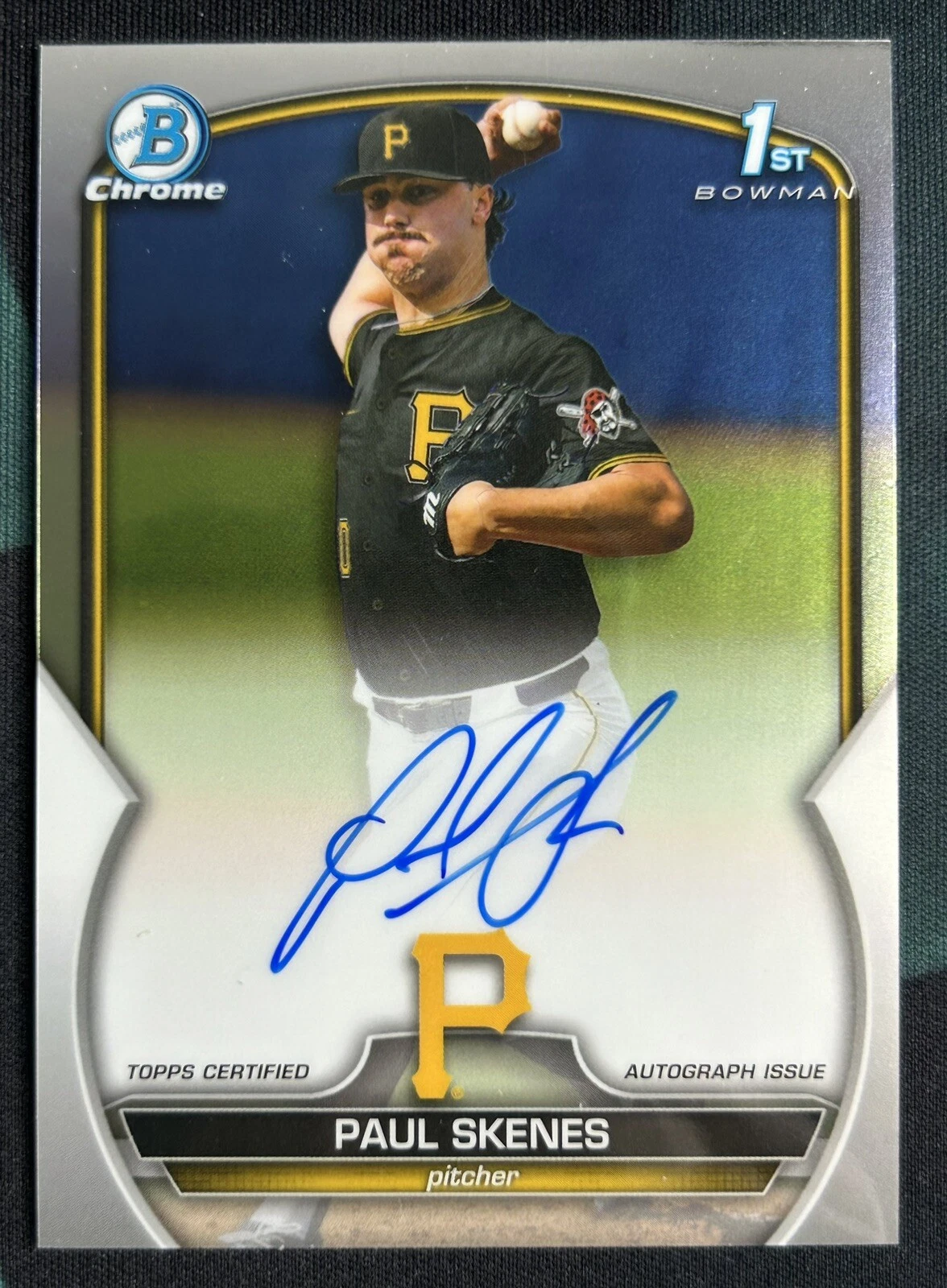
The baseball card market, much like the sport itself, is a realm where nostalgia and speculation collide with ruthless efficiency. Few players embody this duality as vividly as Paul Skenes, the Pittsburgh Pirates’ electrifying rookie sensation. His rookie cards—particularly the Bowman Chrome Draft Autographs—have surged in value, leaving collectors and analysts alike questioning whether the current pricing is sustainable or merely the prelude to a speculative bubble. To understand this phenomenon, we must dissect the market forces at play, the psychological undercurrents driving demand, and the historical precedents that either validate or debunk the frenzy.
The Spectacle of Rookie Card Valuations: A Modern-Day Gold Rush
Rookie cards are the baseball card equivalent of an IPO—initial public offerings where the hype often eclipses reality. Paul Skenes’ cards, however, have ascended beyond mere rookie status; they’ve become the digital-age equivalent of a 1952 Mickey Mantle, a tangible artifact of a generational talent. The Bowman Chrome Draft Autograph, in particular, has seen prices skyrocket to levels that would make even the most seasoned collectors wince. But why? The answer lies in the intersection of scarcity, star power, and the democratization of collecting.
Scarcity is the lifeblood of collectibles, and Skenes’ rookie cards are no exception. Bowman Chrome, with its glossy finish and limited print runs, has long been the gold standard for modern rookie cards. When paired with an autograph—especially one from a player poised to dominate the sport—the result is a perfect storm of desirability. Yet, scarcity alone doesn’t explain the vertiginous climb in prices. The true catalyst is the perception of Skenes as a generational talent, a pitcher whose rookie season has already etched his name into the annals of baseball lore.
The Halo Effect: How Star Power Distorts the Market
Paul Skenes isn’t just another rookie; he’s a phenomenon. His dominance in college—where he struck out batters with metronomic precision—and his seamless transition to the majors have cemented his status as a generational arm. This aura of inevitability has a hypnotic effect on collectors, creating a feedback loop where demand begets demand. The more Skenes’ cards appreciate, the more they’re perceived as “must-haves,” regardless of their intrinsic value.
This is the halo effect in action, a cognitive bias where the perceived greatness of a player spills over into the valuation of their memorabilia. It’s the same phenomenon that propelled Mike Trout’s rookie cards to stratospheric heights or turned a 1986 Fleer Michael Jordan into a six-figure relic. The difference today is the speed at which this effect operates. Social media amplifies hype in real-time, turning a single viral highlight into a market-moving event. When Skenes fans see his fastball carving through lineups, they don’t just see a player—they see a future Hall of Famer, and their wallets respond accordingly.
The Speculative Frenzy: Bubbles, Bandwagons, and the Fear of Missing Out
At the heart of every collectibles bubble is a potent mix of greed and fear—the fear of missing out (FOMO) on the next big thing. Skenes’ rookie cards are currently trading at prices that defy conventional valuation metrics, a clear sign that speculation is driving the market. But is this sustainable, or are we witnessing the early tremors of a correction?
Historical precedents offer a mixed bag of warnings and reassurances. The 1990s saw the infamous “flea market boom,” where unopened packs of 1980s Topps cards became investment vehicles. The crash that followed left many collectors holding worthless cardboard. Yet, the 2000s also saw the rise of players like Derek Jeter, whose rookie cards not only survived the bubble but thrived, becoming blue-chip assets. The key difference? Jeter’s cards were backed by sustained excellence, while many 1990s cards were propped up by hype alone.
Skenes’ case is unique because his on-field performance is already validating the hype. If he continues to dominate, his rookie cards could become the cornerstone of modern collections. But if injuries, inconsistency, or a sudden decline derail his career, the market could correct just as violently as it rose. The question isn’t whether the prices are unsustainable in the abstract—it’s whether the underlying talent justifies the valuation.
The Role of Technology: Digital Collecting and the New Frontier
The baseball card market has evolved beyond physical slabs and protective cases. Today, collectors trade digital assets, authenticated by blockchain technology, where Skenes’ autographs exist as NFTs or digital certificates of authenticity. This shift has democratized access to high-end cards, allowing a broader audience to participate in the market. Yet, it has also introduced new layers of complexity, where the same psychological forces that drive physical card prices—hype, scarcity, star power—now operate in a virtual landscape.
Digital collecting has also accelerated the pace of transactions. A card that once changed hands at a card show over the course of a weekend can now be traded globally in seconds. This liquidity is a double-edged sword: it fuels demand but also makes the market more volatile. For Skenes’ rookie cards, this means prices can spike or plummet based on nothing more than a viral tweet or a single dominant outing. The digital age has turned collecting into a spectator sport, where every fan can play the role of an arbitrageur.
The Collector’s Dilemma: Investment or Passion?
At its core, the baseball card market is a reflection of human psychology—a blend of nostalgia, fandom, and the eternal hope of striking it rich. For some collectors, Skenes’ rookie cards are an investment, a bet on a player’s future greatness. For others, they’re a labor of love, a way to connect with the game on a deeper level. The tension between these two perspectives is what makes the market so fascinating—and so fraught with risk.
Investors see Skenes’ cards as a high-beta asset, one that could appreciate rapidly if he fulfills his potential or collapse just as quickly if he doesn’t. Passionate collectors, on the other hand, are driven by the emotional pull of owning a piece of history. They’re less concerned with resale value and more interested in the story behind the card. This dichotomy is why the market for Skenes’ rookie cards is so polarizing: some see a golden opportunity, while others see a house of cards waiting to collapse.
The truth, as it often is, lies somewhere in between. Skenes’ rookie cards may very well appreciate over time, especially if he cements his legacy as one of the game’s all-time greats. But the current prices are undeniably inflated by speculation, and a correction—whether gradual or sudden—is inevitable. The question is whether collectors are prepared for the reckoning when it comes.
The Future of Skenes’ Rookie Cards: A Crystal Ball Gazing Exercise
Predicting the future of collectibles is an exercise in futility, but we can identify the variables that will shape Skenes’ rookie card market in the coming years. The most critical factor is his on-field performance. If he becomes a perennial Cy Young contender, his cards will only grow in value. If he struggles with injuries or inconsistency, the market will adjust accordingly. Another key variable is the broader baseball card market itself. If the speculative bubble in modern rookies bursts, Skenes’ cards could be collateral damage.
Cultural trends will also play a role. As younger generations enter the collecting fray, their preferences may shift away from traditional baseball cards toward digital assets or other forms of memorabilia. The rise of alternative investments—crypto, art, sneakers—could divert capital away from the baseball card market, leaving fewer buyers willing to pay top dollar for Skenes’ rookie cards.
Yet, for all the uncertainty, one thing is clear: Paul Skenes has already left an indelible mark on the game. His rookie cards are more than just pieces of cardboard or digital files—they’re artifacts of a moment when a new star was born. Whether they’re worth their current price is a question only time can answer. But their cultural significance is undeniable, and that alone may ensure their place in the pantheon of baseball’s most coveted collectibles.