For countless pitchers, the curveball represents the holy grail of pitching mastery—a pitch shrouded in mystique, promising to bewilder hitters with its deceptive trajectory. Yet, frustratingly, many find their curveball refuses to bend, sailing straighter than anticipated. The enigma behind this failure often lies not in arm strength or mechanics, but rather in an overlooked element: grip pressure. This subtle factor can spell the difference between an arresting curve and a lackluster delivery, flipping conventional wisdom on its head and inviting pitchers to reconceptualize their relationship with the ball itself.
The Illusion of the Curveball’s Movement
The conventional narrative credits spin alone for the mesmerizing break of a curveball. High spin rates supposedly generate a magnus effect, creating a downward and lateral movement that confounds hitters. However, countless pitchers experience a paradox: no matter how sharp their wrist snap or how mechanically sound their delivery, the ball remains stubbornly linear. This disconnect exposes a critical truth—spin is necessary but insufficient without proper modulation of grip pressure. The real shift in perspective is realizing the pitch’s movement is a consequence of nuanced interplay, not raw force or speed.
Grip Pressure: The Invisible Variable
Grip pressure is the silent arbiter that dictates whether a curveball curves or flatlines. This is not about squeezing harder in a brute force attempt to command the ball, but rather about the distribution and subtle calibration of pressure across fingers and palm. Pitchers who apply uneven pressure disrupt the ball’s spin axis, robbing it of the rotational stability required for a sweeping arc. Conversely, excessive tension in the fingers can restrict fluid release, diminishing the ability to impart the ideal downward spin that orchestrates the signature curveball drop.
The Physics Behind Grip and Spin Axis Stability
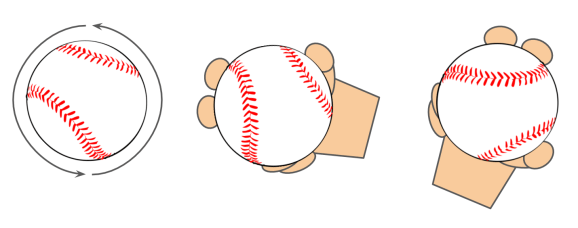
The spin axis refers to the rotational pole around which the baseball rotates during flight. An optimal curveball requires a spin axis tilted downward, usually 45 degrees from the horizontal plane, to harness the magnus effect for that characteristic sweeping drop. However, inappropriate grip pressures can cause the ball to wobble or incorporate unintended side spin. This instability shifts the spin axis, converting what should be a cascading arc into a straighter, less effective pitch. Understanding and mastering grip pressure equates to commanding the spin axis, a subtle yet profound influence on ball trajectory.
Common Grip Mistakes That Sabotage Curve Movement
Many pitchers unknowingly succumb to habitual grip errors that erode spin quality. Placing too much pressure on the middle finger—the primary digit responsible for imparting the downward spin—can choke the release, reducing spin velocity. Other common pitfalls include uneven finger placement and excessive thumb tension, which misalign the ball at release, causing the spin axis to tilt unpredictably. The allure of a tight grip as a control mechanism often backfires, introducing tension that stifles the delicate wrist snap everyone chases.
Training Techniques to Refine Grip Pressure
Recalibrating grip pressure requires conscious effort and biomechanical awareness. Pitchers benefit from drills that emphasize relaxation and proprioception—learning to feel the ball rather than dictate it. One technique involves practicing pitches with minimal force, focusing on finger placement and gentle pressure application. Utilizing video analysis to monitor finger motion during release can reveal unconscious gripping habits. Additionally, switching between slightly different grips during bullpen sessions helps identify the sweet spot where spin peaks without compromising fluidity.
The Psychological Component: From Tension to Trust
Grip pressure is not solely a physical phenomenon; it intersects deeply with a pitcher’s mental state. Anxiety and overthinking often manifest as excessive grip tension, a form of micromanagement fueled by the fear of losing control. Breaking this cycle demands a psychological shift—from rigid control to intuitive trust. Embracing a lighter grip encourages a loose wrist and a freer release, cultivating a natural spin that the pitcher can reliably reproduce. Confidence and relaxation emerge as allies in mastering the curveball’s motion.
Implications Beyond the Curveball
Understanding grip pressure’s role transcends the curveball, offering insights across all pitches. Fastballs, sliders, and changeups each respond uniquely to pressure variances. The curveball, however, serves as a microcosm—showing that subtle tactile dynamics influence pitch success in profound ways. Embracing this knowledge prompts pitchers to adopt a more tactile, sensitive approach, honing their fingers’ “language” with the ball rather than relying solely on velocity or mechanical force.
Conclusion: The Curveball as a Lesson in Nuance and Control
The elusive curveball does not demand overwhelming power or theatrics; it requires an intimate understanding of grip pressure and its impact on ball behavior. Recognizing that the curveball’s movement hinges on invisible pressures invites pitchers to embark on a journey of sensory refinement and body awareness. These revelations promise more than just improved performance; they offer a paradigm shift—transforming the curveball from an inscrutable enigma into a finely tuned instrument of deception and artistry.