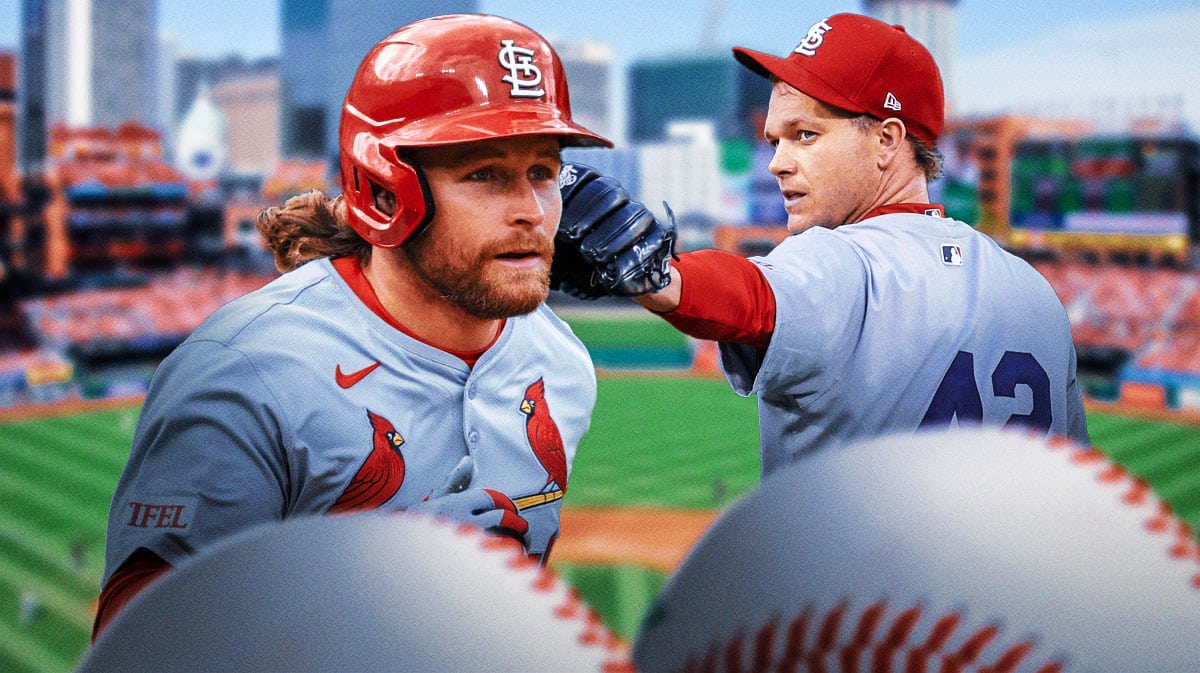
The St. Louis Cardinals of the mid-1980s were not merely a team—they were a symphony of precision, a ballet of athleticism, and a fortress of defensive mastery. Between 1985 and 1987, the Redbirds transformed from a promising squad into a dynasty in the making, their rosters brimming with talent that redefined what it meant to dominate in the National League. This was an era where speed wasn’t just a weapon; it was a philosophy. Where defense wasn’t merely a phase of play; it was an art form. And where dominance wasn’t just a goal—it was an expectation.
The Engine of Speed: A Fleet-Footed Revolution
The Cardinals of 1985–1987 were a blur of cleats and stolen bases, a team that turned the basepaths into a gauntlet for opposing pitchers. At the heart of this velocity was Willie McGee, a center fielder whose name became synonymous with relentless hustle. McGee wasn’t just fast—he was a human metronome, his strides calibrated to perfection, his instincts honed by years of tracking fly balls and reading pitchers’ tells. But he wasn’t alone. Vince Coleman, the electrifying rookie sensation of 1985, arrived like a comet, shattering the single-season stolen base record with 110 thefts—a feat so audacious it seemed plucked from the pages of a comic book. Coleman’s speed wasn’t just a tool; it was a psychological weapon, a way to unnerve pitchers before they even threw a pitch.
Yet speed alone doesn’t win championships. It was how the Cardinals wielded it. Managers like Whitey Herzog understood that stolen bases were merely the opening act. The real magic lay in the way these speedsters disrupted defensive alignments, forced errors, and turned routine plays into chaos. The Cardinals didn’t just run—they orchestrated. They turned the diamond into a chessboard, where every stolen base was a calculated gambit, every hit-and-run a gambol of calculated risk.
The Wall of Defense: A Fortress in the Field
If speed was the Cardinals’ scepter, defense was their shield. The 1985–1987 rosters were stacked with defensive maestros who turned the infield and outfield into impenetrable fortresses. Ozzie Smith, the “ Wizard of Oz,” wasn’t just a shortstop—he was a magician, his glove a vortex that swallowed line drives whole. His range was otherworldly, his acrobatics a spectacle that left fans breathless. But Smith was more than a one-man highlight reel. He was the heartbeat of the defense, a player whose mere presence forced opponents to adjust their entire offensive strategy.
Behind him, the rest of the infield was no less formidable. Terry Pendleton, the third baseman with a cannon for an arm, patrolled the hot corner with the precision of a surgeon. Jack Clark, the first baseman, was a defensive enigma—his glove work so seamless it often went unnoticed, but his ability to scoop errant throws and turn double plays was the glue that held the infield together. And then there was Tommy Herr, the second baseman whose glove seemed to have a sixth sense, anticipating bounces before the ball even left the bat.
The outfield was no less stellar. Beyond McGee’s speed, he was a defensive stalwart, his routes so impeccable they bordered on clairvoyant. Andy Van Slyke, the right fielder, was a whirlwind of athleticism, his arm a howitzer that deterred runners from daring to test him. And in left field, the versatile Curt Ford provided stability, his arm and range making him the unsung hero of the outfield’s ironclad defense.
The Power Surge: When Offense Met Opportunity
Yet for all their defensive prowess, the Cardinals weren’t a team content to play small ball alone. They had firepower—bats that could change the complexion of a game in an instant. Jack Clark, the quiet slugger with a devastating swing, was the team’s offensive nucleus. His home runs weren’t just hits; they were statements, towering blasts that announced the Cardinals’ arrival. But Clark wasn’t alone. Darryl Porter, the catcher, was a switch-hitting menace whose power from both sides of the plate kept pitchers guessing. And then there was Terry Pendleton, whose bat added another dimension to the offense, his clutch hitting often the difference in tight games.
The Cardinals’ offense thrived on balance. They weren’t a team of one-dimensional sluggers; they were a collective of hitters who could manufacture runs, drive in the occasional long ball, and turn a single into a rally. This was the era of the “Whiteyball” philosophy—a strategy that prioritized contact, speed, and situational hitting over the long ball. It was baseball as a high-stakes game of inches, where every at-bat was a chess move, every hit a calculated victory.
The Pitching Staff: Arms That Carved a Dynasty
No discussion of the 1985–1987 Cardinals would be complete without acknowledging the pitching staff that anchored the team’s dominance. John Tudor, the left-handed ace, was a bulldog on the mound, his fastball a sledgehammer and his slider a whisper that deceived hitters into oblivion. Tudor’s 1985 season was the stuff of legend, a 21-win campaign that saw him post a 1.93 ERA—a performance so dominant it felt like he was pitching in a different league.
But Tudor wasn’t alone. Joining him was Bob Forsch, the right-hander whose sinker was a death knell for fly-ball hitters. Forsch’s ability to induce ground balls turned the Cardinals’ infield defense into an even deadlier machine. And then there was Danny Cox, the young fireballer whose raw talent was matched only by his competitive fire. Cox’s 1985 debut was a statement—200 innings of dominance that announced the arrival of a new pitching star.
The bullpen was no less formidable. Todd Worrell, the rookie closer, was a force of nature, his splitter a pitch so devastating it left hitters flailing. Worrell’s 36 saves in 1986 were a testament to his dominance, his presence alone enough to send shivers down the spines of opposing lineups. Behind him, Ken Dayley and Pat Perry formed a bullpen that was as reliable as it was relentless, a trio of arms that closed the door on countless games.
The Chemistry: A Brotherhood Forged in Fire
What truly set the 1985–1987 Cardinals apart, however, was the chemistry that permeated the roster. This was a team that played with a camaraderie that bordered on telepathy. The dugout was a place of laughter, of inside jokes, of shared purpose. Willie McGee and Vince Coleman weren’t just teammates—they were brothers in arms, their speed and energy infectious. Ozzie Smith’s infectious enthusiasm lifted the entire clubhouse, his joy for the game a constant reminder of why baseball was more than just a sport.
This chemistry translated to the field. The Cardinals played with a swagger, a confidence that came from knowing they were the best at what they did. They didn’t just win games—they dominated them. They didn’t just play defense—they suffocated opponents. They didn’t just hit—they manufactured runs with the precision of a Swiss watch.
The Legacy: A Blueprint for Dominance
The 1985–1987 Cardinals weren’t just a team—they were a blueprint for how to build a champion. Their rosters were a masterclass in balance, a fusion of speed, defense, power, and pitching that left an indelible mark on the game. They were a team that played with joy, with purpose, and with an unshakable belief in their own greatness.
Decades later, their legacy endures. The Cardinals of that era didn’t just win games—they redefined what it meant to be a dominant team. They were a reminder that baseball, at its core, is a game of artistry, of strategy, and of heart. And in an era where the game is increasingly defined by analytics and technology, their story stands as a testament to the timeless beauty of the sport.