In the pantheon of baseball collectibles, few cards command the same reverence—or inspire the same speculative fervor—as the 1987 Topps Mark McGwire rookie card. It’s the kind of card that lingers in the corners of hobby shops and auction houses, whispered about in hushed tones as a potential goldmine or dismissed with a shrug as a fleeting fad. The fascination isn’t just about the cardboard itself; it’s about the story it carries, the myth it embodies, and the way it forces us to confront the uneasy marriage of nostalgia and investment. Is this card a boom waiting to happen, or a bust doomed to gather dust? The answer isn’t as simple as checking a price guide. It’s buried in the intersection of baseball history, market psychology, and the unpredictable alchemy of supply and demand.
The 1987 Topps Mark McGwire rookie card is more than just a piece of printed cardboard. It’s a time capsule, frozen in the late-80s optimism of a sport on the cusp of a renaissance. McGwire, with his towering presence and prodigious power, represented the kind of raw, unbridled talent that made baseball feel like a game of infinite possibility. The card itself is a relic of an era when Topps still dominated the trading card landscape, its design a snapshot of the era’s aesthetic—bold colors, sharp angles, and a confidence that bordered on arrogance. But here’s the thing: time has a way of reshaping the narratives we attach to these objects. What was once a commonplace issue, tucked into packs with reckless abandon, has become a symbol of both potential and peril in the modern collecting world.
The Allure of the “Next Big Thing”
There’s a peculiar thrill in collecting the rookie cards of players who haven’t yet fulfilled their promise. It’s the same dopamine rush that drives fantasy baseball managers to chase breakout stars or bettors to wager on underdogs. The 1987 McGwire card embodies this phenomenon perfectly. When it was first issued, McGwire was just another promising slugger in a league brimming with them. But as his career unfolded—first with the Oakland A’s, then with the St. Louis Cardinals—he became something more: a titan of tape-measure home runs, a symbol of the steroid era’s duality, and, ultimately, a cautionary tale. The card, then, isn’t just a piece of memorabilia; it’s a bet on what might have been, a wager on the “what ifs” that haunt sports fans.
This speculative undercurrent is what makes the McGwire rookie card so compelling. Collectors aren’t just buying cardboard; they’re buying into a narrative. They’re betting that the next generation of fans will look back at McGwire’s era with the same nostalgic awe they reserve for Mantle or Mays, or that his legacy will be recontextualized in a way that elevates his status. It’s a gamble on perception, and perception, as we all know, is a fickle beast. The card’s value isn’t just tied to McGwire’s on-field achievements; it’s tied to the stories we tell about him, the myths we perpetuate, and the way those stories intersect with the broader cultural zeitgeist.
The Grading Gambit: When Condition Becomes Currency
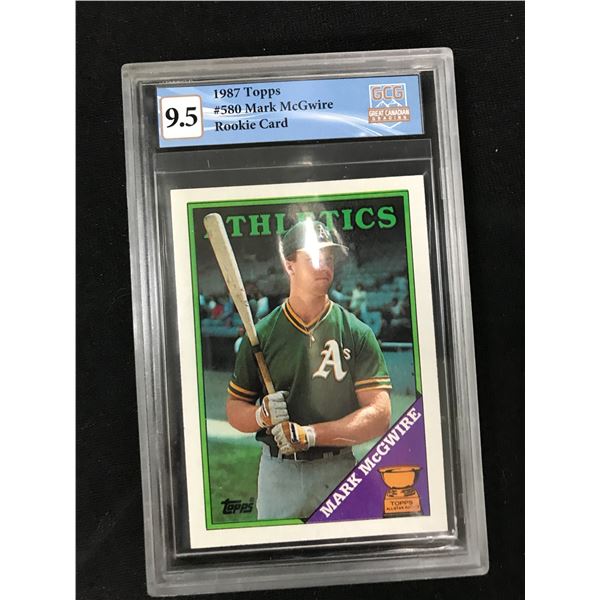
If the McGwire rookie card is a story, then its condition is the plot twist that keeps collectors on the edge of their seats. A card graded 9.5 by a reputable service like GCG isn’t just a piece of cardboard; it’s a near-mint artifact, a unicorn in a sea of worn and creased relics. Grading has transformed the hobby from a nostalgic pastime into a high-stakes game of precision, where the difference between a 9 and a 9.5 can mean the difference between a comfortable retirement and a yard sale. The 1987 McGwire card, in top-tier condition, isn’t just a collectible; it’s a status symbol, a flex in the digital trading card forums where bragging rights are measured in PSA 10s and BGS Black Labels.
But here’s the rub: grading is as much art as it is science. The standards for what constitutes a “near mint” or “gem mint” card have evolved over time, influenced by shifting collector expectations and the whims of grading companies. A card that might have been considered flawless in 1987 could now be docked points for a barely perceptible centering issue or a whisper of a print defect. This subjectivity introduces a layer of risk into the investment equation. Buyers are essentially betting on the consistency of grading standards, a bet that’s as much about faith in the system as it is about the card itself. And when the market is flooded with high-grade copies—because, let’s face it, everyone and their uncle cracked open packs in 1987—the scarcity premium shrinks, leaving only the most discerning (or lucky) collectors with a true advantage.
The grading gamble extends beyond the physical card. It’s a psychological game, too. Collectors who chase high-grade copies aren’t just buying a piece of cardboard; they’re buying peace of mind. They’re telling themselves that they’ve made a “safe” investment, one that will hold its value regardless of market whims. But safety is a relative term in the world of collectibles. A 9.5 McGwire card might be a blue-chip asset today, but what happens when the next generation of collectors decides that “near mint” isn’t good enough? What happens when the market shifts, and the premium for perfection collapses under the weight of its own excess? These are the questions that keep investors up at night, the unspoken fears that lurk beneath the surface of every high-dollar purchase.
The McGwire Effect: Legacy in the Age of Reckoning
No discussion of the 1987 McGwire rookie card would be complete without addressing the elephant in the room: the steroid era. McGwire’s name is inextricably linked to the era’s darkest secrets, his 70-home-run season in 1998 a symbol of both athletic brilliance and institutional failure. The legacy of that era is still being written, and it’s a legacy that complicates the narrative around his collectibles. For some collectors, McGwire’s association with PEDs is a black mark, a stain that diminishes the card’s appeal. Why invest in a piece of memorabilia tied to a player whose achievements are tainted by controversy? For others, it’s precisely that controversy that makes the card more interesting. It’s a conversation starter, a way to engage with the darker corners of baseball history and the way we choose to remember—or forget—the past.
This duality is what makes the McGwire rookie card so fascinating. It’s not just a card; it’s a Rorschach test for baseball fans. It reveals as much about the collector as it does about the player. Do you see a Hall of Famer, a titan of the game whose legacy has been unfairly maligned? Or do you see a cautionary tale, a reminder of the sport’s moral failings? The answer you choose says a lot about where you stand in the broader cultural conversation about sports, ethics, and legacy. And in a hobby where nostalgia often trumps scrutiny, the McGwire card forces collectors to confront uncomfortable truths about the players they admire and the stories they’re willing to buy into.
The market’s reaction to this legacy has been mixed. Some collectors have distanced themselves from McGwire-related memorabilia, opting instead for the cleaner narratives of players like Ken Griffey Jr. or Derek Jeter. Others have embraced the card precisely because of its complicated history, seeing it as a way to engage with the sport’s past in a more honest, unvarnished way. This schism in the collecting community adds another layer of complexity to the investment equation. The McGwire card isn’t just a financial asset; it’s a cultural artifact, and its value is tied as much to its historical significance as it is to its condition or rarity.
The Investment Paradox: Rarity vs. Demand
At its core, the 1987 McGwire rookie card is a study in supply and demand. Topps printed millions of these cards in 1987, and while many have been lost to time, destroyed, or relegated to dusty shoeboxes, the sheer volume of surviving copies means that true scarcity is hard to come by. Yet, the card remains in demand, a fact that speaks to the power of branding and storytelling in the collectibles market. McGwire’s name still resonates with fans, even if his legacy is complicated. His rookie card, then, benefits from a kind of cultural inertia, a momentum that keeps it relevant even as other, more “worthy” cards fade into obscurity.
But here’s the paradox: the more the card is hyped as an investment, the more its value becomes detached from its inherent qualities. It’s not just about the card itself anymore; it’s about the story we’ve built around it. And stories, as we all know, are fragile things. They can be rewritten, reinterpreted, or forgotten entirely. The McGwire card’s value is tied to the collective memory of baseball fans, and collective memory is notoriously fickle. What happens when the next generation of fans looks at McGwire and sees only a flawed figure, a relic of a tainted era? What happens when the nostalgia that drives demand today fades into irrelevance? These are the questions that haunt every investor who’s ever bought a card hoping it would appreciate in value.
The market for vintage baseball cards is notoriously volatile. Trends come and go, and what’s hot today can be cold tomorrow. The McGwire rookie card is no exception. Its value is subject to the whims of fashion, the ebb and flow of collector sentiment, and the broader economic climate. A recession could send prices plummeting, while a resurgence of interest in 80s and 90s baseball could send them soaring. The key to navigating this uncertainty is to recognize that the McGwire card isn’t just an investment; it’s a bet on the future of baseball fandom itself. And in a world where the next big thing is always just around the corner, that’s a bet few can afford to make lightly.
The 1987 Topps Mark McGwire rookie card is a mirror, reflecting the hopes, fears, and contradictions of the collecting world. It’s a card that promises riches but delivers only uncertainty, a relic of a bygone era that refuses to stay buried. Its value isn’t just in the cardboard and ink; it’s in the stories we tell about it, the myths we perpetuate, and the way it forces us to confront the uneasy relationship between nostalgia and investment. Is it a boom waiting to happen? Maybe. Is it a bust doomed to gather dust? Perhaps. But one thing is certain: the McGwire rookie card will always be more than just a piece of cardboard. It’s a testament to the power of baseball to captivate our imaginations, to the way we cling to the past even as the present slips away, and to the eternal human desire to find meaning in the objects we collect. In the end, the card’s true value may not be in its price tag, but in the stories it allows us to tell—and the stories it forces us to remember.