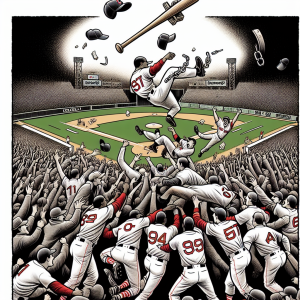
The Boston Red Sox of the 1990s and early 2000s were a team caught in the liminal space between promise and heartbreak, their rosters a tapestry woven with threads of near-misses and what-ifs. Long before the seismic joy of 2004, when the curse of the Bambino finally shattered, the franchise teetered on the edge of greatness—only to watch it slip through their fingers time and again. This era, often overshadowed by the glory that followed, was a crucible of frustration, a period where talent collided with fate in ways that still lingers in the collective memory of Red Sox Nation. To understand the euphoria of breaking the curse, one must first grapple with the rosters that came before—the players who carried the torch, the managers who steered the ship, and the moments that defined a generation of unfulfilled potential.
The Core of Near-Greatness: The Late 1990s Lineup
The late 1990s Red Sox were a team of sluggers, a lineup that could explode at any moment but often lacked the cohesion to sustain dominance. Mo Vaughn, the burly first baseman with a swing that could rattle stadiums, anchored the offense with his prodigious power and intimidating presence. Beside him, Nomar Garciaparra, the rookie sensation from 1997, dazzled with his defensive brilliance and clutch hitting, his bat speed a blur that left pitchers disoriented. Together, they formed the nucleus of a lineup that could decimate opposing pitching staffs—when it wasn’t plagued by inconsistency.
Yet for all their firepower, the Red Sox often stumbled in the most critical moments. The 1998 season, a 92-win campaign, saw them fall short in the playoffs, their postseason dreams dashed by a stunning sweep at the hands of the Cleveland Indians. The lineup’s potential was undeniable, but the lack of depth in key areas—particularly the bullpen—exposed their vulnerabilities. Injuries to key players only exacerbated the problem, leaving the team to rely on stopgap measures that rarely delivered in high-pressure situations.
The Pitching Paradox: Arms That Couldn’t Carry the Load
If the offense was a double-edged sword, the pitching staff of the era was a study in contradiction. Pedro Martinez, the mercurial right-hander acquired in 1997, was a force of nature, his fastball-curveball combination leaving hitters helpless. His 1999 season—a 23-4 record with a 2.07 ERA—was one of the most dominant in franchise history, a reminder of what the Red Sox could achieve when their pitching matched their hitting. Yet even Martinez couldn’t single-handedly propel the team to a World Series.
The rotation beyond Martinez was a revolving door of mediocrity. Derek Lowe, a converted reliever, found new life as a starter, but his inconsistency mirrored the struggles of others like Tim Wakefield, whose knuckleball baffled hitters but couldn’t always secure wins. The bullpen, a critical component in the modern game, was a glaring weakness. While closer Heathcliff Slocumb and setup man Mike Timlin provided moments of stability, the lack of a dominant closer—someone who could shut the door in the ninth inning—often left the team vulnerable to late collapses.
The Managerial Merry-Go-Round: Stability vs. Instability
No discussion of the pre-2004 Red Sox would be complete without examining the carousel of managers who cycled through Fenway Park. Jimy Williams, the steady hand who guided the team through the late 1990s, was a pragmatic leader whose calm demeanor masked the frustrations of a franchise desperate for a breakthrough. His tenure saw the Red Sox reach the playoffs three times, yet each exit was more agonizing than the last, culminating in a heartbreaking loss to the New York Yankees in the 2003 ALCS under Grady Little’s watch.
The managerial changes reflected deeper organizational turmoil. The front office’s inability to build a cohesive roster—one that could complement its stars with reliable role players—left managers like Williams and Little constantly treading water. The pressure to win in a city as passionate as Boston is immense, and the revolving door of skippers was a symptom of a franchise searching for identity in an era where expectations outpaced execution.
The Curse’s Shadow: Psychological Weight and the Road Not Taken
To dissect the rosters of the 1990s and early 2000s is to confront the specter of the curse—a narrative so ingrained in Red Sox lore that it transcended mere superstition. The curse wasn’t just a story; it was a psychological weight, a subconscious burden that players and fans alike carried into every season. The near-misses—the 1999 playoff collapse, the 2003 heartbreak—weren’t just statistical anomalies; they were moments where fate seemed to conspire against the team, as if the baseball gods had decreed that glory would remain just out of reach.
This psychological dimension adds a layer of fascination to the era. The players weren’t just athletes; they were participants in a larger drama, their careers measured against the backdrop of a curse that loomed larger than any individual performance. The frustration of Nomar Garciaparra, the brilliance of Pedro Martinez, the resilience of David Ortiz (who joined the team in 2003)—all were framed by the knowledge that history was stacked against them. It’s this tension between talent and fate that makes the pre-2004 rosters so compelling, a reminder that sports are as much about narrative as they are about statistics.
The What-Ifs: Trades, Injuries, and Missed Opportunities
History is written by the victors, but the alternate timelines of the 1990s Red Sox are a playground for speculation. What if the team had held onto Babe Ruth’s contract in 1920? What if the 1975 team had won the World Series? The pre-2004 era is no different, brimming with what-ifs that haunt fans to this day. The decision to trade away prospects for established stars—often at the behest of ownership—left the farm system barren, a mistake that would take years to correct. The failure to re-sign key free agents, the reluctance to invest in pitching, and the inability to navigate the draft all contributed to a roster that was perpetually one piece short of greatness.
Injuries, too, played a cruel role. Nomar Garciaparra’s wrist issues derailed what could have been a Hall of Fame career in Boston. Pedro Martinez’s shoulder woes in 2001 robbed the team of its most dominant weapon at a critical juncture. These setbacks weren’t just bad luck; they were turning points that reshaped the franchise’s trajectory. The 2003 season, in particular, was a masterclass in resilience, with the Red Sox overcoming a 2-0 deficit in the ALCS against the Oakland Athletics before falling to the Yankees. That series, more than any other, crystallized the era’s paradox: a team that could rise to the occasion but ultimately couldn’t escape its own shadow.
The Legacy of the Era: A Foundation for the Future
Though the 1990s and early 2000s were defined by frustration, they were not without their triumphs. The development of homegrown talent like Garciaparra and the acquisition of Martinez laid the groundwork for the 2004 team. The lessons learned from those near-misses—particularly the importance of bullpen depth and clutch hitting—were not lost on the front office. Theo Epstein, hired in 2002, would later build a roster that addressed the very weaknesses that had plagued the franchise for decades.
Yet the legacy of the era extends beyond mere roster construction. It’s a testament to the enduring allure of baseball, a sport where hope springs eternal even in the face of adversity. The players of that time—Vaughn, Martinez, Garciaparra, and others—were more than just athletes; they were symbols of a city’s unyielding passion. Their struggles, their triumphs, and their resilience forged an identity that would culminate in the most improbable of championships. To remember the pre-2004 Red Sox is to acknowledge that greatness is not always measured in titles, but in the journey toward them.