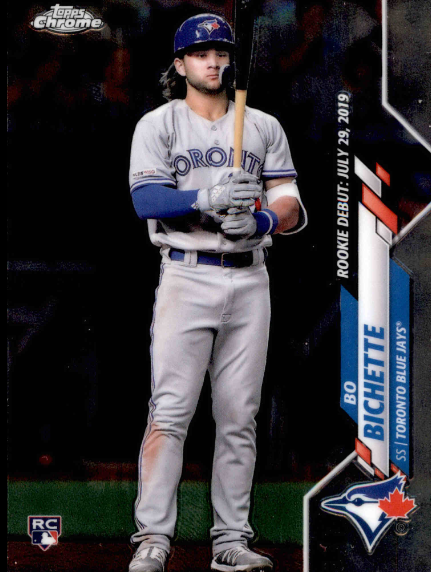
The 2020 Bo Bichette rookie card is more than a piece of cardboard—it’s a time capsule of a young star’s ascent, a frozen moment where potential crystallizes into promise. As the Toronto Blue Jays’ shortstop emerged from the shadows of Vladimir Guerrero Jr. to carve his own legacy, his rookie cards became not just collectibles, but artifacts of a turning point in baseball history. But are they shrewd investments, or merely sentimental keepsakes? To answer that, we must peel back the layers of rarity, demand, and narrative power that make these cards more than ink on paper.

The Canvas of a Star: Design and Rarity as Art
Every great rookie card begins with a canvas—one that captures not just a player, but an era. The 2020 Bo Bichette Bowman Chrome rookie card is a masterclass in modern design: a shimmering gold refractor, its surface catching light like a shortstop’s first dazzling play at the hole. The chrome finish isn’t just aesthetic; it’s a metaphor for the way Bichette reflects the future of baseball—glossy, fast, and impossible to ignore.
The refractor parallels are intentional. Just as light bends through a prism to reveal hidden colors, Bichette’s rookie cards reveal hidden layers of value. The Gold Refractor, in particular, is the rarest of the rare—only a handful per case, making it a unicorn in the collecting world. It’s not just a card; it’s a limited-edition sonnet in a sea of haikus.
The Market’s Pulse: Demand, Scarcity, and the Collector’s Fever
In the stock market, value is driven by earnings reports and quarterly growth. In the baseball card market, it’s driven by momentum—and Bo Bichette has it in spades. His rookie cards, especially the Bowman Chrome variants, have seen a meteoric rise in value, not just because of his on-field performance, but because of the story he represents.
Consider this: a standard 2020 Bowman Chrome Bichette rookie card in PSA 10 Gem Mint condition sold for under $50 in 2020. Fast forward to 2024, and the same card fetches $300–$500. The Gold Refractor? It’s in a league of its own, often trading for $1,000–$2,500 depending on grade and eye appeal. Why? Because collectors aren’t just betting on Bichette’s stats—they’re betting on his legacy.
The scarcity of high-grade refractors creates a feeding frenzy. It’s the same psychology that drives rare sneaker drops or limited-edition vinyl pressings. When supply is artificially constrained, demand inflates like a balloon ready to burst—except in this case, the balloon is holding its shape.
The Grading Gauntlet: Why Condition is the Ultimate Decider
A rookie card’s value is only as strong as its grading. A PSA 10 isn’t just a score; it’s a seal of immortality. The difference between a PSA 9 and a PSA 10 isn’t linear—it’s exponential. A Bichette Gold Refractor PSA 9 might sit at $800, while a pristine PSA 10 could command $3,000 or more. The reason? Perfection is the holy grail, and collectors will pay a king’s ransom for it.
But grading is a gamble. Even the most careful handling can’t guarantee a perfect slab. Centering, corners, edges, and surface quality are the four horsemen of the grading apocalypse. A card with slightly off-center borders might still be a gem, but it’s a flawed gem—one that loses its luster in the eyes of high-end buyers. The market rewards precision the way a shortstop rewards a perfectly timed double play: with relentless efficiency.
The Blue Jays Factor: A Franchise in the Spotlight
Bichette isn’t just a player—he’s a franchise cornerstone. The Toronto Blue Jays, once the underdogs of the AL East, have transformed into perennial contenders, and Bichette is the heartbeat of that resurgence. His rookie cards benefit from the same halo effect that once elevated Mike Trout’s early cards during the Angels’ brief playoff runs.
When the Blue Jays are in contention, Bichette’s cards get a boost. When he delivers a walk-off hit or makes a jaw-dropping defensive play, the market reacts like a stock ticker in overdrive. The emotional connection between player, team, and collector is the secret sauce that turns a card from a commodity into a cultural artifact.
Think of it like this: a Bichette rookie card isn’t just a piece of memorabilia—it’s a front-row seat to the birth of a new baseball dynasty. And dynasties, as history shows, are the most valuable stories of all.
The Investment Equation: Short-Term Fluctuations vs. Long-Term Appreciation
Is a Bo Bichette rookie card a safe investment? The answer depends on your timeline. In the short term, the market can be volatile. A bad season, an injury, or even a slow start can cause prices to dip. But in the long term, Bichette’s trajectory suggests that his rookie cards will only grow in value.
Compare him to other shortstops of his generation—players like Francisco Lindor or Xander Bogaerts. Lindor’s 2016 Bowman Chrome rookie card, once a $200 card, now sells for over $1,000 in high grades. Bogaerts’ 2012 Bowman Chrome? A $50 card in 2012 is now a $300–$500 card. The pattern is clear: elite shortstops with staying power see their rookie cards appreciate like fine wine.
The key difference with Bichette is his age. At just 25, he’s entering the prime of his career. If he stays healthy and continues to produce at an All-Star level, his rookie cards could become the blue-chip stocks of the hobby—assets that appreciate steadily, year after year.
The Wildcard: Autographs and Parallels
While the base rookie cards are the stars of the show, the real treasure hunters are after the parallels and autographs. The 2020 Bowman Chrome Superfractor, limited to just one per case, is the Mona Lisa of Bichette’s rookie output. A PSA 10 Superfractor can fetch $5,000 or more—a number that seems absurd until you consider the sheer scarcity.
Autographed versions add another layer of complexity. A Bichette autograph on a Gold Refractor isn’t just a signature—it’s a signed contract with destiny. These cards often trade for a premium, especially if the autograph is sharp and the card is flawless. The market for autographed rookie cards is where the most passionate collectors play, and Bichette’s are no exception.
The Bottom Line: A Star in the Making
So, is a Bo Bichette rookie card a good investment? The answer isn’t a simple yes or no—it’s a resounding maybe, but a maybe with incredible upside. These cards are more than financial instruments; they’re pieces of a larger narrative, a story of a player who could define an era.
If Bichette fulfills his potential—if he becomes the face of the Blue Jays for a decade, if he wins a Silver Slugger, if he hoists a World Series trophy—then his rookie cards will be worth far more than their weight in gold. They’ll be worth their weight in legend.
For collectors, the choice is clear: buy the card, hold the story, and wait for the magic to unfold. Because in the world of baseball cards, as in baseball itself, the best investments aren’t just about numbers—they’re about the moments they represent.