In the pantheon of baseball’s most revered rookie cards, few names carry the weight of Edgar Martinez. A man whose bat was as precise as a surgeon’s scalpel, whose career arc defied the conventional wisdom of power-dominated eras, and whose legacy now looms larger than ever in the collective memory of the game. Yet, when we speak of his rookie card, we’re not merely discussing a piece of cardboard—we’re confronting a narrative of undervaluation, a market teetering on the precipice of rediscovery, and a collector’s dilemma: Is this card a hidden gem, quietly appreciating in the shadows, or a rising star poised to explode into the stratosphere of blue-chip investments? The answer lies not in the card’s surface, but in the deeper currents of baseball history, supply and demand, and the evolving tastes of a new generation of fans.
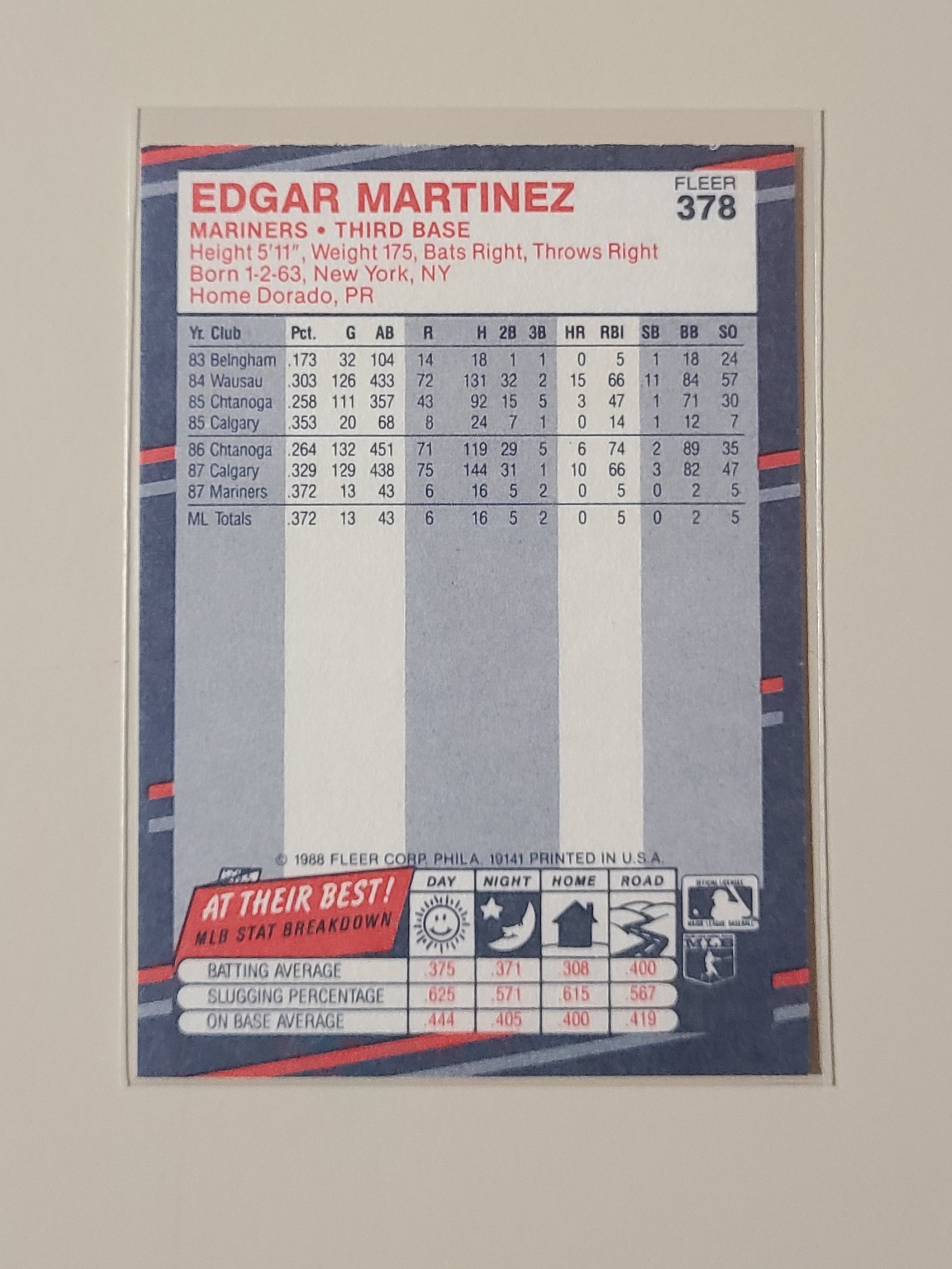
Picture this: a 1988 Fleer Edgar Martinez rookie card, its borders slightly frayed from decades of careful handling, its surface marred by the faintest creases of a well-loved collection. To the untrained eye, it’s just another vintage card from an era when Fleer’s sets were as ubiquitous as the trading card industry itself. But to those who understand the story behind the man, this card is a time capsule—a tangible link to a player who redefined what it meant to be a designated hitter, a player whose bat spoke volumes in an era when sluggers dominated the headlines. Martinez wasn’t just a hitter; he was an artisan, a craftsman whose .312 career batting average and .418 on-base percentage made him one of the most feared right-handed hitters of his generation. And yet, his rookie card? It trades hands for a fraction of the price of a Ken Griffey Jr. or a Derek Jeter from the same year. Why? That’s the question that keeps collectors up at night.
The Undervaluation Paradox: Why Martinez’s Rookie Card Lags Behind Its Peers
To understand the current state of Edgar Martinez’s rookie card value, we must first confront a glaring paradox: a player of his stature, whose career accolades include seven All-Star selections, five Silver Slugger Awards, and a place in the Baseball Hall of Fame, should command a premium in the trading card market. And yet, his 1988 Fleer card remains a relative bargain compared to contemporaries like Barry Bonds, Greg Maddux, or even his Mariners teammate Ken Griffey Jr. The reasons for this undervaluation are as complex as they are fascinating.
First, there’s the issue of era. The late 1980s were a transitional period for baseball cards. The hobby was still in its infancy, and Fleer’s sets, while popular, lacked the prestige of Topps’ monopoly. Martinez, though a rising star, wasn’t yet the household name he would become by the mid-1990s. His rookie card was printed in the same set as Griffey’s, but while Griffey’s card soared in value due to his meteoric rise and marketability, Martinez’s remained a sleeper. Collectors at the time couldn’t have predicted the seismic shift in his career trajectory—the transition from a promising third baseman to one of the most feared right-handed hitters in baseball history.
Second, there’s the matter of supply. The 1988 Fleer set is vast, with over 700 cards, and Martinez’s rookie card, while desirable, isn’t the rarest of the bunch. Unlike modern limited-edition inserts, his card was printed in mass quantities, ensuring that high-grade examples remain relatively accessible. This abundance has kept prices suppressed, even as demand for Martinez’s memorabilia has surged in recent years. It’s a classic case of a player’s legacy outpacing the market’s recognition of his rookie card’s potential.
Finally, there’s the intangible factor of collector psychology. Martinez’s career was defined by consistency rather than flash. He wasn’t a 500-foot home run hitter or a flamethrowing pitcher. His greatness was measured in batting titles, clutch hits, and an uncanny ability to get on base. In a hobby that often prioritizes spectacle over substance, Martinez’s rookie card has struggled to capture the imagination of the masses. But here’s the twist: that very underdog status may be the key to its future value.
The Hall of Fame Effect: How Martinez’s Legacy Fuels Collector Demand
Everything changed in 2019. When Edgar Martinez was finally inducted into the Baseball Hall of Fame after years of debate and near-misses, the trading card market took notice. Hall of Fame status is the ultimate catalyst for a player’s memorabilia, and Martinez’s rookie card was no exception. Prices for high-grade examples began to tick upward, and savvy collectors started to take a second look at a card that had long been overlooked.
But the Hall of Fame effect is just the beginning. Martinez’s legacy extends far beyond Cooperstown. His 1995 playoff performance—where he delivered one of the most iconic hits in Mariners history, the double that sent the team to the World Series—cemented his place in baseball lore. That moment alone has driven demand for his memorabilia, and his rookie card is the most tangible link to that era. Collectors who want a piece of that history are increasingly turning to the 1988 Fleer card as the ultimate artifact.
Moreover, Martinez’s impact on the game transcends his statistics. He was a pioneer for Latin American players, a role model for aspiring hitters, and a symbol of resilience in an era when designated hitters were often dismissed as second-class citizens. His rookie card, therefore, isn’t just a collectible—it’s a piece of baseball’s cultural evolution. As the hobby becomes more diverse and inclusive, cards like Martinez’s are gaining renewed relevance. Collectors are no longer content with chasing the same handful of superstars; they’re seeking out the stories that define the game’s soul. And Martinez’s story? It’s one of the richest in modern baseball.
The Grading Factor: Why Condition is King in Martinez’s Market
If there’s one word that sends shivers down the spine of any serious collector, it’s “grading.” For Edgar Martinez’s rookie card, the difference between a PSA 9 and a PSA 10 isn’t just a matter of points—it’s the difference between a solid investment and a potential windfall. The grading process, which evaluates a card’s condition on a scale from 1 to 10, has become the great equalizer in the trading card market. And for Martinez’s card, high grades are becoming increasingly scarce.
Why? Because the 1988 Fleer set, while mass-produced, was not immune to the ravages of time. Centering issues, surface scratches, and corner wear are common afflictions, even in cards that have been handled with care. A PSA 10, the holy grail of graded cards, is a rarity for Martinez’s rookie, with only a handful of examples certified at that level. This scarcity has driven prices for top-tier graded cards to dizzying heights. In 2023, a PSA 10 sold for over $1,500—a figure that would have been unthinkable just a decade ago.
But here’s where the market gets interesting. Unlike some vintage cards where the supply of high-grade examples is virtually nonexistent, Martinez’s rookie card still has room to grow. The number of PSA 9s and 10s in existence is limited, but not so limited that the market is saturated. This means that as demand increases, prices for high-grade cards could continue to climb, making them a prime target for investors looking to get in before the wave.
Of course, grading isn’t without its risks. The grading companies themselves have faced scrutiny over inconsistent standards, and the cost of grading can eat into potential profits. But for collectors who are willing to take the plunge, the rewards could be substantial. A well-graded Martinez rookie card isn’t just a collectible—it’s a blue-chip asset with the potential to appreciate significantly in the coming years.
The Investment Angle: Is Now the Time to Buy?
So, the question remains: Is Edgar Martinez’s rookie card a hidden gem, waiting to be discovered by the masses, or a rising star on the verge of a major breakout? The answer depends on your perspective—and your tolerance for risk.
For the patient collector, the case for Martinez’s rookie card is compelling. The Hall of Fame induction, the growing appreciation for his legacy, and the limited supply of high-grade examples all point to a card that is poised for growth. But for the investor looking for a quick flip, the market may still be too nascent. Prices have risen in recent years, but they haven’t yet reached the stratospheric levels of some other vintage cards. This creates an opportunity for those willing to take a calculated risk.
One strategy could be to target mid-grade cards (PSA 7 or 8) that offer a balance of affordability and upside. These cards are more accessible to the average collector, but they still have the potential to appreciate as the market matures. Alternatively, focusing on raw cards in excellent condition—those that could grade well upon submission—could yield significant returns if the grading is favorable.
Another angle to consider is the broader market trends. The trading card industry is evolving, with younger collectors driving demand for vintage cards that tell compelling stories. Martinez’s rookie card fits that bill perfectly. It’s not just a piece of cardboard; it’s a narrative of perseverance, excellence, and the quiet revolution of a player who redefined a position. As the hobby becomes more story-driven, cards like Martinez’s are likely to command premium prices.
Of course, no investment is without risk. The market for vintage cards is notoriously volatile, and Martinez’s rookie card is no exception. Economic downturns, shifts in collector tastes, and even changes in grading standards may impact its value. But for those who believe in the power of storytelling and the enduring legacy of Edgar Martinez, the risks may well be worth the reward.
In the end, the value of Edgar Martinez’s rookie card isn’t just measured in dollars and cents. It’s measured in the intangible thrill of owning a piece of baseball history, a tangible connection to a player who left an indelible mark on the game. Whether it’s a hidden gem or a rising star may depend on who you ask—but one thing is certain: the story of this card is far from over.