
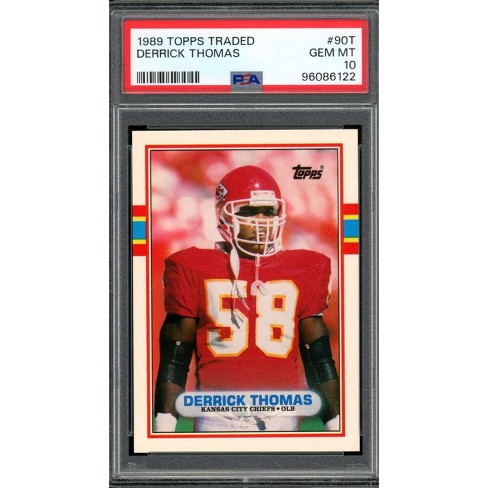
In the pantheon of football card collecting, few rookie cards command the same reverence as the 1989 Topps Traded #90T featuring Derrick Thomas. Three decades after its release, this card remains a cornerstone of vintage football collecting—not just for its aesthetic appeal, but for the indelible legacy it represents. It’s not merely a piece of cardboard; it’s a tangible artifact of one of the most electrifying pass-rushers in NFL history. Yet, its enduring allure extends beyond nostalgia. Collectors still chase this card with fervor, and their fascination reveals something deeper about the psychology of collecting, the mythology of sports icons, and the timeless allure of the “what if” in athletic greatness.
The Derrick Thomas rookie card isn’t just sought after because it’s old. It’s coveted because it encapsulates a moment frozen in time—a snapshot of potential unfulfilled, of a career that blazed bright but was tragically cut short. That tension between promise and reality is what makes this card resonate so deeply. Collectors aren’t just buying cardboard; they’re investing in a story, a myth, a fleeting glimpse of greatness that continues to haunt and inspire long after the final whistle.
The Card That Captured Lightning in a Bottle
The 1989 Topps Traded set was designed to highlight rising stars, and Derrick Thomas—drafted fourth overall by the Kansas City Chiefs out of Alabama—was the crown jewel. His rookie card, #90T, features a dynamic action shot of Thomas mid-sack, his arms outstretched like a predator poised to strike. The image is kinetic, almost violent in its energy, mirroring the way Thomas dismantled offensive lines with relentless speed and power. The card’s design is quintessential late-80s Topps: bold colors, sharp angles, and a glossy finish that makes the image pop off the cardboard.
What makes this card visually compelling isn’t just its design, though. It’s the way it captures Thomas in his prime—before injuries, before the weight of expectations, before the world knew the full scope of his talent. The card feels alive, as if Thomas could leap off the shelf and sack a quarterback at any moment. That immediacy is part of its magic. It’s not a static portrait; it’s a moment suspended in time, a glimpse of a player who seemed destined to redefine the defensive end position.
Collectors often remark on how the card’s artwork feels almost prophetic. Thomas did go on to have a Hall of Fame-caliber career—racking up 72.5 sacks in just 11 seasons before a tragic spinal cord injury ended his life prematurely at age 33. The card, in hindsight, feels like a premonition of greatness, a visual omen of the legacy he would leave behind. That layer of foreshadowing adds a haunting depth to the collecting experience. It’s not just about owning a piece of history; it’s about holding a relic that seems to whisper, “This is what could have been.”
The Rarity Factor: Why Supply Meets Demand
At first glance, the 1989 Topps Traded #90T doesn’t scream “rare.” After all, Topps produced millions of cards in the late 80s, and rookie cards from that era are hardly scarce. Yet, the Derrick Thomas card occupies a unique space in the market. High-grade copies—especially those graded PSA 10—are notoriously difficult to find. The card’s paper stock, while durable, was prone to wear, and finding one in pristine condition requires a perfect storm of luck and preservation.
This scarcity isn’t just a numbers game. It’s a reflection of the card’s cultural footprint. The Thomas rookie card was a must-have for Chiefs fans in 1989, and many were tucked away in shoeboxes, binders, or under mattresses for decades. The ones that survived untouched are the ones that fetch top dollar today. A PSA 10 recently sold for over $1,200, a figure that would have stunned collectors in the early 90s but feels almost modest given the card’s significance.
But rarity alone doesn’t explain the frenzy. What truly drives demand is the card’s role as a gateway to a larger narrative. Collectors aren’t just chasing cardboard; they’re chasing a piece of a story that transcends sports. The Thomas card is a bridge between eras—a tangible link to a time when football cards were still a primary way fans connected with their heroes. In an age of digital highlights and NFTs, the tactile nature of this card makes it feel sacred, a relic from a purer time when collecting was about passion, not investment portfolios.
The Myth of the Unfulfilled Legend
Perhaps the most compelling reason collectors are drawn to the Derrick Thomas rookie card is the shadow of “what if.” Thomas’s career was cut short not by a decline in skill, but by a freak accident during a charity basketball game in 1999. The irony is almost cruel: a man who spent his life sacking quarterbacks was felled by a spinal injury on the court. His death at 33 cemented his status as a tragic hero, a figure whose potential was never fully realized.
This narrative of unfulfilled destiny is a powerful force in collecting. Cards like Thomas’s—those tied to players whose lives or careers were tragically interrupted—often become the most sought-after. Think of the Bo Jackson rookie card, or the Pete Reiser cards from the 1940s. These aren’t just collectibles; they’re memorials. They force collectors to confront the fragility of greatness, the way even the most dominant athletes are subject to the whims of fate.
The Thomas card, in particular, carries an added layer of poignancy because of his impact on the field. He was a five-time Pro Bowler, a two-time First-Team All-Pro, and the NFL’s sack leader in 1990. His 1990 season—when he recorded 20 sacks in just 14 games—remains one of the most dominant defensive performances in modern history. The card, then, isn’t just a relic of a great player; it’s a reminder of a career that could have been even greater. That tension between what was and what might have been is what gives the card its emotional weight.
The Investment Angle: More Than Just a Card
Of course, no discussion of collectible cards would be complete without addressing the elephant in the room: money. The Derrick Thomas rookie card is, undeniably, a sound investment. High-grade copies have appreciated steadily over the years, and with the resurgence of vintage football cards in the collecting market, its value is likely to continue climbing. But to reduce the card’s appeal to mere financial gain is to miss the point entirely.
Collectors who chase the Thomas rookie card aren’t doing it solely for profit. They’re doing it because the card represents something ineffable—a connection to a player who embodied the raw, unbridled energy of the late 80s NFL. In an era before social media and highlight reels, football cards were one of the few ways fans could engage with their favorite players on a personal level. The Thomas card, with its dynamic action shot and bold design, feels like a direct line to the player himself. It’s a way to hold a piece of history in your hands.
Moreover, the card’s investment potential is a byproduct of its cultural significance, not the other way around. The more collectors value the story behind the card, the more its market value rises. It’s a self-fulfilling prophecy: the more people are drawn to the Thomas card, the more valuable it becomes, and the more valuable it becomes, the more people are drawn to it. This cyclical nature is what makes the card so fascinating to study. It’s not just a collectible; it’s a cultural phenomenon.
The Legacy Lives On
Today, the Derrick Thomas rookie card remains a touchstone for Chiefs fans, football historians, and collectors alike. It’s a reminder of a time when the NFL was still a regional sport, when players like Thomas could rise from college football obscurity to become household names. It’s a testament to the power of sport to captivate and inspire, even decades after the final play.
But perhaps most importantly, the card endures because it forces us to confront the impermanence of greatness. Derrick Thomas’s life and career were cut short, but his legacy lives on through the cards that bear his image. Each time a collector holds a Thomas rookie card, they’re not just holding cardboard—they’re holding a piece of a story that refuses to be forgotten. They’re holding a fragment of lightning in a bottle, a fleeting glimpse of greatness that continues to illuminate the world of collecting.
In a hobby often driven by nostalgia and speculation, the Derrick Thomas rookie card stands apart. It’s not just a card. It’s a relic, a memorial, a story waiting to be told. And as long as there are collectors who believe in the power of sport to transcend time, this card will continue to be chased, cherished, and revered.









