
Baseball cards are more than just cardboard and ink—they’re time capsules, frozen moments where the crack of a bat, the roar of the crowd, and the sweat of a player’s brow are distilled into a collectible artifact. Among the pantheon of vintage cardboard, the cards of Matt Williams stand as a peculiar enigma. Once a household name in the late 1980s and early 1990s, Williams was a powerhouse third baseman whose prodigious home runs and clutch hitting made him a fan favorite. Yet, decades later, his baseball card value remains curiously understated, often overshadowed by contemporaries like Ken Griffey Jr. or Barry Bonds. Is this oversight a reflection of shifting collector priorities, or is there something deeper—something almost poetic—in the way Williams’ legacy has faded from the spotlight?
To understand why Matt Williams’ baseball cards haven’t achieved the same stratospheric values as his peers, we must first examine the broader context of the baseball card market. The late 1980s and early 1990s were a golden era for cardboard, marked by the explosion of the junk wax era—a time when production numbers soared, and cards flooded the market. For every iconic rookie card, there were a dozen forgettable commons, their value diluted by sheer volume. Williams’ cards, while solid, were never the crown jewels of that era. His 1987 Topps rookie card, for instance, is a handsome piece of cardboard, but it lacks the rookie-year hype of a Griffey or the rookie-card scarcity of a Frank Thomas. In a market saturated with stars, Williams was a bright comet—visible, but not singular.
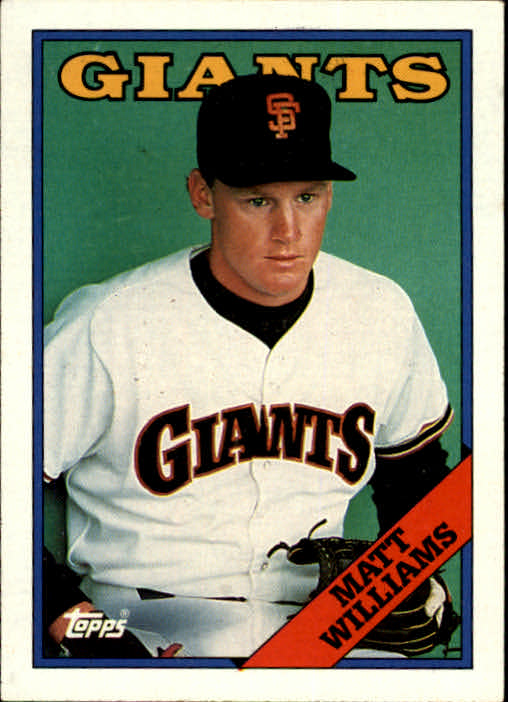
Yet, Williams’ career trajectory alone should have elevated his cards to greater heights. A five-time All-Star, a Silver Slugger winner, and a member of the 1994 Giants team that nearly won the World Series, he was undeniably elite. His 1994 season, cut short by the strike, saw him lead the league in home runs (43) and RBIs (123) before the season’s abrupt end—a statistical anomaly that only added to his mystique. If cards were purely a reflection of on-field performance, Williams’ cardboard would be far more coveted. But baseball cards are as much about narrative as they are about numbers. And here lies the crux of Williams’ underrated status: his story is compelling, but it lacks the mythic grandeur of a tragic hero or the underdog triumph of a lesser-known player.
Consider the cards of players like Kirby Puckett, whose 1984 Topps rookie card now sells for thousands, or Tony Gwynn, whose 1983 Fleer rookie is a blue-chip investment. Both players had Hall of Fame careers, but their cards also benefited from cultural narratives—Puckett’s Minnesota Twins legacy, Gwynn’s San Diego Padres loyalty, and their roles in defining an era. Williams, by contrast, played for three teams (Giants, Indians, Diamondbacks) and never became the face of a franchise in the same way. His career, while stellar, was marked by consistency rather than spectacle. He wasn’t the flashy newcomer, nor was he the aging legend clinging to relevance. He was the steady hand, the reliable run producer—a player whose greatness was undeniable but not cinematic.
This brings us to a fascinating paradox in the baseball card market: the tension between performance and persona. Cards of players like Williams, who excelled without cultivating a larger-than-life persona, often struggle to achieve premium values. The market thrives on stories—on the myth of the prodigy, the redemption arc, or the untimely decline. Williams’ career, while impressive, doesn’t fit neatly into these archetypes. His 1990s Giants tenure was marked by near-misses in the postseason, and his later years with the Diamondbacks were overshadowed by the rise of Randy Johnson and Curt Schilling. He was, in many ways, the quintessential “good player on a great team,” a role that rarely translates to individual card desirability.
Another layer to this underappreciation is the shifting demographics of the collector base. Modern collectors, particularly younger ones, are often drawn to cards that evoke nostalgia or represent cultural touchstones. Williams’ peak years coincided with the rise of the steroid era, a period now viewed with a mix of fascination and skepticism. While Williams himself was never linked to performance-enhancing drugs, the era’s taint has cast a long shadow over many of its stars. Collectors today may gravitate toward pre-steroid-era icons or post-steroid clean-cut players, leaving those who thrived in the gray area of the late 1980s and early 1990s in a kind of limbo.

Yet, for those who take the time to dig deeper, Williams’ cards offer a quiet allure. His 1990 Fleer Ultra card, with its sharp action shot, captures a moment of pure athleticism—a frozen instant where Williams’ powerful swing is mid-air, his body coiled with potential energy. The design of the card, with its glossy finish and bold colors, reflects the optimism of the era, a time when baseball cards were as much about style as they were about statistics. In an age where modern cards are often criticized for their sterile, mass-produced aesthetics, Williams’ vintage cards feel alive with character.
There’s also something inherently bittersweet about Williams’ legacy. His 1994 season, so promising before the strike, remains one of the great “what ifs” in baseball history. Had the season continued, Williams might have entered the record books in a more definitive way. Instead, his career became a study in near-greatness—a player who was always on the cusp of something greater but never quite reached the pinnacle. This narrative of potential unfulfilled is a powerful one in collecting circles. It’s the same pull that draws collectors to cards of players like Dave Stieb or Kevin Mitchell, whose careers were marked by flashes of brilliance rather than sustained dominance.
For the astute collector, Matt Williams’ cards represent an opportunity to acquire a piece of baseball history that is undervalued precisely because it doesn’t fit the mold of the market’s darlings. His 1989 Score card, with its bold red and blue design, or his 1993 Bowman card, with its dynamic action pose, are not just collectibles—they’re artifacts of a bygone era, when baseball was still the national pastime and cards were a child’s window into the game. In a market that increasingly chases the next big thing, Williams’ cards offer a chance to own a piece of history that is quietly, unassumingly beautiful.
So, are Matt Williams’ baseball cards underrated or forgotten? The answer, as with so many things in collecting, is a matter of perspective. They may not command the prices of a Griffey or a Bonds, but they hold a different kind of value—one rooted in authenticity, in the quiet dignity of a career well-played. In a hobby that often prioritizes hype over substance, Williams’ cards are a reminder that greatness doesn’t always announce itself with fanfare. Sometimes, it’s found in the overlooked, the understated, the steady. And in that, there’s a kind of magic all its own.









