
In the hallowed halls of baseball card collecting, few pieces of cardboard command the reverence of the 1954 Topps Ernie Banks rookie card. It’s not just a card—it’s a relic, a time capsule, a silent witness to the dawn of a legend. When you hold one, you’re not just touching paper and ink; you’re brushing against the very fabric of history, where a young, ebullient shortstop from Dallas would soon redefine what it meant to play the game with joy. The 1954 Topps Ernie Banks rookie card isn’t merely collectible; it’s a promise—a promise of greatness, of sunshine in the bleachers, of a swing so pure it could melt winter’s chill. It whispers of a time when baseball was as much about character as it was about statistics, and when one man’s smile could light up an entire franchise.
But why does this card, in particular, stand as a lodestar in the vast constellation of vintage cardboard? What alchemy of timing, talent, and tenacity transformed a simple piece of sports memorabilia into a cultural artifact? To understand its magic, we must step back into the early 1950s—a period when baseball was America’s pastime, and the Topps Company was just beginning its reign as the king of the bubblegum card empire. The 1954 set, with its bold colors and innovative design, was a gamble that paid off in spades. And at the center of it all stood Ernie Banks, the man who would become known as “Mr. Cub,” not just for his 512 home runs, but for the way he played the game—with an unshakable optimism that seemed to defy the very notion of a bad day.
The Genesis of a Legend: Ernie Banks and the 1954 Topps Revolution
Ernest Banks arrived in Chicago in 1953, fresh off a stellar rookie season with the Kansas City Monarchs of the Negro Leagues. The Cubs, desperate for talent and starved for excitement, purchased his contract for a mere $20,000—a pittance for the player who would become one of the game’s most beloved figures. Banks was a revelation: a switch-hitting shortstop with power to spare, a cannon for an arm, and a grin that could disarm even the sternest critic. His arrival coincided with a pivotal moment in baseball history—the integration of the major leagues was still in its infancy, and Banks, along with Willie Mays and Hank Aaron, was helping to redefine what it meant to be a Black athlete in a rapidly changing America.
The 1954 Topps set was a bold departure from the staid, monochrome designs of the past. Topps, in its second year of producing baseball cards, introduced full-color photography, a larger format, and a distinctive horizontal layout. The Ernie Banks rookie card, numbered #94 in the 567-card set, captured him mid-swing, his body coiled with potential energy, his eyes locked on the pitch. The background was a vibrant yellow, a color that seemed to radiate warmth and optimism—fitting, given Banks’ reputation as baseball’s eternal sunshine. The card wasn’t just a portrait; it was a manifesto. It declared that baseball could be fun, that players could be heroes, and that the future was bright.

The Card’s Design: A Masterclass in Visual Storytelling
The genius of the 1954 Topps design lies in its simplicity and its audacity. In an era when most cards were small, rectangular, and often drab, Topps dared to go big—literally. The 1954 cards measured a generous 2.5 inches by 3.5 inches, a size that allowed for greater detail and a more immersive visual experience. The horizontal orientation of the Banks card, with its sweeping composition, draws the eye across the image, from the bat’s graceful arc to the player’s focused expression. It’s a snapshot of a moment, frozen in time, yet brimming with motion.
The color palette is another stroke of brilliance. The yellow background isn’t just a backdrop; it’s a character in its own right. It evokes the golden glow of a summer afternoon at Wrigley Field, the warmth of a Chicago summer, the optimism of a city that had just emerged from the shadows of World War II. The red and blue accents—used sparingly but effectively—add a touch of vibrancy without overwhelming the viewer. And then there’s Banks himself, clad in the Cubs’ iconic blue and red, his uniform crisp and his posture confident. The card doesn’t just show a player; it captures a spirit.
For collectors, the design of the 1954 Topps set was a revelation. It wasn’t just a card; it was a piece of art. And like all great art, it demanded to be seen, to be held, to be experienced. The Ernie Banks rookie card, in particular, stands out because it doesn’t just depict a player—it encapsulates an era. It’s a bridge between the old world of baseball and the new, a tangible link to a time when the game was as much about personality as it was about performance.
The Rarity Factor: Why This Card Is a Holy Grail
Rarity is the lifeblood of collectibles, and the 1954 Topps Ernie Banks rookie card is a rare beast indeed. In 1954, Topps produced approximately 1.2 million cards in total, but the distribution was uneven. The set was printed in multiple series, and the Banks card, being part of the later series, was printed in smaller quantities than the early stars like Mickey Mantle and Ted Williams. This scarcity, combined with the fact that many cards were discarded, lost, or damaged over the decades, makes high-grade examples exceptionally difficult to find.
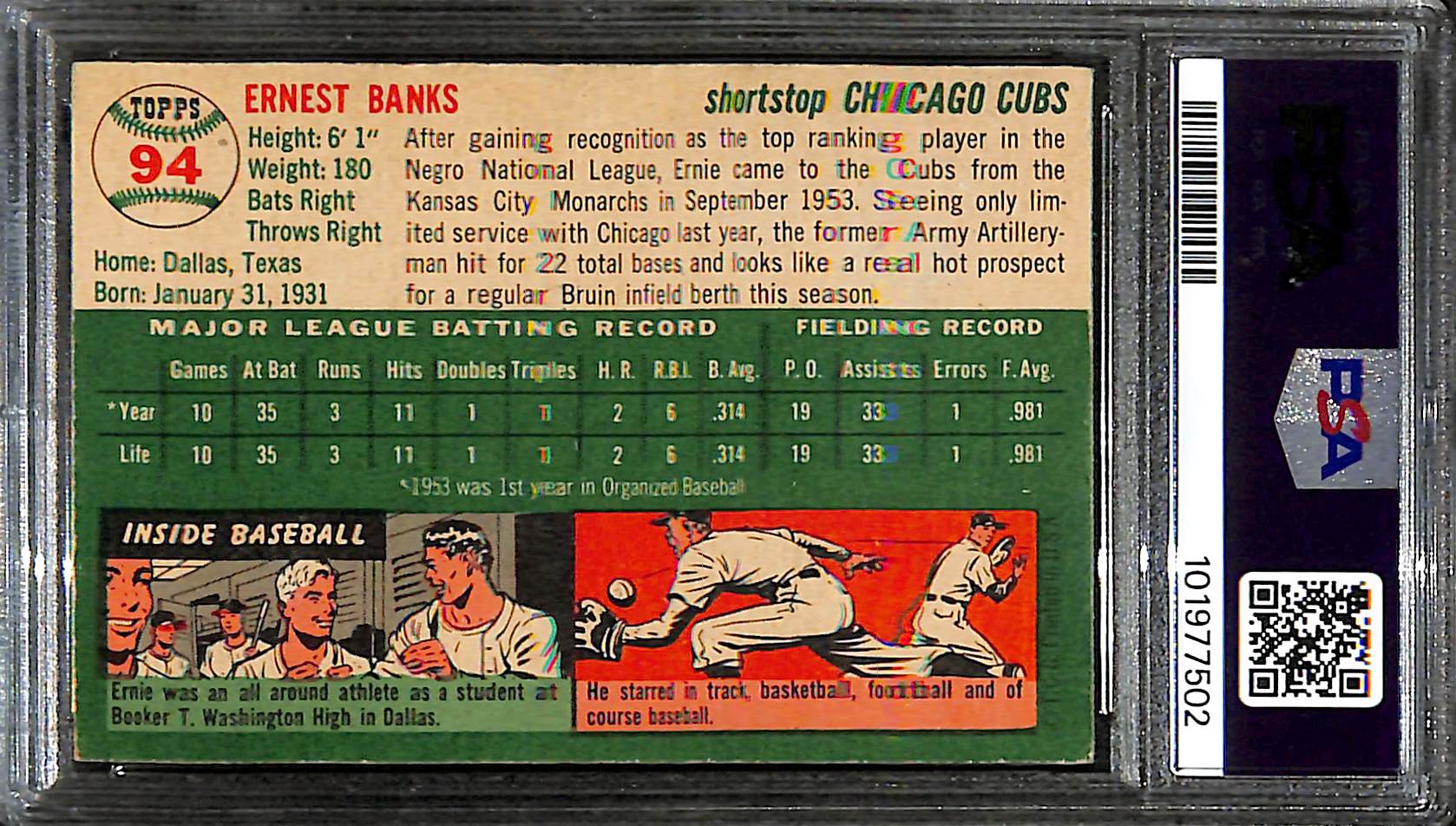
Graded cards tell a story of survival. A PSA 5, like the one offered in the auction, is a testament to the card’s journey through time. It’s survived the sticky fingers of childhood, the shuffling of shoeboxes, the occasional spill of soda or the crush of a collector’s album. A grade of 5 on the PSA scale means the card is well-centered, with only minor wear, and a surface that’s mostly intact. It’s not perfect—nothing ever is—but it’s close enough to evoke the thrill of holding a piece of history that’s stood the test of time.
The Legacy of Mr. Cub: Beyond the Card
Ernie Banks’ legacy is woven into the very fabric of baseball. He was more than a player; he was an institution. For 19 seasons, all with the Cubs, Banks embodied the spirit of the game. He played in an era when shortstops were expected to be defensive anchors, but Banks brought an offensive flair that redefined the position. He hit 512 home runs, won two MVP awards, and, most importantly, he never lost his smile. Even in the face of the Cubs’ decades-long postseason drought, Banks remained a beacon of hope, a reminder that baseball was about more than just wins and losses.
The 1954 rookie card is more than a collectible; it’s a symbol of that legacy. It’s a reminder of the man who said, “It’s a beautiful day for a ballgame, let’s play two,” and meant it. It’s a nod to the player who could turn a double play with the grace of a dancer and hit a home run with the power of a titan. And it’s a tribute to the fans who, generation after generation, have found solace and joy in the story of Mr. Cub.
For many collectors, owning the 1954 Topps Ernie Banks rookie card is a rite of passage. It’s a way to connect with the past, to feel the pulse of a game that has captivated hearts for over a century. It’s a piece of Americana, a tangible link to a time when baseball was the national pastime and heroes were made on dusty diamonds, not on highlight reels.
The Market’s Pulse: Why This Card Still Commands Respect
The collectibles market is a fickle beast, but some cards remain impervious to its whims. The 1954 Topps Ernie Banks rookie card is one of them. Despite fluctuations in the market, high-grade examples continue to fetch impressive sums at auction. Why? Because demand outstrips supply, and because the card’s cultural significance ensures it will always be in demand.
In recent years, the market for vintage baseball cards has seen a surge in interest, driven by a new generation of collectors who view cards not just as investments, but as artifacts of cultural history. The Ernie Banks rookie card, with its iconic design and storied past, fits perfectly into this narrative. It’s not just a card; it’s a story. And stories, especially those tied to legends like Banks, have a way of transcending time.
For investors, the card represents a rare opportunity to own a piece of baseball history that’s likely to appreciate over time. For purists, it’s a chance to hold a piece of the game’s soul. And for fans, it’s a way to keep the spirit of Mr. Cub alive, one card at a time.
The 1954 Topps Ernie Banks rookie card is more than a collectible; it’s a promise kept. It’s a promise that baseball will always have heroes, that the game will always find a way to inspire, and that the joy of the diamond will never fade. When you hold this card, you’re not just holding cardboard and ink—you’re holding a piece of history, a fragment of a time when a young shortstop from Dallas stepped onto the field and changed the game forever. And that, in the end, is why this card remains one of the most iconic in all of sports memorabilia.









