Baseball’s evolution into a data-driven spectacle has given rise to metrics that dissect defensive brilliance with surgical precision. Among these, Outs Above Average (OAA) stands as a beacon, illuminating the often-overlooked artistry of fielders who transform potential hits into outs. Unlike traditional statistics that merely tally errors or putouts, OAA contextualizes a player’s defensive impact by comparing their actual performance against the league average for similar plays. This metric doesn’t just quantify skill—it narrates the untold stories of diving catches, razor-sharp reactions, and the uncanny ability to anticipate a batter’s intentions before the ball is even struck. For fans and analysts alike, OAA transforms the field into a stage where defensive prowess is not just seen but celebrated in vivid detail.
The Anatomy of OAA: How It Deciphers Defensive Mastery
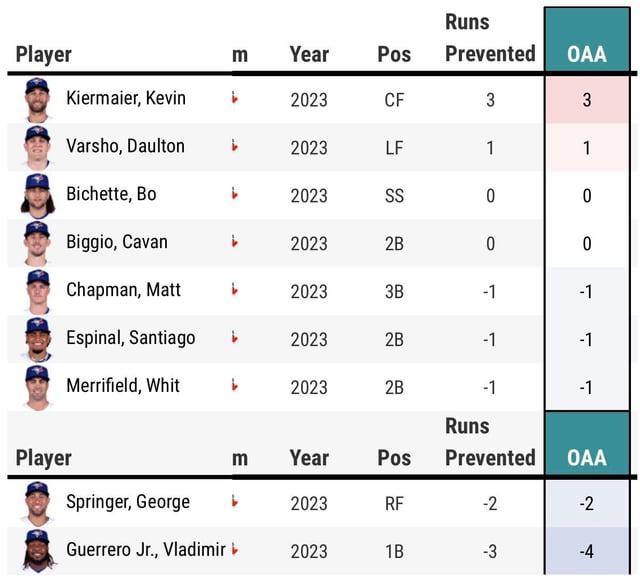
At its core, Outs Above Average is a defensive metric that measures a player’s ability to convert batted balls into outs beyond what an average fielder would achieve in the same situation. The calculation hinges on a complex interplay of data points: the trajectory of the ball, the fielder’s positioning, the speed of the batter, and even the environmental conditions like wind and altitude. Each play is assigned a probability of becoming an out based on historical data, and OAA quantifies how often a fielder exceeds these expectations. For instance, a shortstop who leaps to his right to snare a line drive that would typically fall for a hit doesn’t just earn a highlight-reel play—he accrues OAA points that reflect his defensive acumen. This metric levels the playing field, allowing players in less glamorous positions to shine alongside the flashy outfielders who make the SportsCenter Top 10.
The beauty of OAA lies in its granularity. It doesn’t just reward the flashy one-handed grabs or the improbable over-the-shoulder catches; it also acknowledges the subtle, game-saving plays—the infielder who charges a slow grounder to prevent an extra-base hit, or the corner outfielder who tracks down a sinking liner in the gap. By isolating these moments, OAA provides a nuanced portrait of defensive excellence, one that transcends the binary of “error” or “no error” to reveal the true impact of a fielder’s actions.
Visualizing OAA: The Art of Defensive Storytelling
While raw numbers tell a story, visuals bring it to life. The OAA highlight reel is a cinematic experience, where each clip is a testament to the fielder’s spatial awareness and reflexive genius. Imagine a center fielder sprinting toward the warning track, his eyes locked on a towering fly ball, only to adjust mid-stride as the wind carries it just out of reach—only for him to make an acrobatic leap to snag it at the last second. This isn’t just a catch; it’s a defensive masterclass, and OAA quantifies the improbability of the play. These visuals don’t just entertain; they educate, offering fans a deeper appreciation for the athleticism and strategy that define elite defense.
The power of visualization extends beyond the highlight reel. Advanced tracking systems, such as Statcast’s fielding metrics, overlay OAA data onto video footage, creating a layered narrative where every movement is dissected. These visualizations highlight the fielder’s positioning before the pitch, their first step in response to the batter’s swing, and the precise moment of contact between glove and ball. For coaches and players, this feedback loop is invaluable, allowing them to refine their approach and turn potential weaknesses into strengths. For fans, it’s a window into the hidden intricacies of the game, where every play is a puzzle solved in real time.
Position-Specific OAA: Where the Metric Shines Brightest
Outs Above Average isn’t a one-size-fits-all metric; its value varies dramatically depending on the position. For outfielders, OAA often becomes a measure of raw athleticism and range, where the ability to cover ground and make highlight-reel catches can single-handedly shift the momentum of a game. A center fielder with a +20 OAA over a season isn’t just a defensive asset—he’s a run-preventer, a player whose mere presence on the field deters opposing hitters from taking aggressive approaches.
In the infield, OAA takes on a different flavor. For middle infielders like shortstops and second basemen, the metric emphasizes quick reflexes, precise footwork, and the ability to turn double plays with surgical efficiency. A second baseman who ranges far to his right to rob a right-handed hitter of a base hit doesn’t just save a run; he disrupts the opposing team’s offensive rhythm. Meanwhile, corner infielders—first and third basemen—are judged on their ability to handle hard-hit balls, whether it’s a diving stop at first or a backhanded grab at third to prevent a run from scoring. OAA rewards these players for their consistency, turning routine plays into defensive gold.
Even catchers, often overlooked in defensive discussions, have their own OAA narrative. While their primary contributions lie in pitch-framing and throwing out baserunners, OAA can also capture their ability to block pitches in the dirt or make quick, accurate throws to second base to cut down a runner. In an era where every run counts, these plays are the unsung heroics that often go unnoticed—until the OAA stat brings them into the spotlight.
OAA in the Context of Modern Baseball Strategy
The rise of OAA has fundamentally altered how teams approach defensive alignment and player development. Gone are the days when a player’s defensive value was judged solely by errors or fielding percentage. Today, front offices use OAA to identify undervalued defenders, target mid-tier free agents with elite defensive metrics, or even shift their defensive alignments based on the tendencies of opposing hitters. A team with multiple players posting high OAA scores in the outfield might opt for a more aggressive shift, knowing their defenders can cover the gaps left by the alignment.
For players, OAA has become a roadmap to defensive improvement. Young infielders study their OAA breakdowns to identify areas where their footwork or first-step quickness lags behind the league average. Outfielders analyze their route efficiency, using OAA data to refine their paths to fly balls and reduce the number of extra-base hits allowed. Even established veterans turn to OAA to extend their careers, fine-tuning their positioning and reactions to compensate for the natural decline in athleticism. In this way, OAA isn’t just a stat—it’s a tool for evolution, pushing the boundaries of what’s possible on the defensive side of the game.
The metric has also reshaped how fans engage with the sport. Social media platforms now feature OAA-driven content, from viral clips of jaw-dropping defensive plays to in-depth breakdowns of a player’s defensive range. Fantasy baseball enthusiasts pore over OAA data to identify sleepers who might not light up the box score but are quietly saving their teams runs through their glove work. Broadcasters, too, have embraced OAA, using it to add context to plays that might otherwise be dismissed as routine. A diving stop that prevents a double? That’s not just a great play—it’s a +1.5 OAA moment.
The Future of OAA: Where Technology and Tradition Collide
As technology advances, so too will the capabilities of OAA. Machine learning algorithms are already being trained to predict defensive outcomes with even greater accuracy, incorporating variables like player fatigue, weather patterns, and even the psychological state of the batter. Imagine a future where OAA isn’t just a retrospective stat but a predictive tool, helping managers decide whether to pull a pitcher early or shift their infield based on real-time defensive probabilities. The integration of augmented reality could allow fans to overlay OAA data onto live games, turning every defensive play into an interactive learning experience.
Yet, for all its sophistication, OAA remains rooted in the timeless essence of baseball. The metric doesn’t just quantify defense—it celebrates the human element of the game, the split-second decisions and athletic feats that have defined baseball for over a century. In an era where home runs and strikeouts dominate the headlines, OAA reminds us that the game is still won and lost in the dirt, where fielders turn potential hits into outs with a blend of instinct, preparation, and sheer willpower.
As the 2024 season unfolds, keep an eye on the OAA highlight reels. They’re not just a showcase of defensive brilliance—they’re a testament to the enduring magic of baseball, where every out is a story, and every fielder is the hero of their own highlight reel.