The crack of the bat, the roar of the crowd, the tension in the air—baseball is a sport of patience, strategy, and precision. Yet, in the heart of the ninth inning, when the game hangs in the balance, there exists a moment so audacious, so counterintuitive, that it defies the very essence of the sport. This is the tale of the “wave” that begins at the most inappropriate time: the bottom of the ninth, with a tying run on base. It is a story of chaos and control, of desperation and daring, where the unexpected becomes the only path to victory.
The Anatomy of a Perfect Storm: When Timing Betrays Logic
Baseball is a game of rhythm. The steady cadence of pitches, the measured strides of base runners, the deliberate swings of batters—all follow a predictable tempo. Yet, the bottom of the ninth inning is where this rhythm fractures. The stakes are highest, the pressure is unbearable, and the margin for error is nonexistent. A tying run on base is not just a statistical anomaly; it is a ticking time bomb, a fuse lit in the darkest corner of the dugout. To unleash a “wave” of aggressive play at this juncture is to invite chaos, to shatter the delicate equilibrium that has governed the game for nine innings.
The metaphor of a wave crashing against a seawall captures this perfectly. The seawall, representing the opposing team’s defense, is fortified, immovable, a testament to their preparation. The wave, however, is not a gentle tide—it is a rogue swell, born of desperation, crashing against the wall with reckless abandon. The timing is wrong. The conditions are wrong. And yet, it is the only way forward.
The Psychology of Desperation: Why the Wave Must Begin
In the bottom of the ninth, the trailing team is not just playing for runs; they are playing for survival. The mind-set shifts from strategy to instinct. The manager, usually a paragon of calculated decision-making, becomes a gambler, betting the farm on a single roll of the dice. The players, too, are transformed. Fear and adrenaline sharpen their reflexes, blur their judgment, and push them to the edge of their physical and mental limits.
This psychological metamorphosis is what makes the “wave” so compelling. It is not a calculated play but a visceral reaction—a primal scream against the inevitability of defeat. The tying run on base is not just a runner; it is a catalyst, a spark that ignites a firestorm of aggressive base running, hit-and-run plays, and suicide squeezes. The wave begins not because it is smart, but because it is the only thing left to try.
The Dance of the Unpredictable: When Strategy Meets Serendipity
Baseball is often described as a game of inches, but in the bottom of the ninth, it becomes a game of seconds. A stolen base, a wild pitch, a bloop single—these are not just plays; they are miracles, born of chaos and chance. The “wave” is not a scripted sequence but a spontaneous combustion of talent and luck, where every decision is a gamble and every outcome is uncertain.
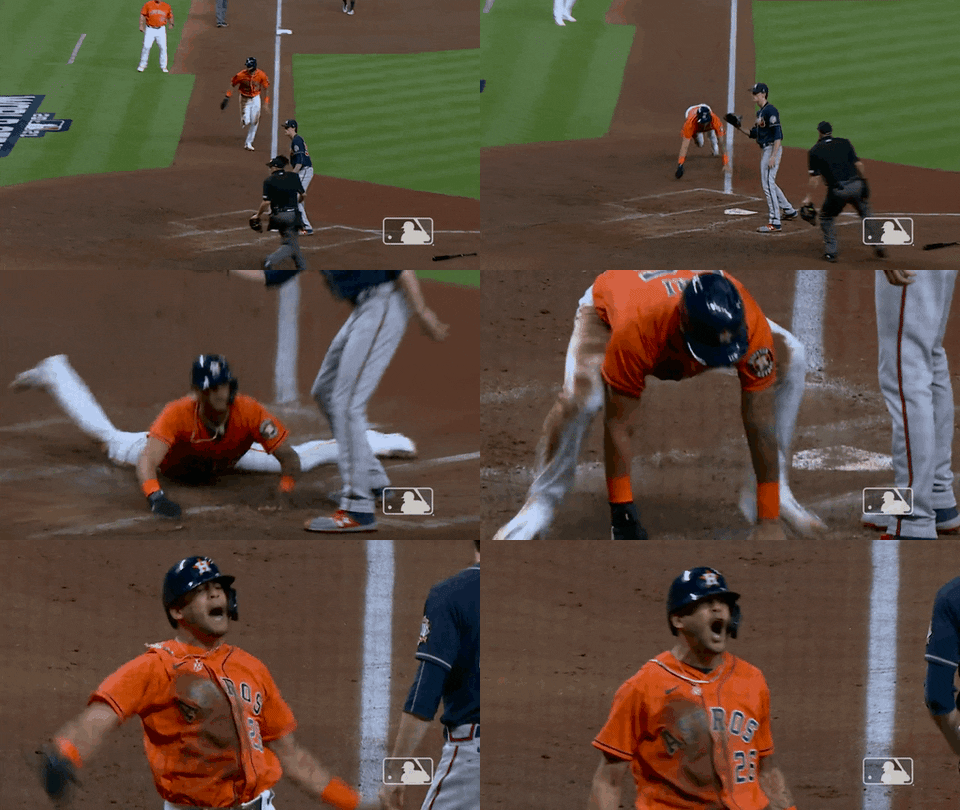
Consider the hit-and-run play. The batter must time his swing to perfection, the runner must read the pitch with split-second accuracy, and the fielders must react in an instant. Failure is catastrophic; success is euphoric. It is a high-wire act without a net, a testament to the raw, unfiltered beauty of the sport. The wave, once set in motion, is a whirlwind of motion and noise, a spectacle that defies the laws of probability.
The Art of the Improbable: When the Unthinkable Becomes Reality
History is littered with examples of the “wave” in the bottom of the ninth. The walk-off grand slam, the pinch-hit two-run double, the stolen base that leads to a game-winning run—these are not just highlights; they are legends. They are the moments that define careers, that etch themselves into the collective memory of fans, that prove that baseball is not just a sport but a theater of the absurd.
Take, for instance, the 2016 World Series, Game 7. The Chicago Cubs, down by a run in the bottom of the ninth, faced the daunting task of overcoming the Cleveland Indians. What followed was not a single play but a symphony of chaos—a wild pitch, a bases-loaded walk, and a ground ball that somehow found its way through the infield. The wave had begun, and by the time it crashed ashore, the Cubs had etched their names into history. It was not just a win; it was a resurrection.
The Aftermath: When the Wave Recedes and the Dust Settles
When the dust settles and the celebrations (or the silence) begin, the “wave” leaves behind more than just a win or a loss. It leaves behind a story, a narrative that transcends the box score. It is a reminder that baseball is not just a game of numbers but a game of human emotion, of triumph and tragedy, of the sublime and the ridiculous.
The tying run on base in the bottom of the ninth is not just a statistic; it is a crucible. It is where careers are made and broken, where legends are born and where the ordinary becomes extraordinary. The wave that begins at the most inappropriate time is not just a play—it is a metaphor for life itself, a reminder that sometimes, the only way forward is to defy the odds, to embrace the chaos, and to ride the wave, no matter how treacherous the waters may be.