There’s a peculiar irony in baseball cards. They’re tiny slices of cardboard, yet they carry the weight of nostalgia, achievement, and sometimes, staggering financial value. Among the pantheon of collectibles, Mike Piazza’s rookie card stands as a paradox—a card that oscillates between undervalued treasure and overhyped relic, depending on who you ask. To the uninitiated, it might seem like just another piece of cardboard with a player’s face printed on it. But to those who’ve spent years chasing its elusive print runs and grading reports, it’s a story of perseverance, market whimsy, and the enduring allure of baseball’s golden era.
Walk into any vintage card show, and you’ll hear whispers about Piazza’s 1993 Topps rookie card. Some collectors swear it’s a sleeping giant, poised to explode in value like a dormant volcano. Others dismiss it as a relic of the junk wax era, a mass-produced trinket that lacks the scarcity of its pre-1980s counterparts. The truth, as it often does, lies somewhere in the middle—a nuanced tale of supply, demand, and the intangible magic that turns a simple card into a cultural artifact.
The Card That Defied the Odds: A Rookie Card in a Junk Wax World
Piazza’s rookie card emerged in 1993, smack dab in the heart of the so-called “junk wax era.” This was a time when Topps churned out cards by the millions, flooding the market with glossy, forgettable pieces of cardboard. Most of these cards were printed in quantities that would make even the most optimistic collector’s eyes water—hundreds of thousands, sometimes millions, of copies flooding card shops and flea markets. In this landscape, a rookie card’s value was often measured in pennies, not premiums. Yet Piazza’s card bucked the trend.
What set Piazza apart wasn’t just his on-field prowess—though his .318 career batting average and 427 home runs certainly helped—but the timing of his arrival. He debuted in 1992, just as the baseball card industry was peaking in production but beginning to falter in relevance. The 1993 Topps set, where his rookie card resided, was one of the last gasps of the pre-internet era’s card boom. By the mid-1990s, the bubble would burst, leaving collectors drowning in unsold inventory. Piazza’s card, however, somehow avoided the fate of its peers. It wasn’t the rarest of the era, but it wasn’t the most common either. A perfect storm of factors—his rookie status, his rapid ascent to stardom, and the sheer volume of cards produced—created a delicate balance that would later define its market.

The Grading Grind: How Condition Dictates Destiny
No discussion of Piazza’s rookie card is complete without diving into the labyrinthine world of grading. In the collectibles market, condition isn’t just important—it’s everything. A PSA 10 gem mint Piazza rookie can fetch thousands, while a creased, corner-dinged example might struggle to break double digits. The difference between a 9 and a 10 on the PSA scale can mean the difference between a comfortable down payment on a house and a coffee-stained lunch receipt.
Grading services like PSA, BGS, and SGC have turned the hobby into a high-stakes game of precision. Collectors obsess over centering, surface quality, and print defects, poring over scans like art historians scrutinizing brushstrokes. For Piazza’s card, the grading process is particularly brutal. The 1993 Topps set is notorious for its print quality issues—off-center cuts, ink smudges, and paper imperfections plague many copies. A pristine Piazza rookie isn’t just a card; it’s a unicorn, a mythical beast whispered about in grading forums and auction houses alike.
The market reflects this obsession. A PSA 10 Piazza rookie has sold for over $10,000 in recent years, while a PSA 8 might linger in the $500-$1,000 range. The disparity isn’t just about aesthetics; it’s about scarcity. High-grade Piazza rookies are rarer than a no-hitter in a pitcher’s duel, and collectors know it. The grading grind isn’t just a hurdle—it’s a rite of passage, a gauntlet that separates the casual fan from the die-hard enthusiast.
The Market’s Rollercoaster: From Obscurity to Overpriced Classic?
Piazza’s rookie card hasn’t had a smooth ride in the market. Like a rollercoaster with a faulty brake system, its value has seesawed between obscurity and overinflated hype. In the early 2000s, the card was a relative bargain, trading hands for a few hundred dollars in top grades. As the vintage market heated up in the 2010s, so did Piazza’s card. Auction houses like Heritage and Goldin began featuring it prominently, and prices crept upward. By 2020, a PSA 10 was fetching $5,000 or more—a far cry from its junk wax origins.
But here’s where the story takes a twist. Some collectors argue that Piazza’s card has become overpriced, a victim of its own success. The vintage market, particularly for 1980s and 1990s stars, has seen explosive growth, with prices for icons like Ken Griffey Jr. and Derek Jeter reaching stratospheric heights. Piazza, despite his Hall of Fame credentials, hasn’t quite reached that echelon. His card’s value, while impressive, still pales in comparison to the top-tier rookies of the era. Is this a sign of market correction, or a reflection of Piazza’s relative standing in the pantheon of baseball immortals?
The answer might lie in the card’s dual identity. To some, it’s a blue-chip investment, a piece of cardboard that’s only going to appreciate. To others, it’s a sentimental keepsake, a tangible connection to a player who defined an era. The market’s perception of Piazza’s card is a Rorschach test—what you see depends on where you stand. For the investor, it’s a calculated gamble. For the fan, it’s a piece of history.
Parallels and Pedigrees: The Quest for the Ultimate Piazza
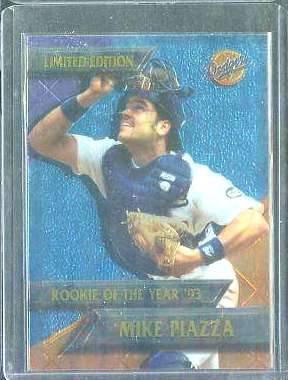
No discussion of Piazza’s rookie card would be complete without acknowledging the parallel universe of parallels. In the modern card market, parallels—alternate versions of a base card with unique design elements or serial numbering—have become a cornerstone of collecting. Piazza’s rookie card is no exception. From the flashy refractors to the numbered parallels, collectors have endless options to chase.
The most coveted of these is the 1993 Topps Gold label rookie, a shimmering gold-foil variant that’s far rarer than the base version. A PSA 10 Gold Piazza can fetch upwards of $20,000, a price tag that puts it in the same league as some of the hobby’s most elite cards. Then there are the numbered parallels, like the 1993 SPx or the Ultra Pro, which offer a more affordable entry point for collectors who want a piece of Piazza’s legacy without breaking the bank.
The allure of parallels lies in their scarcity. Unlike the base rookie, which was printed in the hundreds of thousands, parallels were often limited to a few thousand copies. This artificial scarcity drives demand, turning what might otherwise be a common card into a must-have for completists. For Piazza fans, the parallel market is a treasure hunt, a way to add depth and variety to a collection that already feels complete.
The Human Element: Why We Can’t Let Go of Piazza’s Card
At its core, the fascination with Piazza’s rookie card isn’t just about numbers or grades or market trends. It’s about the stories we attach to these pieces of cardboard. Piazza’s card represents more than just a player’s debut; it’s a snapshot of a time when baseball was changing, when the steroid era was on the horizon, and when the hobby of collecting cards was at its peak. It’s a relic of a bygone era, a tangible link to a world that feels both distant and familiar.
There’s also the intangible magic of Piazza himself. Few players have embodied the spirit of baseball’s golden age as completely as he did. His powerful swing, his effortless grace behind the plate, and his quiet leadership made him a fan favorite. Collectors who grew up watching Piazza play don’t just see a card; they see a memory. They see the crack of the bat, the roar of the crowd, the thrill of a walk-off home run. In that sense, Piazza’s rookie card is more than an investment—it’s a time capsule.
The market may fluctuate. Grading standards may evolve. But Piazza’s rookie card will always hold a special place in the hearts of collectors. It’s a reminder that baseball cards aren’t just pieces of cardboard. They’re stories waiting to be told, legacies waiting to be preserved, and dreams waiting to be chased.
So, is Mike Piazza’s rookie card a hidden gem or an overpriced classic? The answer, as it turns out, is both. It’s a card that defies easy categorization, much like the player it honors. It’s a relic of a simpler time, a trophy for the dedicated, and a canvas for the imagination. And in a hobby that’s as much about emotion as it is about economics, that might just be the most valuable thing of all.