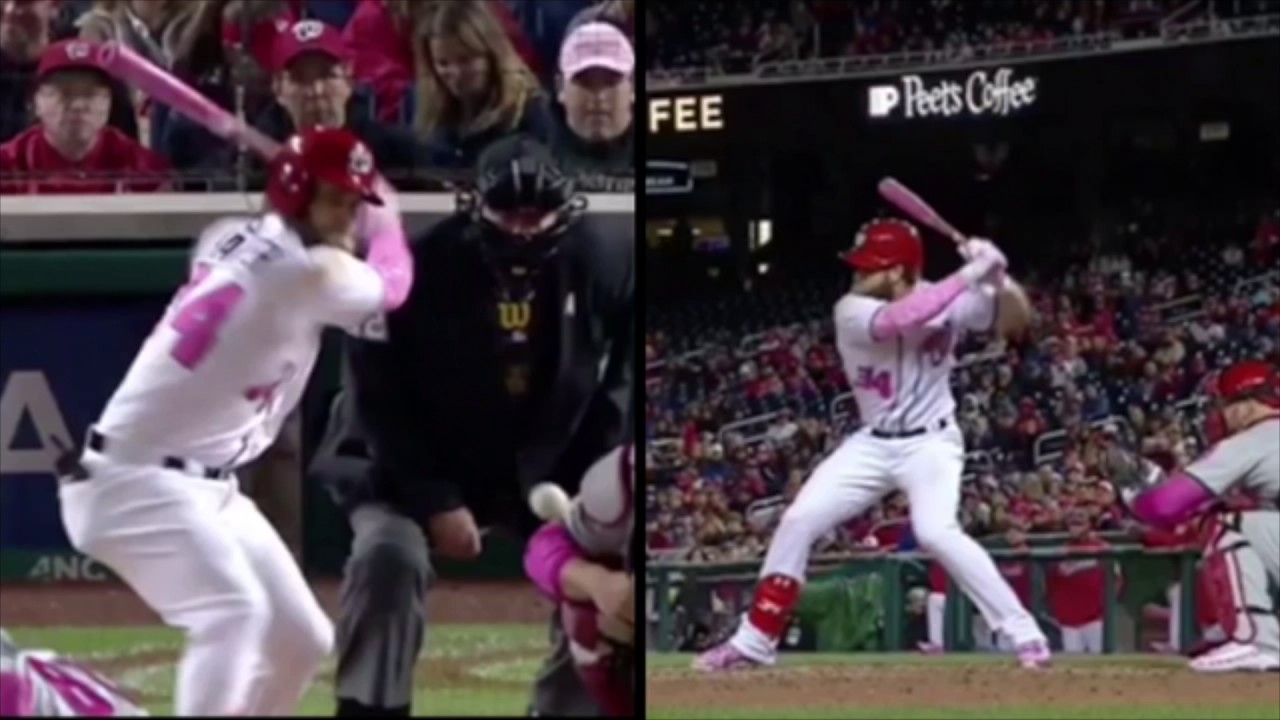
In the tapestry of Major League Baseball lore, few moments echo through the collective psyche of fans and analysts quite like a player’s signature swing. Among these, Bryce Harper’s “swing of his life” stands as a perennial point of fascination. On the surface, what seems like a simple mechanical motion at the plate invites deeper inquiry into why it captivates so many, transcending mere statistics. This narrative unravels the layers behind the swing that has become emblematic of Harper’s career and explores the intricate interplay of timing, power, and artistry that fuels baseball’s enduring allure.
The Anatomy of a Swing: More than Meets the Eye
At first glance, a baseball swing is a fluid choreography of muscles and motion, a calculated dance between batter and ball. However, Bryce Harper’s swing extends beyond biomechanical precision; it embodies an unspoken synergy of power, balance, and timing. The “swing of his life” narrative often stems from an almost mythical perception that at one pivotal moment, Harper’s motion coalesced into a flawless execution—where every kinetic element converged with the crack of the bat producing an unforgettable spectacle.
Harper’s swing is characterized by his explosive lower body, leveraging ground reaction forces to generate bat speed. What captivates observers is not just the raw power but the finesse embedded within the stroke—the subtle adjustments in his stance and the microsecond decisions that allow him to adapt to pitch type and location in real-time. This amalgamation of artistry and athleticism creates a magnetic appeal, inviting repeated viewings and dissected analyses.
Cultural Resonance and the Idolization of the Moment
The fixation on the “swing of his life” taps into a broader cultural tendency to crystallize a player’s identity around singular, transcendent moments. In baseball, where seasons consist of hundreds of games and thousands of at-bats, the collective memory often distills entire careers to emblematic snapshots. Harper’s swing is revered not only for its physical excellence but for what it represents—a moment of triumph, resilience, and raw athletic expression.
This narrative thrives within fan communities and media alike, as it humanizes a professional athlete often perceived as larger-than-life. The swing becomes a touchstone for hope and excitement, a shared experience that encapsulates the unpredictability and drama inherent in baseball. It is a reminder that amidst the grind and statistics, the sport still breathes through these electric instants.
The Psychological Undercurrents Behind Perfection
Delving deeper, the fascination with Harper’s swing also hints at the psychological dimensions of performance under pressure. The “swing of his life” is often recounted in contexts laden with high stakes—playoffs, pennant races, or game-winning moments—imbuing it with an aura of clutch capability. This convergence between skill and mental fortitude resonates profoundly, amplifying the moment’s significance.
Psychologists studying athletes underscore that moments like Harper’s iconic swings represent peak flow states—periods where a player is fully immersed, synchronized with their skills and environment. Spectators glimpse these ephemeral states, which elevate a routine physical action into a sublime display of human potential. It’s this transcendent quality that feeds the enduring allure of the “swing of his life.”
Technical Evolution: How Harper’s Swing Reflects Modern Hitting Philosophy
Harper’s swing also serves as a tangible illustration of baseball’s technical evolution. Over recent decades, hitting philosophies have pivoted toward maximizing launch angle and exit velocity, principles at the core of the so-called “home run revolution.” Harper’s swing incorporates these elements without sacrificing traditional mechanics, striking a delicate balance between innovation and classical technique.
His approach reflects a holistic understanding that power must be coupled with precision. By adjusting wrist angles and bat path, Harper exemplifies a modern slugger who can dynamically read pitch trajectories and optimize contact for distance and direction. This adaptation illustrates baseball’s ongoing dialogue between tradition and innovation, with Harper’s swing positioned as a nexus.
The Media and Fanfare: Amplifying the Legend
The proliferation of digital media has transformed how pivotal moments in baseball are consumed and mythologized. Harper’s swing has been replayed, re-analyzed, and memeified across platforms, contributing to its legendary status. This saturation fuels a feedback loop wherein each revisit intensifies the swing’s symbolic weight.
Media narratives often frame these moments with dramatic commentaries and slow-motion replays, highlighting nuances imperceptible in real time. Consequently, Harper’s swing transcends a mere athletic feat to become a cultural artifact, a visual emblem of peak baseball performance. Fans collectively participate in this myth-making, enshrining the moment within the ever-expanding lore of MLB.
Legacy and the Continual Quest for Perfection
Ultimately, the “swing of his life” narrative is inseparable from the broader human pursuit of perfection in sport. For Harper, each at-bat carries the prospect of replicating that sublime moment—a reminder that mastery is both an achievement and a continual journey. The narrative captures the paradox of baseball: a sport steeped in routine yet capable of producing flashes of transcendent brilliance.
As Harper’s career evolves, so too will the mythology surrounding his swing, inviting fresh generations of observers to witness and interpret its significance. The “swing of his life” thus remains both a historical milestone and an open question—what does ultimate hitting perfection truly look like, and how close can any athlete come to its elusive grasp?