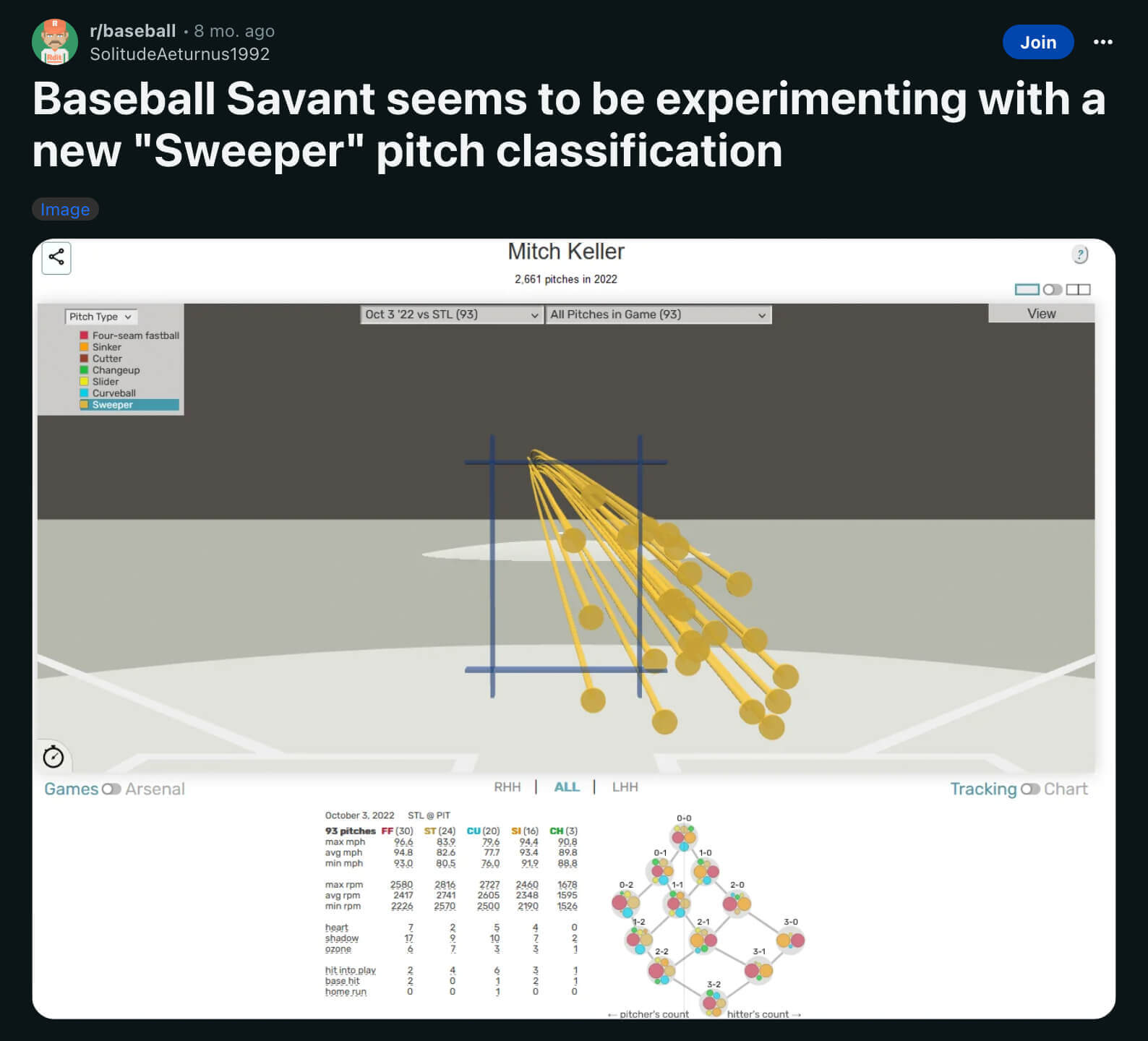
The “sweeper” has emerged as one of the most enigmatic and devastating pitches in modern baseball, a weapon that has redefined the art of pitch design. Unlike its more celebrated counterparts—the fastball, curveball, or slider—the sweeper operates in a league of its own, blending deception, physics, and sheer audacity to befuddle hitters. Its rise from obscurity to ubiquity in the MLB is a testament to the sport’s relentless evolution, where data-driven innovation collides with raw athleticism. To understand the sweeper is to peer into the intricate machinery of baseball’s pitch ecosystem, where spin, movement, and timing converge in a high-stakes game of cat and mouse.
The Genesis of the Sweeper: A Pitch Born from Necessity
The sweeper’s origins trace back to the late 20th century, when pitchers began experimenting with extreme horizontal movement to exploit the vulnerabilities of right-handed hitters. Initially dismissed as a gimmick—a glorified slider with exaggerated break—it gained legitimacy as pitchers refined its mechanics. The sweeper thrives in an era where launch angles and exit velocities dominate analytics, offering a countermeasure to the power-hitting revolution. Its defining feature is a pronounced, late-breaking horizontal movement, often exceeding 10 inches of break, which induces weak contact or whiffs. Unlike the traditional slider, which relies on a sharp downward bite, the sweeper glides laterally, mimicking the trajectory of a curveball before veering sharply away from the hitter’s barrel.
The Physics Behind the Magic: Spin, Seam, and the Magnus Effect
At the heart of the sweeper’s deception lies the Magnus effect, a phenomenon where the spin of a pitched ball creates a pressure differential, forcing it to deviate from its initial path. Pitchers manipulate this effect by altering the axis of spin, typically tilting it between 10 and 20 degrees to maximize horizontal movement. The seam orientation also plays a pivotal role; a slight adjustment in grip can transform a mediocre pitch into a weapon. High-speed cameras and TrackMan data reveal that elite sweepers generate spin rates upwards of 2,500 RPM, with a spin efficiency nearing 90%. This efficiency ensures that the ball’s energy is directed into lateral movement rather than wasted on erratic bounces. The interplay between spin axis, seam pressure, and release point creates a pitch that defies conventional expectations, often appearing as a fastball before plummeting into the zone like a falling leaf.
Grip Variations: Crafting the Perfect Sweeper
Mastering the sweeper begins with the grip, a delicate balance of pressure and finger placement. The most common variants include the “gyro-sweeper,” which features a slight tilt to enhance gyroscopic stability, and the “gyro-less sweeper,” where the spin axis is more horizontal, producing a sharper break. Some pitchers employ a modified two-seam grip, while others opt for a four-seam variant with a slight finger offset. The key is consistency; even a millimeter’s deviation in grip can alter the pitch’s movement by several inches. Pitchers like Jacob deGrom and Sandy Alcantara have perfected their sweeper grips through thousands of throws, each adjustment fine-tuned to exploit a hitter’s weaknesses. The grip is not just a starting point—it’s the foundation upon which the pitch’s entire identity is built.
Pitching Arsenal: Integrating the Sweeper into a Pitching Repertoire
A sweeper is rarely a pitcher’s sole weapon; its true power lies in its ability to complement an existing arsenal. When paired with a high-velocity fastball and a complementary breaking ball, the sweeper becomes a triple threat. The contrast in movement forces hitters to adjust their timing constantly. For instance, a pitcher might sequence a fastball up and in, followed by a sweeper low and away, exploiting the hitter’s tendency to overcommit to the first pitch. The sweeper’s late break also makes it an ideal pitch to finish an at-bat, catching hitters off guard when they least expect it. However, its effectiveness hinges on deception; if the pitcher telegraphs the pitch through body language or release point, the hitter’s reaction time becomes negligible.
Hitter’s Nightmare: The Psychological Warfare of the Sweeper
For hitters, the sweeper is a psychological minefield. The pitch’s deceptive trajectory plays tricks on the eyes, making it appear slower than it actually is. Studies show that hitters often misjudge the sweeper’s speed by up to 5 MPH, a critical miscalculation when timing is everything. The late break compounds the challenge, as the ball seems to hang in the zone before darting out of reach. Elite hitters like Aaron Judge and Mike Trout have spoken about the sweeper’s ability to disrupt their pitch recognition, forcing them to adjust their approach mid-at-bat. The pitch’s success rate against right-handed hitters is particularly striking, with whiff rates often exceeding 30% in high-leverage situations. It’s a pitch that doesn’t just challenge a hitter’s skill—it dismantles their confidence.
Data-Driven Dominance: How Analytics Have Revolutionized the Sweeper
The sweeper’s ascent to prominence is inseparable from the analytics revolution. Teams now employ machine learning algorithms to predict how hitters will react to specific pitch types, allowing pitchers to optimize their sweeper usage. Statcast data reveals that the most effective sweepers are thrown in counts where the hitter is least likely to expect a breaking ball—typically 0-2 or 1-2. The pitch’s expected weighted on-base average (xwOBA) against right-handed hitters has plummeted in recent years, dropping below .200 for some pitchers. This data-driven approach extends to pitch sequencing, where the sweeper is strategically placed to disrupt a hitter’s launch angle profile. The result is a pitch that doesn’t just get outs—it redefines the very metrics by which outs are measured.
The Future of the Sweeper: Innovation and Adaptation
As hitters adapt to the sweeper’s dominance, pitchers are already exploring new variations to stay ahead. Some are experimenting with “gyro-sweepers,” which combine high spin rates with minimal seam tilt to create a pitch that breaks late but retains a deceptive velocity. Others are blending the sweeper with the cutter, creating a hybrid pitch that merges the best of both worlds. The rise of automated pitching machines and virtual reality training has also accelerated the learning curve, allowing pitchers to refine their sweeper mechanics without the wear and tear of live game action. The sweeper’s future may even extend beyond baseball, with pitchers in other sports—such as softball and cricket—beginning to adopt its principles. One thing is certain: the sweeper is not a fleeting trend but a cornerstone of baseball’s next tactical frontier.
Conclusion: The Sweeper as a Symbol of Baseball’s Evolution
The sweeper is more than just a pitch; it’s a microcosm of baseball’s relentless innovation. It embodies the sport’s dual nature—a game where tradition and technology collide to produce something entirely new. From its humble beginnings as a pitcher’s experiment to its current status as a must-have weapon, the sweeper has redefined what it means to attack a hitter. Its success is a reminder that baseball is not just a physical contest but a cerebral one, where the battle is won in the margins of spin, movement, and timing. As the game continues to evolve, the sweeper will remain at the forefront, a testament to the enduring quest for competitive advantage in America’s pastime.