The 2001 Topps Albert Pujols rookie card isn’t just a piece of cardboard—it’s a time capsule, a silent testament to greatness that arrived before the world fully grasped its magnitude. Two decades after its release, the card remains a cornerstone of modern baseball card collecting, yet whispers persist: is it still undervalued? The answer isn’t found in raw numbers alone, but in the convergence of legacy, scarcity, and shifting market winds. To understand its true worth, we must peel back layers of history, examine the forces shaping its value today, and consider what the future might hold for this iconic piece of cardboard.
The Genesis of a Legend: Why the 2001 Topps Pujols Card Matters
Albert Pujols didn’t just debut in 2001—he erupted. As a rookie with the St. Louis Cardinals, he announced himself with a .329 batting average, 37 home runs, and 116 RBIs, capturing National League Rookie of the Year honors in a landslide. The 2001 Topps set, released in a post-strike era hungry for fresh stars, featured Pujols on card #449, a modest placement that belied his immediate impact. Unlike the high-gloss, premium rookies of the 1980s and 1990s, Pujols’ card was a standard base issue—no refractors, no autographs, no gimmicks. Yet its simplicity became its strength. In an era where rookie cards were often overproduced, Pujols’ card stood out for its authenticity, a raw snapshot of a player destined for immortality.
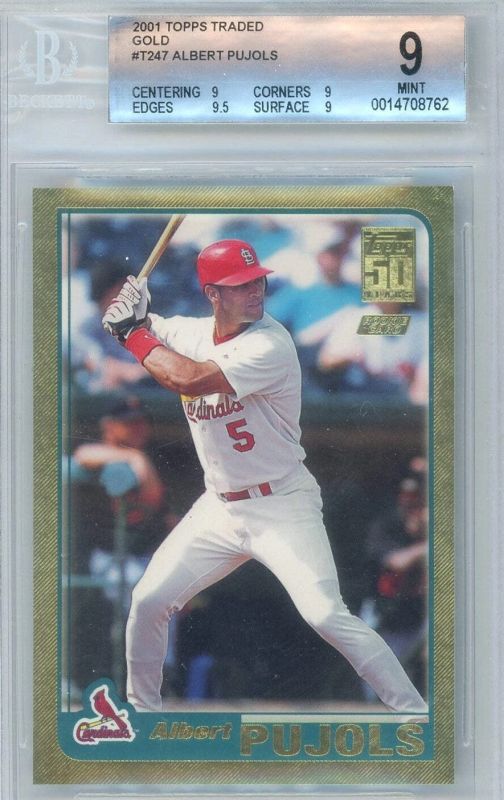
The card’s design is deceptive in its understatement. The front features Pujols in a crisp Cardinals uniform, bat resting on his shoulder, eyes locked on an unseen pitch. The back, a classic Topps checklist layout, includes a brief bio and career stats—modest details for a player who would rewrite the record books. What makes this card special isn’t its flash, but its fidelity. It captures Pujols at the exact moment the baseball world took notice, before the accolades, before the contracts, before the mythos. In collecting terms, it’s a “true rookie” in the purest sense—unaltered, unembellished, and untouched by the speculative frenzies that would later define the hobby.
The Market’s Slow Burn: Why Pujols’ Card Wasn’t Always a Blueprint
For years, the 2001 Topps Pujols rookie card was a sleeping giant. While contemporaries like Derek Jeter and Chipper Jones saw their base rookies skyrocket in value during the 1990s boom, Pujols’ card remained relatively affordable. The reasons were multifaceted. First, Topps’ production numbers for the 2001 set were staggering—millions of base cards flooded the market, diluting scarcity. Second, Pujols’ rookie year coincided with the early days of the modern collecting boom, when raw talent alone didn’t guarantee immediate financial reward. Collectors were still chasing the high of the 1980s boom, and Pujols, though dominant, wasn’t yet the household name he’d become.
The turning point arrived in the mid-2010s, as the hobby underwent a seismic shift. The rise of graded cards, the proliferation of online marketplaces, and the entry of millennial collectors with disposable income all played a role. Pujols’ card, once overlooked, began to appreciate as his legacy solidified. By 2020, a PSA 10 in NM-MT condition could fetch $500–$800, a far cry from the $50–$100 range it commanded a decade prior. But here’s the twist: even as prices rose, the card’s value trajectory lagged behind other 2001 rookies. Why? Because Pujols’ card wasn’t just about his on-field success—it was about the *perception* of his card’s role in the market.
Consider the parallel with Ichiro Suzuki’s 2001 Upper Deck rookie. Both cards were base issues from the same year, both featured future Hall of Famers, yet Ichiro’s card consistently outpaced Pujols’ in value. The difference? Ichiro’s card was part of a premium set (Upper Deck), and his cultural impact—his Japanese heritage, his relentless style—resonated more deeply with collectors. Pujols, while beloved, was seen as a “safe” investment, a card that would hold value but wouldn’t necessarily explode. That perception, however, may now be shifting.
The Grading Revolution: How PSA and BGS Changed the Game
The modern collector’s obsession with grading has redefined what it means for a card to be “undervalued.” A raw 2001 Topps Pujols card in excellent condition might sell for $100, but a PSA 10 in a holder commands $800–$1,200. The grading premium is stark, and it’s a trend that shows no signs of slowing. The reason? Scarcity. High-grade examples of the card are far rarer than the base population suggests. Many collectors from the early 2000s stored their cards carelessly, exposing them to wear, creases, or sun damage. Those that survived unscathed are now prized like buried treasure.
But grading isn’t just about condition—it’s about narrative. A PSA 10 Pujols card isn’t just a high-grade card; it’s a piece of history preserved in plastic. The grading companies have turned collecting into a science, and the 2001 Topps Pujols is a prime beneficiary. As more collectors chase the “perfect” copy, the card’s value is being recalibrated. The market is no longer just paying for the player’s legacy; it’s paying for the *integrity* of the card itself. This is a subtle but critical shift—one that could push prices even higher as the supply of high-grade copies dwindles.

The Hall of Fame Effect: How Pujols’ Legacy Fuels Demand
Albert Pujols didn’t just have a Hall of Fame career—he had one of the greatest careers in baseball history. His 703 home runs, three MVP awards, and two World Series rings cemented his place among the all-time greats. But here’s the kicker: his rookie card’s value isn’t just tied to his statistical achievements. It’s tied to the *story* of his career—the underdog narrative, the consistency, the longevity. Collectors don’t just buy Pujols’ card because he was great; they buy it because his journey mirrors the American Dream, a tale of perseverance and excellence.
The Hall of Fame induction in 2022 was a watershed moment. While Pujols’ card had already appreciated significantly by then, the induction acted as a final exclamation point on his legacy. Collectors who had held out for years finally had confirmation: Pujols wasn’t just a star; he was immortal. This psychological shift is critical. When a player enters the Hall of Fame, their rookie cards often experience a secondary surge in value, not because of new information, but because of renewed emotional connection. The 2001 Topps Pujols card is no exception. It’s no longer just a card of a great player—it’s a card of a legend.
But the Hall of Fame effect cuts both ways. For some collectors, the induction might signal a “peak” in value, a moment to take profits. For others, it’s a catalyst to acquire the card before the next generation of collectors drives prices even higher. The market is a pendulum, and right now, it’s swinging toward optimism.
The Future: Is the 2001 Topps Pujols Card Still a Sleeper?
To ask if the 2001 Topps Albert Pujols rookie card is undervalued is to ask a question that cuts to the heart of modern collecting: what is value, really? Is it the raw price of a card, or is it the intangible pull of a player’s legacy? At current market rates, a PSA 10 sells for $1,000–$1,500, while a raw NM card might fetch $200–$300. These numbers are strong, but they don’t tell the full story. The card’s true potential lies in three areas: the grading bottleneck, the generational shift in collecting, and the nostalgia factor.
First, the grading bottleneck. PSA and BGS have slowed their turnaround times, and the backlog of cards waiting to be graded is massive. For a card like Pujols’, where high-grade examples are already scarce, this means that the supply of newly graded 10s will be limited for years. As older collectors age out and younger ones enter the market, the demand for pristine copies will only grow. Second, the generational shift. Millennials and Gen Z collectors are entering their prime earning years, and they’re not just chasing the same cards as their predecessors. They’re looking for stories, for connections to players they grew up watching. Pujols’ card offers both—a direct link to a player who dominated an entire era.
Finally, nostalgia. The 2001 Topps set is a relic of a bygone era, a time before the hobby was dominated by autographs, memorabilia, and serial-numbered parallels. It’s a card that feels pure, untainted by the excesses of modern collecting. As the hobby becomes more commercialized, the appeal of a simple, iconic base rookie card will only grow. The 2001 Topps Pujols card isn’t just a piece of cardboard—it’s a time machine, a way to hold a piece of baseball history in your hands.
So, is it still undervalued? The answer depends on your perspective. If you’re looking for a quick flip, the card may not be the best bet. But if you’re a collector who values legacy, scarcity, and the intangible magic of the hobby, then the 2001 Topps Albert Pujols rookie card might just be the ultimate sleeper—a card that’s poised to rewrite its own value story in the years to come.
The 2001 Topps Albert Pujols rookie card is more than an investment. It’s a bridge between eras, a silent witness to a career that redefined excellence. As the market evolves and new collectors seek authenticity in a sea of gimmicks, this card’s star is rising—not with the flash of a refractor or the allure of an autograph, but with the quiet confidence of a legend. The question isn’t whether it’s undervalued. The question is how much higher it will go before the world finally catches up.