The golden age of baseball cards is upon us, and at the heart of this renaissance stands the indomitable Ty Cobb—baseball’s mercurial “Georgia Peach,” whose legacy isn’t just etched in Cooperstown’s halls, but now emblazoned across auction blocks and private collections with staggering financial force. The value of vintage Ty Cobb baseball cards isn’t merely climbing; it’s shattering records, redefining what it means to own a piece of America’s pastime. From the sun-bleached rookies of 1905 to the jewel-toned relics of the 1914 E98 set, each card is more than cardboard and ink—it’s a portal to a time when Cobb’s aggressive steals and .366 lifetime average made him both feared and revered. Today, these cards are not just collectibles; they’re blue-chip assets, coveted by investors and nostalgists alike, with prices that oscillate like a fastball on a humid summer night. Whether you’re a seasoned numismatist or a first-time bidder, understanding the forces behind Cobb’s soaring valuation is key to navigating this thrilling market.

The 1909–10 T206 Cobb: The Crown Jewel of the Deadball Era
Few cards command the kind of mythic aura as the 1909–10 T206 Ty Cobb, often referred to as the “Holy Grail” of vintage baseball cards. Printed during the Deadball Era—a time when strategy trumped spectacle—this card captures Cobb mid-swing, his intense gaze a precursor to the dominance he would soon unleash on opponents. What makes the T206 Cobb so extraordinary isn’t just its age, but its rarity. With an estimated 200–300 copies believed to exist today, surviving examples are rarer than a no-hitter in the modern era. In 2021, a PSA 5-grade specimen shattered expectations, selling for over $1.1 million, a figure that sent shockwaves through the hobby. But why such astronomical value? Scarcity is only part of the story. The T206 Cobb’s allure lies in its historical weight—it’s a tangible link to the infancy of the modern game, when tobacco companies first glimpsed the commercial magic of immortalizing players. Condition is everything; a card graded PSA 6 or higher can fetch seven figures, while even a mid-grade example commands six figures with ease. For collectors, owning a T206 Cobb isn’t just about investment—it’s about holding a piece of baseball’s DNA.
The 1914 E98: Cobb’s Rookie Card and the Art of the Set
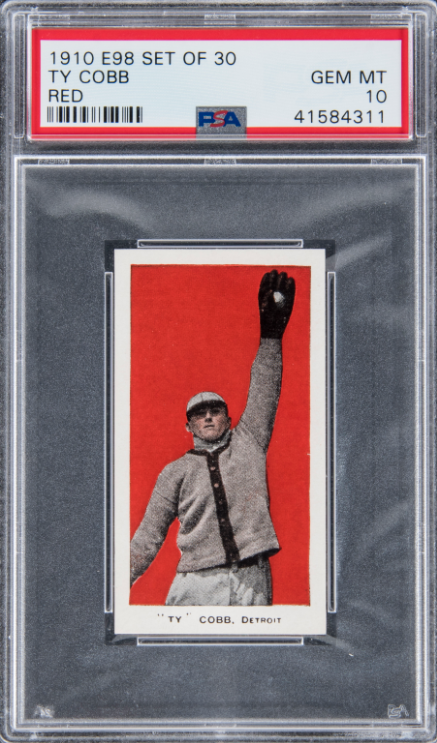
While the T206 Cobb reigns supreme in prestige, the 1914 E98 Cobb is the undisputed monarch of rookie cards—a distinction that elevates its status to near-mythic levels. Issued by the American Tobacco Company, the E98 set is a masterclass in early 20th-century lithography, with Cobb’s portrait rendered in rich, saturated hues that leap off the cardboard. Unlike the T206, which was distributed across multiple brands, the E98 Cobb was a standalone star, its singular focus amplifying its desirability. In 2023, a PSA 8 E98 Cobb—one of only six known—crossed the auction block for $2.88 million, shattering the previous record for any baseball card. What drives such fervor? The E98 Cobb isn’t just a card; it’s a cultural artifact. It represents Cobb’s rookie season, a time before he became the game’s most polarizing figure, when he was merely a 17-year-old prodigy from Narrows, Georgia. The set’s scarcity is compounded by the fragility of the era’s printing techniques, with many cards suffering from paper-thin corners and faded ink. Today, a high-grade E98 Cobb isn’t just a collectible—it’s a trophy, a status symbol, and a testament to the enduring power of Cobb’s legend.
Grading and Authentication: The Gatekeepers of Value
In the high-stakes world of vintage baseball cards, grading is the arbiter of worth. Professional grading services like PSA, BGS, and SGC act as the gatekeepers, transforming subjective condition into objective value. A Cobb card graded PSA 9 might fetch ten times the price of a PSA 5, even if the visual differences are subtle to the untrained eye. The grading process scrutinizes centering, corners, edges, surface quality, and print definition—factors that can make or break a card’s financial fate. For instance, a T206 Cobb with pristine centering and razor-sharp corners can command a premium of 30–50% over a poorly centered counterpart. Authentication is equally critical. With the rise of sophisticated forgeries, buyers must rely on expert verification to confirm a card’s provenance and legitimacy. Certificates of authenticity, pedigree research, and auction house guarantees have become non-negotiable in high-value transactions. The market rewards diligence; a Cobb card with a clean, unbroken paper trail can appreciate exponentially, while one with questionable origins risks becoming a financial albatross. For collectors, understanding grading scales and authentication protocols isn’t just savvy—it’s survival.
Market Trends: Why Cobb Cards Are Breaking Records
The meteoric rise in Ty Cobb baseball card values isn’t an isolated phenomenon—it’s part of a broader cultural and economic shift. The pandemic accelerated a generational transfer of wealth, with younger collectors and investors seeking tangible assets amid market volatility. Baseball cards, particularly those tied to Cobb’s legacy, emerged as a haven for diversification. Auction houses like Heritage and Sotheby’s have reported record-breaking sales, with Cobb cards consistently ranking among the top performers. But the trend extends beyond mere speculation. The nostalgia economy is booming, fueled by streaming documentaries, biographies, and even Cobb’s portrayal in Ken Burns’ *Baseball*. His complex legacy—brilliant but brutal, revered yet reviled—adds a layer of intrigue that modern stars lack. Cobb’s cards are no longer just collectibles; they’re cultural touchstones, bridging generations of fans. Additionally, the rise of online marketplaces has democratized access, allowing global buyers to compete in real-time auctions. The result? A perfect storm of demand, scarcity, and digital connectivity that shows no signs of abating. Cobb cards aren’t just appreciating—they’re redefining the very concept of value in the collectibles market.
Investment Strategies: Building a Cobb Card Portfolio
For those looking to enter the Cobb card market, strategy is paramount. Diversification is key—while the T206 and E98 Cobb cards are the headline grabbers, lesser-known issues like the 1911 T245 and 1915 Cracker Jack cards offer more accessible entry points with strong upside potential. Condition hunting is another smart approach; focusing on high-grade examples of mid-tier Cobb cards can yield significant returns without the seven-figure price tag. Long-term holding is often the most lucrative path, as Cobb’s cultural capital continues to grow. However, timing matters. Market peaks, such as the 2021–2022 surge, can be followed by corrections, so patience is a virtue. Networking with dealers, attending major auctions, and joining collector forums can provide early insights into emerging trends. Some investors opt for fractional ownership through platforms like Rally Rd. or Collectable, allowing them to participate in high-value Cobb cards without the full financial commitment. Regardless of the approach, the golden rule remains: buy the best condition you can afford, verify provenance meticulously, and hold with conviction. Cobb’s legacy is only getting brighter.
The Emotional Quotient: Why Cobb Cards Resonate Beyond Dollars
Amid the spreadsheets and auction results, it’s easy to forget the intangible magic of Cobb cards. These aren’t just assets—they’re emotional time capsules. A T206 Cobb card, with its sepia-toned portrait, evokes the grit of the Deadball Era, when players fought for every run and managers schemed like chess grandmasters. The E98 Cobb, with its vibrant red border, captures the optimism of a young phenom stepping into the spotlight. For collectors, these cards are more than investments; they’re connections to history. Cobb himself was a paradox—a man of unparalleled skill and unapologetic intensity, whose legacy is as much about his on-field brilliance as it is about his off-field controversies. Holding his card is like shaking hands with a ghost, a fleeting moment where the past and present collide. The emotional pull is undeniable, and it’s this intangible quality that sustains the market’s momentum. In a world of digital assets and fleeting trends, Cobb cards offer something rare: a tangible link to the soul of baseball.
The Ty Cobb baseball card market is more than a financial phenomenon—it’s a cultural renaissance. As records continue to fall and new generations discover the thrill of the chase, Cobb’s cards stand as both trophies and testaments to the enduring power of America’s pastime. Whether you’re drawn by the allure of history, the thrill of the hunt, or the promise of financial gain, one thing is certain: the Georgia Peach’s legacy is not just preserved in cardboard and ink. It’s thriving, evolving, and breaking records with every passing auction. For collectors and investors alike, the message is clear—Ty Cobb’s cards aren’t just valuable. They’re timeless.