The St. Louis Cardinals’ journey from 2002 to 2006 was a masterclass in resilience, strategy, and sheer baseball alchemy—transforming a roster of understated talent into a dynasty that etched its name into the annals of the sport. This era wasn’t just about wins and losses; it was a symphony of clutch performances, managerial brilliance, and the kind of intangible chemistry that turns a team of individuals into a single, unstoppable force. Like a well-oiled machine, each player brought a distinct gear to the grind, meshing perfectly to propel the Cardinals from perennial contenders to world champions.
The Foundation: A Core of Unyielding Grit
The Cardinals’ resurgence began with a nucleus of players who embodied the soul of St. Louis baseball—hard-nosed, relentless, and steeped in the franchise’s storied tradition. At the heart of this core was Albert Pujols, a phenomenon whose bat seemed to defy physics, launching baseballs into the stratosphere with a grace that belied his brute strength. Alongside him, Scott Rolen stood as the defensive sentinel, his leather glove a fortress at third base, while Jim Edmonds patrolled center field with the instincts of a seasoned hunter. This trio formed the bedrock of a team that refused to yield, their collective excellence setting the tone for the years to come.
The pitching staff, too, was a marvel of balance. Chris Carpenter, a right-handed titan with a fastball that could shatter glass, anchored the rotation, while Matt Morris and Woody Williams provided the steady hands needed to navigate the treacherous waters of the National League. The bullpen, led by the indomitable Jason Isringhausen, was a fortress of late-inning dominance, its arms striking fear into opposing lineups like a pack of wolves circling prey. Together, this core forged an identity: a team that thrived under pressure, turning close games into masterpieces of strategy and execution.
The 2004 Season: A Near-Miss That Forged a Champion
The 2004 Cardinals were a team on the precipice, their roster brimming with potential yet haunted by the ghosts of playoff failures past. With a 105-win season under their belts, they stormed through the regular season like a freight train, only to derail in the NLCS against the Houston Astros. The collapse was a bitter pill, but it served as the crucible in which the team’s true mettle was tested. The lessons learned in that defeat—of mental fortitude, of adaptability—would later become the cornerstones of their championship run.
That season also saw the emergence of David Eckstein, a player whose scrappy demeanor and relentless hustle embodied the Cardinals’ ethos. His ability to manufacture runs and ignite rallies made him the heartbeat of the lineup, a spark plug in a machine built for greatness. Meanwhile, the pitching staff, bolstered by the acquisition of Larry Walker and the maturation of young arms like Jason Marquis, began to take on the shape of a juggernaut. The 2004 season was a dress rehearsal, a glimpse of the glory that lay just beyond the horizon.
The 2005–2006 Offseason: The Alchemy of Reinvention
If the 2004 season was a trial by fire, the offseason that followed was the Cardinals’ crucible of reinvention. General manager Walt Jocketty, a maestro of roster construction, made a series of moves that would redefine the team’s identity. The acquisition of Jeff Suppan, a grizzled veteran with a fastball that still had teeth, added depth to the rotation, while the signing of Yadier Molina—then a raw but promising catcher—began to reshape the team’s defensive backbone. The Cardinals weren’t just adding players; they were sculpting a new narrative, one where experience and youth would dance in perfect harmony.
Yet, the most transformative move was the trade that brought in Jim Edmonds’ replacement, a young outfielder named Rick Ankiel. Once a phenom whose pitching arm had faltered, Ankiel reinvented himself as a hitter, his prodigious power and cannon arm in right field becoming a weapon of psychological warfare for opponents. The Cardinals had taken risks, gambled on redemption, and in doing so, had forged a team that was greater than the sum of its parts. The 2005–2006 offseason was less a period of rest than a period of metamorphosis, a chrysalis in which the butterfly of destiny was taking shape.
The 2006 Regular Season: A Masterclass in Dominance
The 2006 Cardinals didn’t just win games—they orchestrated them. The season unfolded like a well-scripted play, each victory a carefully choreographed ballet of strategy and execution. Albert Pujols, in the midst of his prime, was a force of nature, his bat a metronome ticking toward history. Meanwhile, the pitching staff, now bolstered by the likes of Jeff Weaver and Anthony Reyes, operated with the precision of a Swiss timepiece, their collective ERA a testament to their dominance.
The Cardinals’ offense was a hydra-headed beast, capable of erupting at any moment. Whether it was the clutch hitting of David Eckstein, the power surge of Jim Edmonds, or the baserunning exploits of Juan Encarnación, the lineup was a kaleidoscope of offensive weapons. Defensively, the team was a wall, its infield a fortress and its outfield a sieve no longer. The 2006 season was a clinic in how to play baseball at the highest level—a symphony of skill, timing, and tenacity.
By the time the playoffs rolled around, the Cardinals were a team possessed, their confidence bordering on arrogance. They steamrolled through the NLDS and NLCS, their opponents left dazed and bewildered by the sheer force of their will. The World Series against the Detroit Tigers was a coronation, a coronation that felt as inevitable as the rising sun.
The 2006 World Series: A Championship Forged in Fire
The 2006 World Series was less a contest than a coronation. The Cardinals, draped in their red and white, faced a Tigers team that had burst onto the scene with the ferocity of a wildfire. Yet, St. Louis was a team that had been tempered by adversity, its spirit unbroken by past failures. Game after game, the Cardinals imposed their will, their bats and arms leaving the Tigers gasping in their wake.
Albert Pujols, the series’ undisputed MVP, was a man on a mission, his three home runs a thunderous declaration of his dominance. David Eckstein, the little engine that could, became the heart of the lineup, his timely hits and infectious energy lifting the team to new heights. And in the bullpen, Jason Isringhausen stood like a colossus, his fastball a siren song that lured opposing hitters to their doom.
The final out of the series—a ground ball back to the mound, fielded by Jeff Weaver—was the exclamation point on a season of unparalleled excellence. The Cardinals had not just won a championship; they had redefined what it meant to be a team. Their victory was a testament to the power of belief, of a roster that had come together like a puzzle finally complete.
The Legacy: A Dynasty Etched in Red
The Cardinals’ 2002–2006 era was more than a run of success; it was a cultural touchstone, a reminder of what could be achieved when talent, strategy, and heart converged. The players who donned the uniform during those years became legends, their names etched into the franchise’s lore alongside the likes of Musial and Gibson. The 2006 championship was the capstone, the moment when a team of contenders became a dynasty.
Yet, the true magic of those years lay in the intangibles—the way the team rallied around Eckstein’s hustle, the way Pujols’ power became a weapon of psychological warfare, the way the pitching staff turned close games into masterpieces of control. The Cardinals of 2002–2006 were more than a team; they were a brotherhood, a family bound by a shared dream and the unshakable belief that they could achieve it.
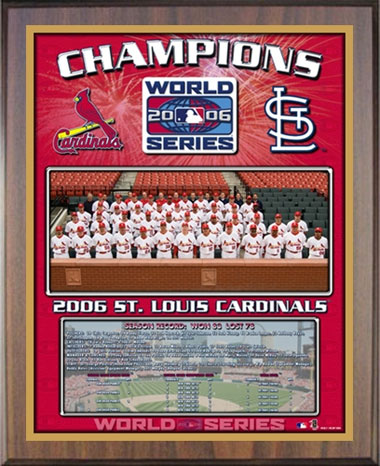
Years later, their legacy endures, a beacon for those who dare to dream. The 2006 World Series plaque, a symbol of their triumph, stands as a testament to a team that refused to accept anything less than greatness. In the annals of baseball history, their story is one of the most compelling—a tale of grit, glory, and the unbreakable spirit of the Cardinals.