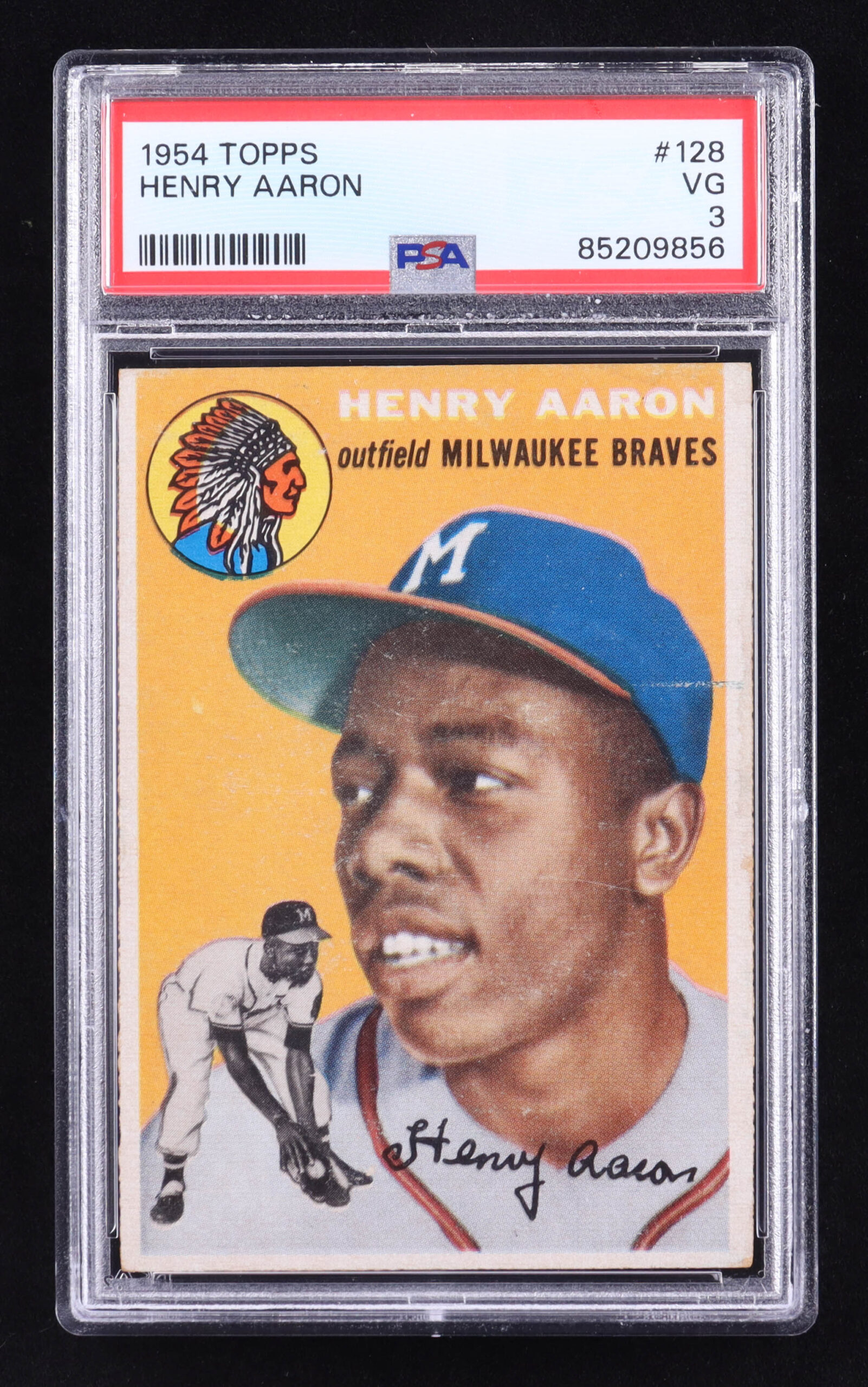
The crack of a bat, the swish of a mitt, the hushed anticipation in a stadium—baseball is a sport steeped in ritual, nostalgia, and the quiet drama of imperfection. Among its most hallowed artifacts are vintage trading cards, fragile relics that carry the weight of history in their corners and creases. None resonate more deeply than the 1954 Topps #128 rookie card of Hank Aaron, a piece of cardboard that has captivated collectors for generations. But what happens when such a treasure arrives at a grading facility bearing the scars of time? The answer is not just a number on a label—it’s a revelation about value, perception, and the enduring allure of baseball’s past.
The Myth of the Flawless Gem: Why Near-Pristine Cards Feel Overrated
There’s an unspoken dogma in the collecting world: the closer a card is to perfection, the higher its value. A PSA 10, we’re told, is the pinnacle of desirability, a flawless window into the past. Yet this obsession with immaculate surfaces often obscures the more compelling stories hidden within a card’s imperfections. A PSA 3 Hank Aaron rookie isn’t just a damaged relic—it’s a time capsule, its wear whispering tales of decades spent in wallets, shoeboxes, and the back pockets of fans who cherished it long before grading became a billion-dollar industry.
The allure of the near-perfect card is undeniable, but it’s also sterile. A PSA 10 exists in a vacuum, untouched by the lived-in reality that gives vintage cards their soul. The creases, the corner bends, the ink that has faded like a memory—these aren’t flaws. They’re signatures of authenticity, proof that this card once belonged to someone who loved the game enough to carry it close. In an era where digital perfection dominates, the damaged card reminds us that baseball’s magic lies in its imperfections.
The Alchemy of Grading: How a Single Number Distorts Perception
Grading is supposed to be an objective science, a way to quantify a card’s condition with precision. But in practice, it’s as much art as it is analysis. A PSA 3 isn’t just a low grade—it’s a narrative. The corners may be rounded, the surface marred by a faint crease, the centering slightly off. Yet within those imperfections lies a story of resilience. This card survived the wear and tear of decades, only to be scrutinized under harsh lights by graders who measure millimeters with the precision of horologists.
What’s often overlooked is how grading standards have evolved. A PSA 3 in 1990 might have been considered a “fine” card, but today’s stricter benchmarks push it into the lower tiers. This shift reflects a market that increasingly favors pristine specimens, leaving collectors to grapple with the paradox: is a card’s value truly intrinsic, or is it a construct of grading trends? The Hank Aaron rookie, in particular, forces us to confront this dilemma. Its historical significance is undeniable, but its condition complicates the narrative of unbridled appreciation.
The Hidden Economics: Why Damaged Cards Can Outperform Expectations
Conventional wisdom suggests that a damaged card is a depreciating asset, but the market tells a different story. There’s a growing faction of collectors who prize rarity over perfection, seeking out cards with provenance, history, or simply the patina of age. A PSA 3 Hank Aaron rookie, while not a six-figure card, occupies a sweet spot: rare enough to be desirable, common enough to be attainable. Its lower grade doesn’t diminish its appeal—it amplifies it.
Consider the psychology at play. A flawless card feels like an investment, a commodity to be flipped or displayed. But a damaged card? It feels like a treasure. It’s the difference between owning a Picasso and inheriting a family heirloom that’s been passed down through generations. The latter carries emotional weight, a connection to the past that transcends monetary value. In the world of baseball cards, this emotional resonance is often the driving force behind long-term appreciation.
The Aesthetic of Decay: Why We’re Drawn to the Worn and Weathered
There’s a quiet rebellion in the appreciation of damaged cards. In a hobby obsessed with flawlessness, the worn and weathered stand out precisely because they defy convention. A PSA 3 Hank Aaron rookie isn’t just a card—it’s a study in contrast. The bold, vibrant colors of the 1954 Topps design clash with the muted tones of age, creating a visual tension that’s oddly compelling. The creases, far from detracting, add texture, depth, and a sense of movement, as if the card itself is in motion.
This fascination with decay isn’t limited to baseball cards. It’s a phenomenon seen in vintage photography, antique furniture, and even architecture. There’s a melancholic beauty in the passage of time, a reminder that nothing lasts forever. Baseball cards, with their fragile cardboard and fragile histories, embody this fragility. They’re not meant to last forever—they’re meant to be held, cherished, and eventually, to show their age. A PSA 3 Hank Aaron rookie forces us to confront this reality, to accept that perfection is an illusion, and that the true value of a collectible lies in its imperfections.
The Collector’s Dilemma: Sentiment vs. Speculation
Every collector faces a fundamental choice: do they chase the highest-grade cards for their investment potential, or do they seek out pieces with soul, even if their market value is lower? The Hank Aaron rookie embodies this tension. A PSA 10 might fetch six figures, but it’s a static object, a museum piece frozen in time. A PSA 3, on the other hand, is alive with possibility. It could have been pulled from a shoebox in 1985, or it could have been a childhood keepsake passed down through a family. Its story is unwritten, waiting to be discovered.
The market for vintage cards is increasingly dominated by investors who view them as financial instruments rather than cultural artifacts. But the most passionate collectors understand that a card’s value isn’t just in its grade—it’s in its history. A PSA 3 Hank Aaron rookie might not be the flashiest card in a collection, but it’s the one that tells a story. It’s the card that reminds us why we fell in love with baseball in the first place: not because it’s perfect, but because it’s real.
The Future of Grading: Will the Pendulum Swing Back?
As the collecting world becomes more digital and more homogenized, there’s a growing counter-movement toward authenticity. Collectors are seeking out raw cards, ungraded treasures that carry the unfiltered patina of age. Grading companies are responding with new services that emphasize preservation over perfection, offering encapsulation that highlights a card’s natural wear rather than masking it. Could this be the beginning of a shift away from the tyranny of the perfect grade?
If so, the Hank Aaron rookie will be at the forefront of this revolution. Its damaged surface isn’t a liability—it’s a feature. It’s a reminder that baseball cards, like the game itself, are meant to be played, not just admired. The next time you hold a vintage card, ask yourself: is its value in the grade, or in the story it carries? For many collectors, the answer is already clear.