Roy Halladay’s rookie cards aren’t just pieces of cardboard—they’re time capsules, frozen moments of a pitcher whose dominance reshaped the game. For collectors, these cards represent more than nostalgia; they’re investments tied to a legacy of precision, grit, and an unrelenting work ethic. But what makes a Halladay rookie card truly valuable? Is it the scarcity of his early issues, the emotional pull of his Hall of Fame career, or something deeper—an intangible connection to an era when pitchers still commanded the mound with fearless authority?
For many, the allure of Halladay’s rookie cards begins with their rarity. Unlike the mass-produced inserts flooding modern sets, his earliest cards were printed in modest quantities, making them elusive even in today’s market. The 1997 Bowman Chrome, for instance, is a cornerstone of any Halladay collection. Its reflective surface and sharp focus on a young, determined Halladay capture the essence of a player on the cusp of greatness. But rarity alone doesn’t drive value—it’s the convergence of scarcity, demand, and historical significance that transforms these cards into coveted treasures.

Then there’s the 1997 Bowman base card, a humble yet iconic piece that often flies under the radar. Its simplicity—just Halladay in his Toronto Blue Jays uniform, a nameplate beneath—belies its importance. This card is a gateway for collectors who appreciate the raw, unfiltered charm of early ’90s baseball cards. Its value lies not in flashy parallels or autographs, but in its purity as a first-year issue. For those who grew up watching Halladay’s career unfold, this card is a tangible link to his humble beginnings, before the Cy Young Awards and postseason heroics.
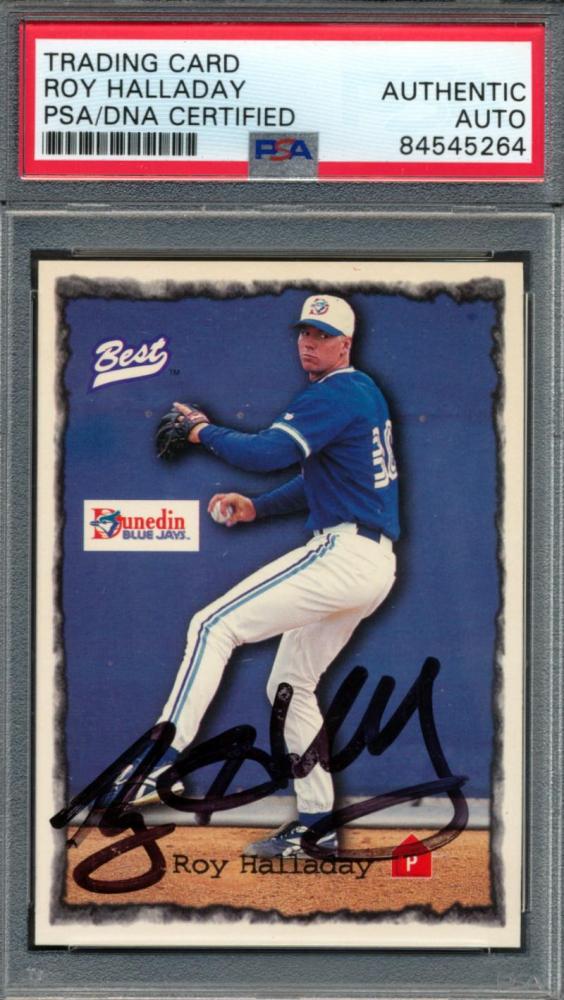
But the real showstoppers are the autographed variants. A signed 1997 Best #15 card, graded PSA 10, can fetch tens of thousands at auction. Why? Because Halladay’s autograph is as rare as his pitching performances were dominant. Unlike modern stars who sign thousands of cards at conventions, Halladay’s autographs are scarce, making them a holy grail for collectors. The 1997 Best set, with its distinctive border and bold design, frames Halladay’s signature in a way that feels timeless—almost as if the card itself is paying homage to the pitcher’s methodical, no-nonsense approach to the game.
The fascination with Halladay’s rookie cards extends beyond their financial worth. There’s an emotional resonance here, a connection to a player who embodied the archetype of the modern ace. Halladay wasn’t just a pitcher; he was a technician, a student of the game who treated every start like a chess match. His two Cy Young Awards and postseason masterpiece—a 2010 no-hitter in the playoffs—cemented his legacy, but his rookie cards remind us of the journey. They’re artifacts of a time when Halladay was just another prospect, toiling in the minors, dreaming of greatness.
For collectors, this emotional pull is just as compelling as the investment potential. A Halladay rookie card isn’t merely a commodity; it’s a story. It’s the thrill of flipping through a shoebox of old cards and stumbling upon a Halladay Bowman Chrome, the same one you ogled in the 1997 Topps factory set. It’s the pride of owning a piece of history that predates his fame, a silent testament to the years of hard work before the accolades.
Yet, the market for Halladay rookie cards isn’t without its complexities. Condition is paramount. A card with even the slightest crease or corner wear can plummet in value, while a pristine PSA 10 can command a premium. The 1997 Bowman Chrome, for example, is notoriously susceptible to print defects, making high-grade examples exceedingly rare. Collectors must weigh the risks of chasing these cards—whether to invest in raw copies with grading potential or to splurge on already-graded slabs. The latter offers certainty, but at a steep premium.
Then there’s the question of parallels and relics. Modern collectors often chase the shiniest objects, and Halladay’s rookie cards have seen their share of gimmicks. Inserts featuring game-used patches or autographs from his later years muddy the waters, appealing to those who prioritize novelty over authenticity. But purists argue that the true value lies in the original issues—the 1997 Bowman, the 1997 Best, the 1997 Topps—cards that capture Halladay in his rookie skin, before the accolades and the fame.
The financial aspect of Halladay rookie cards is equally intriguing. While his cards aren’t at the stratospheric levels of a Mike Trout or a Derek Jeter rookie, they’ve shown steady appreciation over time. The 1997 Bowman Chrome, in particular, has seen its value climb as Halladay’s legacy grows. It’s a classic case of a player’s on-field success trickling down to his collectibles. But unlike modern rookies, whose cards can skyrocket overnight, Halladay’s market moves with deliberation, reflecting the patience he brought to the mound.
For those considering adding a Halladay rookie card to their collection, the advice is simple: buy what you love. Whether it’s the 1997 Bowman Chrome’s reflective sheen or the 1997 Best’s bold design, the best investment is the one that sparks joy. Halladay’s cards aren’t just financial assets; they’re heirlooms, passed down through generations of fans who understand the weight of his contributions to the game.
In the end, Roy Halladay’s rookie cards are more than collectibles—they’re monuments to a pitcher who redefined excellence. They remind us that greatness isn’t born overnight; it’s forged through countless hours of preparation, resilience, and an unshakable belief in one’s abilities. For collectors, owning a piece of that journey is a privilege, a chance to hold a fragment of history in their hands. And as long as baseball is played, Halladay’s rookie cards will continue to captivate, their value measured not just in dollars, but in the stories they tell.