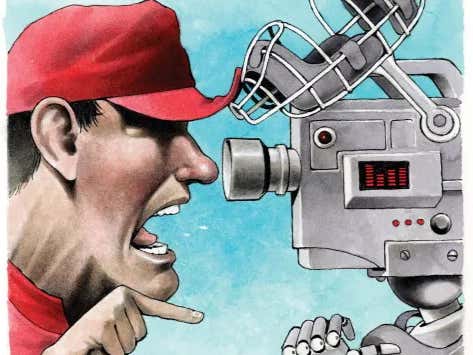
The crack of the bat, the roar of the crowd, the umpire’s emphatic “Strike three!”—these are the hallmarks of baseball’s timeless rhythm. Yet beneath the surface of this venerable game, a quiet revolution has been unfolding in the minor leagues. Robot umpires, those silent sentinels of precision, have begun to patrol the bases and call balls and strikes with unblinking mechanical fidelity. No longer confined to the realm of science fiction, these automated arbiters have transitioned from experimental novelties to integral components of the developmental fabric of Major League Baseball. Their presence raises profound questions: Can machines truly replace human judgment without eroding the soul of the sport? What does the data reveal about their performance, and how are players, coaches, and fans adapting to this seismic shift? As we examine the early innings of this technological transformation, one thing becomes clear—the era of the robot umpire is not merely about accuracy; it’s about redefining the very essence of fairness in America’s pastime.
The Rise of the Automated Arbiters: A Brief Historical Context
The concept of mechanized officiating in baseball is not a sudden innovation but the culmination of decades of technological aspiration. The seeds were sown in the late 20th century, when radar guns and pitch-tracking systems began to quantify the invisible—spin rates, exit velocities, and, most critically, the precise location of a baseball as it crossed the plate. The PITCHf/x system, introduced in 2006, was a watershed moment, offering real-time data that could be cross-referenced with umpire calls. Yet, for years, this data remained a tool for analysis rather than a replacement for human judgment. The turning point arrived in 2019, when Major League Baseball’s Atlantic League became the first professional circuit to deploy automated ball-strike systems (ABS) in select games. The experiment was bold: replace the umpire’s call with a computer’s verdict, delivered in real time, without fanfare or hesitation. The rationale was simple—eliminate human error, reduce the influence of bias, and, perhaps most tantalizingly, expedite the pace of play. What began as a curiosity soon became a proving ground, with the minor leagues serving as the laboratory where baseball’s future was being written in lines of code and silicon.
The Data Speaks: Accuracy, Consistency, and the Human Factor
To evaluate the efficacy of robot umpires, one must first dissect the metrics that define their performance. The most immediate measure is accuracy—the percentage of calls that align with the automated system’s determinations. Early data from the minor leagues suggests that ABS systems achieve an accuracy rate hovering around 95%, a figure that outstrips even the most seasoned human umpires, whose error rates can fluctuate between 5% and 10% depending on the pitch’s location and the umpire’s positioning. This disparity is not merely a matter of precision; it is a testament to the system’s ability to eliminate the subjective variables that plague human judgment—fatigue, angle of view, and, in some cases, unconscious bias. Yet, accuracy alone does not capture the full spectrum of the robot umpire’s impact. Consistency is another critical dimension. Unlike their human counterparts, who may call a borderline pitch a strike in one inning and a ball in the next, automated systems apply the same threshold universally. This uniformity is both a strength and a source of tension, as it strips away the human element that has long been woven into the fabric of the game’s lore. Players accustomed to the idiosyncrasies of individual umpires now face a new reality: a world where the strike zone is not a negotiation but a fixed, unyielding boundary.
The Human Response: Adaptation, Resistance, and the Psychological Shift
The introduction of robot umpires has not been met with universal acclaim. For pitchers, the transition has been met with a mix of relief and frustration. On one hand, the elimination of errant calls provides a sense of fairness—no longer will a perfectly placed fastball be unjustly deemed a ball due to an umpire’s misjudgment. On the other, the psychological advantage of working the edges of the strike zone has been neutralized. Pitchers who once relied on an umpire’s tendency to expand the zone in certain counts must now refine their approach, focusing on pure location rather than the art of “pitching to the umpire.” Batters, too, have been forced to recalibrate their strategies. The traditional dance between hitter and umpire—where a batter might take a borderline pitch in a crucial count, knowing the umpire’s propensity to call it a strike—has been disrupted. Now, the strike zone is a digital construct, and players must adapt their swing decisions accordingly. For coaches, the challenge is twofold: managing player expectations while integrating the new system into their tactical playbooks. The human element, once a cornerstone of baseball’s strategy, is being systematically replaced by algorithms, leaving many to wonder whether the soul of the game is being traded for the sake of efficiency.
The Broader Implications: Pace of Play, Fan Engagement, and the Future of Officiating
Beyond the confines of the diamond, the robot umpire experiment carries implications that resonate across the sport’s ecosystem. Pace of play, a perennial concern for baseball’s stakeholders, stands to benefit from the precision of automated systems. The elimination of prolonged arguments, replay reviews, and umpire conferences shaves precious seconds off each game, contributing to a faster, more streamlined experience. For fans accustomed to the glacial pace of traditional baseball, this could be a welcome evolution. Yet, the question lingers: Does speed come at the cost of spectacle? Baseball’s charm lies in its pauses—the strategic huddles, the dramatic confrontations, the umpire’s theatrical strike call. If robot umpires render these moments obsolete, will the game lose a layer of its narrative richness? Moreover, the fan experience is not merely about what happens on the field but how it is perceived. The introduction of ABS systems has sparked debates about transparency. While the data is publicly available, the real-time nature of the calls lacks the human touch that has historically softened the edges of officiating. Will fans embrace a future where every pitch is a binary verdict, devoid of the drama that has defined baseball’s most iconic moments?
The Unseen Variables: Technology, Trust, and the Intangibles of the Game
Beneath the surface of the robot umpire’s mechanical precision lies a web of unseen variables that complicate the narrative. Technology, for all its advancements, is not infallible. Glitches, calibration errors, and the occasional misfiring of sensors can introduce new forms of unpredictability. The 2022 season saw instances where automated systems misclassified pitches due to equipment malfunctions or data transmission delays, reminding observers that even the most sophisticated systems are not immune to failure. Trust, too, emerges as a critical factor. Players and coaches must place their faith in a system that, despite its accuracy, lacks the human capacity for empathy or contextual understanding. A pitch that grazes the outer edge of the zone may be called a ball by a robot, but a human umpire might exercise discretion in a high-leverage situation. The absence of this nuance raises philosophical questions about the role of officiating in sports. Is the goal to achieve absolute fairness, or is there value in the imperfections that make the game feel alive? The intangibles—the umpire’s intuition, the player’s reaction, the crowd’s collective breath held in anticipation—are not easily quantified, yet they are the lifeblood of baseball’s enduring appeal.
Conclusion: A Game in Transition
The robot umpire era in the minor leagues is more than a technological novelty; it is a harbinger of baseball’s evolving identity. The data so far paints a picture of a system that delivers on its promises of accuracy and consistency, yet it also exposes the complexities of replacing human judgment with machine precision. Players are adapting, fans are debating, and the sport is grappling with questions that transcend the box score. As the experiment continues to unfold, one thing is certain: the robot umpire is not merely a tool but a symbol of baseball’s relentless pursuit of perfection. Whether this pursuit will enhance or diminish the game’s essence remains to be seen, but the conversation itself is a testament to the enduring power of America’s pastime. In the end, the robot umpire may not be the final answer, but it is undeniably the next chapter in a story that has been written for over a century—and it is a chapter that demands our attention.