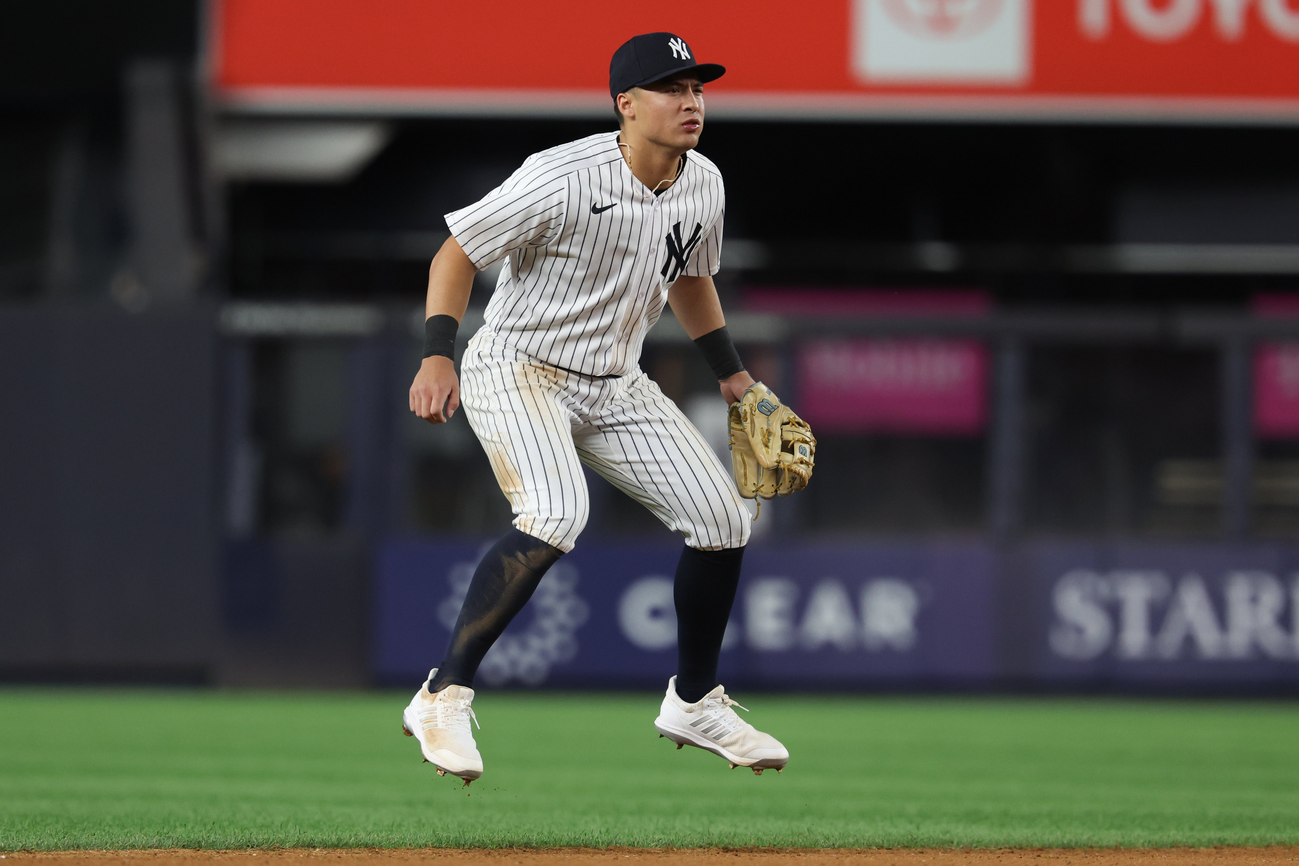
Baseball’s most coveted defensive accolade, the Gold Glove, has long been a barometer of a player’s prowess with the leather. Yet, when the whispers of Anthony Volpe’s 2023 Gold Glove win began to circulate, a curious dichotomy emerged—one that pitted defensive brilliance against offensive mediocrity. The New York Yankees’ shortstop, a defensive virtuoso with a glove that seems to defy physics, now finds himself at the center of a debate that transcends the diamond: Can a player be celebrated for one facet of the game while the other languishes in obscurity? This is the story of Anthony Volpe—not just as a Gold Glove recipient, but as a batter whose bat has yet to harmonize with his glove’s symphony.
The Glove That Speaks in a Language of Its Own
Volpe’s defensive portfolio reads like a highlight reel scripted by a filmmaker obsessed with precision. His range is breathtaking, a blur of motion that turns potential hits into outs with a frequency that borders on the supernatural. The metrics back it up: his Defensive Runs Saved (DRS) and Ultimate Zone Rating (UZR) paint a picture of a player who doesn’t just meet the standard—he redefines it. Opponents, once lulled into complacency by the predictability of his predecessors, now find themselves outmaneuvered by a shortstop whose instincts are as sharp as his first-step quickness.
But defense, for all its artistry, is only half the equation. A Gold Glove is a badge of honor, yet it’s a silent one—it doesn’t tally runs, it doesn’t drive in RBIs, and it certainly doesn’t send fans home buzzing about the next home run. Volpe’s glove is a masterclass in defensive alchemy, transforming the ordinary into the extraordinary, but the question lingers: What happens when the bat fails to echo the glove’s virtuosity?
The Bat’s Stutter: A Symphony of Near-Misses
If Volpe’s glove is a concerto, his bat is a stuttering monologue—full of potential, yet frustratingly inconsistent. His 2023 offensive line reads like a ledger of missed opportunities: a .209 batting average, a .283 on-base percentage, and a slugging mark that barely scrapes .320. These numbers aren’t just pedestrian; they’re a red flag waving in the face of a franchise that demands offensive production from its middle infielders.
The issue isn’t a lack of effort. Volpe’s swing is a whirlwind of controlled aggression, a compact yet explosive motion that should, in theory, generate more contact. Yet, the results betray the mechanics. Pitchers have exploited his aggressive approach, inducing weak grounders and lazy flyouts with an ease that suggests his at-bats are a puzzle they’ve already solved. The league’s advanced metrics tell a damning tale: his whiff rate is among the highest for shortstops, and his hard-hit rate is mired in the bottom third of the position. For a player whose glove makes him a defensive anchor, the bat has become an albatross.
The Weight of Expectations: A Rookie’s Burden
Volpe’s 2023 was supposed to be a year of growth, a stepping stone in what many envisioned as a long, illustrious career. Instead, it became a crucible of unmet expectations. The Yankees, a franchise that thrives on the balance of power and precision, placed enormous faith in their young shortstop. His defensive ceiling was stratospheric; his offensive floor, however, remained stubbornly terrestrial. The pressure to deliver at the plate while maintaining his defensive brilliance must have been immense—a juggling act that even the most seasoned veterans would find daunting.
Yet, the narrative around Volpe has been disproportionately skewed toward his glove. The Gold Glove, while a testament to his defensive gifts, has inadvertently overshadowed the work that lies ahead. Baseball is a game of adjustments, and Volpe’s next offseason must be a period of meticulous refinement. The question isn’t whether he can become a complete player—it’s whether he can silence the critics who see his bat as a glaring weakness in an otherwise sterling resume.
The Fan Divide: Cheers for the Glove, Silence for the Bat
The reaction to Volpe’s Gold Glove win was a microcosm of the modern baseball fan’s divided loyalties. Yankees supporters, ever the loyalists, rallied behind their young star, celebrating his defensive prowess as if it were the equivalent of a 40-home-run season. Social media erupted with tributes to his acrobatic plays, memes of his glove work went viral, and the narrative of “the best defensive shortstop in baseball” took hold. But beneath the surface, a quieter skepticism simmered. Fans who prioritize offensive firepower questioned whether a Gold Glove alone was enough to justify Volpe’s place in the lineup.
This divide isn’t unique to Volpe—it’s a reflection of baseball’s evolving metrics and fan priorities. The Moneyball era taught us that runs are currency, and a player who doesn’t contribute to that ledger risks being viewed as a luxury rather than a necessity. Yet, the romance of the game still clings to defensive brilliance. A diving stop, a backhanded grab, a throw that beats a runner by a hair—these moments are the lifeblood of baseball’s soul. The challenge for Volpe, then, is to bridge the gap between the poetic and the practical, to prove that his glove and bat can coexist in harmony.
The Path Forward: Refining the Craft
For Volpe, the road to offensive redemption is fraught with challenges, but not insurmountable. The first step lies in addressing the mechanical flaws that have hobbled his production. A deeper dive into his swing path, pitch recognition, and approach at the plate could reveal the adjustments needed to turn weak contact into authoritative drives. The Yankees’ coaching staff, armed with data and experience, must become architects of his offensive rebirth, sculpting a swing that balances aggression with selectivity.
Offseason training will be critical. Volpe must focus on drills that enhance his bat speed without compromising his defensive agility. Weighted bat exercises, tee work, and high-velocity pitching simulations could help him internalize the adjustments. Moreover, a shift in mental approach—one that embraces patience without sacrificing his natural instincts—could be the key to unlocking his offensive potential. The goal isn’t to transform him into a power hitter, but to make him a more complete hitter, one who punishes mistakes and avoids the defensive traps pitchers have set for him.
The 2024 season looms as a proving ground. If Volpe can show tangible progress at the plate, the narrative will shift from “defensive savant” to “emerging superstar.” If not, the whispers of “what if” will grow louder, and the pressure to address his offensive deficiencies will intensify. Baseball is unforgiving, and a player’s legacy is often defined by their ability to adapt.
The Bigger Picture: The Evolution of the Modern Shortstop
Volpe’s journey is emblematic of a broader trend in baseball: the redefinition of the shortstop position. Gone are the days when a middle infielder’s value was measured solely by their glove. Today, the position demands a hybrid skill set—defensive wizardry paired with offensive competence. Players like Francisco Lindor and Xander Bogaerts have set the standard, proving that a shortstop can be both a defensive stalwart and an offensive catalyst. Volpe, with his glove already etched in gold, must now carve out his own legacy with the bat.
The modern shortstop is a paradox—a defensive general who must also wield the sword. It’s a role that requires versatility, adaptability, and an almost obsessive work ethic. For Volpe, the challenge is clear: to evolve from a one-dimensional defensive marvel into a two-way force. The path won’t be easy, but the destination—a player whose glove and bat are equally feared—is within reach.