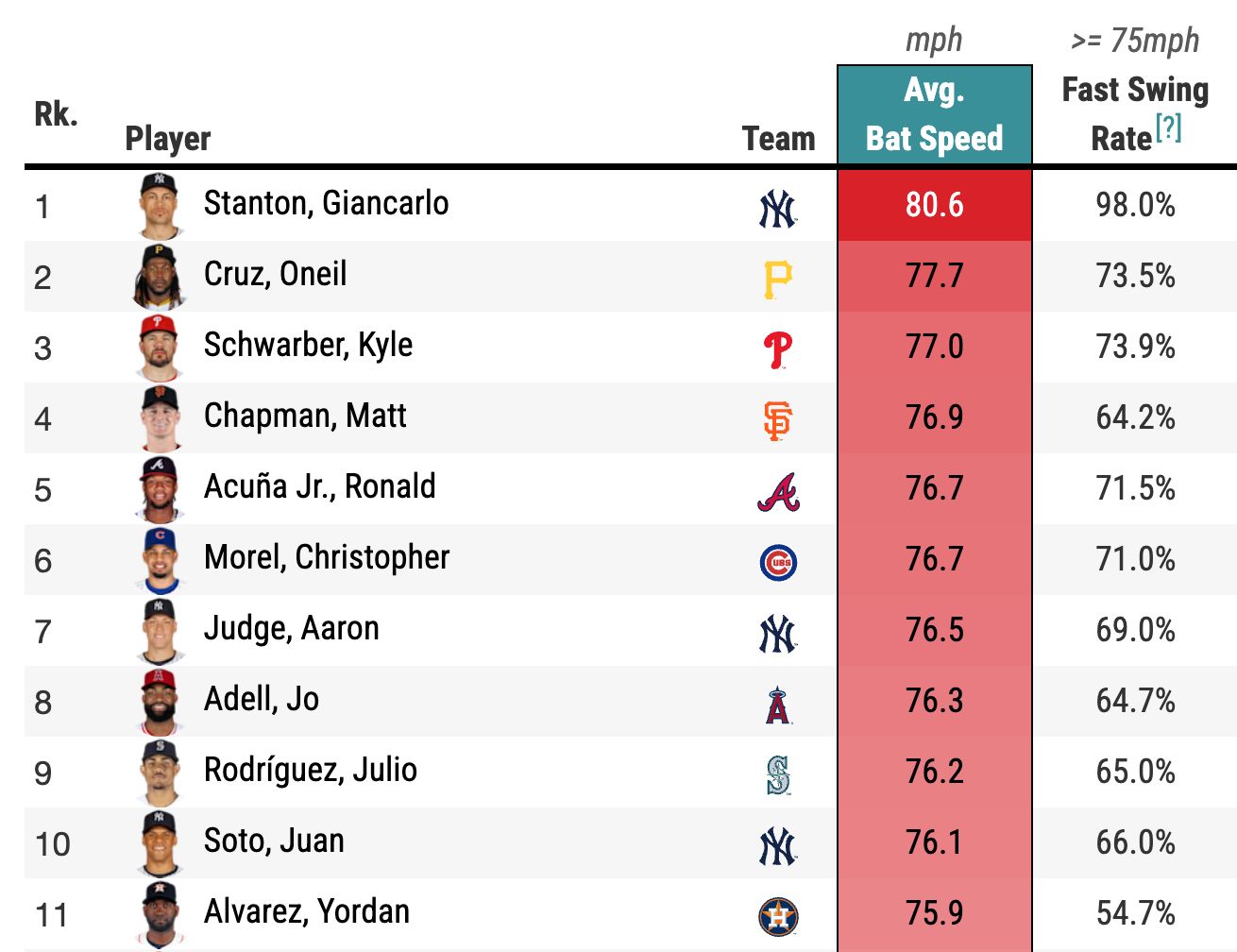
In the high-stakes world of Major League Baseball, where milliseconds separate a home run from a harmless groundout, bat speed isn’t just a statistic—it’s a weapon. The crack of a bat traveling at 80 mph or more is the sonic boom of a hitter’s dominance, a sound that echoes through stadiums and lingers in the minds of pitchers long after the game ends. But how do these athletes cultivate such explosive power? The answer lies not in brute force alone, but in a meticulously crafted fusion of science, discipline, and instinct. Behind the curtain of every 110-mph exit velocity are hours of deliberate training, biomechanical precision, and an almost obsessive attention to the smallest details of the swing.
The Physics of the Swing: Why Speed Begets Power
At its core, bat speed is a study in kinetic energy transfer. The faster a bat moves through the strike zone, the more energy it imparts to the ball upon contact. This isn’t merely about swinging harder—it’s about optimizing the kinetic chain, the sequential activation of muscles from the legs to the hands. Elite hitters initiate the swing with a powerful stride, planting the front foot to create a stable base. The hips then rotate explosively, followed by the torso, shoulders, and finally the arms and wrists, each segment accelerating the bat in a whip-like motion.
This chain reaction is governed by Newton’s Third Law: for every action, there is an equal and opposite reaction. The ground pushes back against the hitter’s force, allowing energy to flow upward through the kinetic chain. The result? A bat that doesn’t just move—it *slices* through the air, generating lift and backspin that send the ball soaring. The difference between a 90-mph swing and a 110-mph swing isn’t just 20 extra miles per hour—it’s the difference between a line drive and a towering home run, between a strikeout and a walk-off grand slam.
Weighted Training: The Alchemy of Resistance
To build bat speed, players often turn to weighted training—a paradoxical blend of resistance and freedom. By swinging bats that are 5% to 10% heavier than a game bat, hitters develop neuromuscular adaptations that enhance their speed when they return to a standard bat. The added weight forces the muscles to fire more rapidly, training them to contract with greater velocity. But it’s not just about swinging heavier bats; it’s about doing so with perfect mechanics. A hitter who sacrifices form for added weight will only reinforce bad habits.
Some players use donut rings or weighted sleeves, while others prefer bat speed trainers like the *Hitting Jacket* or *Blast Motion* sensors, which provide real-time feedback on swing metrics. The key is specificity: the training must mimic the actual mechanics of a game swing. Drills like the *Tee Work with Weighted Bat* or *Soft Toss with Resistance Bands* help ingrain the muscle memory needed to maintain bat speed under pressure. The goal isn’t to swing harder—it’s to swing *smarter*, with the bat moving in the most efficient path possible.
Biomechanics and the Art of the Load
The load—the subtle crouch and coil before the pitch is thrown—is where bat speed begins. Elite hitters like Aaron Judge and Pete Alonso don’t just stand flat-footed; they create a dynamic tension, shifting their weight onto the back leg while keeping their hands high and back. This loaded position stores elastic energy, like a coiled spring ready to unleash. The deeper the load, the more potential energy is stored, and the more explosive the subsequent uncoiling.
But loading isn’t just about depth—it’s about timing. A hitter who loads too early risks tipping off the pitch, while one who loads too late sacrifices power. The sweet spot lies in synchronizing the load with the pitcher’s delivery. High-speed cameras and motion capture technology have revealed that the best hitters initiate their load as the pitcher begins their windup, creating a seamless transition from stillness to violence. The hands stay back, the hips stay closed, and the bat remains in the “power V” position—elbows high, bat angled toward the pitcher—until the last possible moment.
Technology’s Role: Data-Driven Domination
Modern baseball is as much about analytics as it is about athleticism, and bat speed is no exception. Devices like *TrackMan*, *Rapsodo*, and *Blast Motion* have revolutionized how players train, providing granular data on swing mechanics, bat path, and exit velocity. These tools don’t just measure—they *teach*. A hitter can see, in real time, how a slight adjustment to their hip rotation or bat angle affects their bat speed. They can identify inefficiencies in their swing path, such as an uppercut that’s too steep or a bat that casts too early.
But technology’s greatest contribution may be its ability to demystify the swing. Gone are the days of relying solely on a coach’s eye or a hitter’s gut feeling. Now, players can quantify their progress, tracking improvements in bat speed over weeks and months. The data doesn’t lie—it reveals the hidden patterns that separate good hitters from great ones. For instance, a study of MLB hitters found that those with the highest bat speeds shared a common trait: a bat path that remained on plane with the pitch for an extended period, maximizing the window for contact.
The Mental Game: Visualization and Rhythm
Bat speed isn’t just a physical attribute—it’s a mental one. The best hitters don’t just train their bodies; they train their minds. Visualization is a cornerstone of their preparation. Before stepping into the batter’s box, they mentally rehearse their swing, imagining the crack of the bat and the flight of the ball. This mental rehearsal primes the neuromuscular system, making the actual swing feel almost automatic.
Rhythm is another critical factor. A hitter’s swing isn’t a single, isolated motion—it’s a symphony of timing and tempo. The best hitters have a cadence, a rhythmic flow that syncs their load, stride, and swing. Some, like Mike Trout, have a deliberate, almost metronomic tempo, while others, like Ronald Acuña Jr., rely on explosive, staccato movements. The key is consistency. A hitter who varies their rhythm from pitch to pitch is a hitter who’s prone to timing issues. The mental game is about finding that sweet spot between aggression and control, between chaos and precision.
Nutrition and Recovery: Fueling the Explosive Swing
Bat speed isn’t built in the cage alone—it’s forged in the kitchen and the training room. Nutrition plays a pivotal role in a hitter’s ability to generate power. Proteins, complex carbohydrates, and healthy fats provide the energy needed for explosive movements, while micronutrients like magnesium and zinc support muscle recovery and nerve function. Players often consume a mix of fast-digesting carbs and lean proteins post-workout to replenish glycogen stores and repair muscle tissue.
Recovery is equally crucial. Overtraining can lead to fatigue, which slows reaction times and reduces bat speed. Many hitters incorporate active recovery techniques, such as yoga or swimming, to maintain mobility without adding stress. Sleep is another non-negotiable component. During deep sleep, the body releases growth hormone, which aids in muscle repair and adaptation. Elite hitters prioritize 8 to 10 hours of sleep per night, knowing that every swing they take is only as good as the recovery that follows.
The Future of Bat Speed: Innovation and Adaptation
The pursuit of bat speed is an ever-evolving arms race. As technology advances, so too do the methods for training it. Virtual reality (VR) is emerging as a game-changer, allowing hitters to simulate game situations in a controlled environment. Imagine stepping into a VR headset and facing a virtual pitcher, with real-time feedback on your bat speed and swing path. The possibilities are limitless.
Genetic research is another frontier. Studies have identified specific genes, like ACTN3, that influence muscle fiber composition and power output. While genetic testing won’t turn a 90-mph hitter into a 110-mph hitter overnight, it can help players tailor their training to their unique physiological makeup. The future of bat speed training may lie in personalized, data-driven programs that account for a player’s genetic predispositions, biomechanical profile, and even their psychological tendencies.
But at its heart, the quest for bat speed remains a human endeavor. It’s about the grind—the early mornings, the late nights, the relentless pursuit of perfection. It’s about the hitter who stays after practice to work on their load, the one who films their swing to spot inefficiencies, the one who visualizes success before it happens. Bat speed isn’t just a metric; it’s a testament to the fusion of art and science, of instinct and intellect. And in the end, it’s what separates the legends from the rest.