Keeping score in baseball is an essential skill for fans, coaches, and players alike. It transforms the game from a simple competition into a rich narrative full of statistics, strategies, and pivotal moments. While it may seem daunting at first glance, mastering the art of scorekeeping is entirely within reach, even for beginners. This guide will walk you through the fundamental principles and techniques, equipping you with the knowledge to accurately record each play with confidence and precision.
Understanding the Scorecard Layout
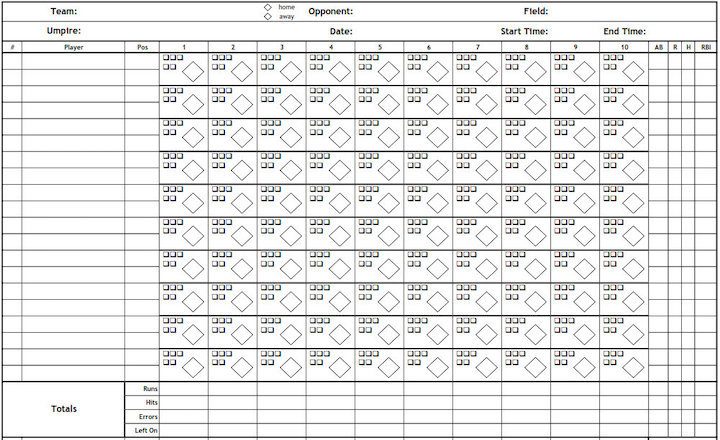
Before delving into the mechanics of scorekeeping, it is crucial to familiarize yourself with the structure of the baseball scorecard. Typically, the scorecard consists of a grid with rows designated for players and columns for innings. Each box represents a player’s performance in a particular inning, allowing you to track their progression throughout the game. Additional sections document team totals, runs, hits, errors, and pitching statistics.
Many scorecards include diagrams of the bases to facilitate the notation of base-running activity. Grasping this layout is akin to knowing the canvas before painting; it provides a clear framework and helps you visualize the flow of the game as you record it.
Symbols and Abbreviations: The Language of Scorekeeping
Baseball scorekeeping relies heavily on a system of standardized symbols and abbreviations that succinctly communicate complex plays. For instance, positions are represented by numbers (e.g., 1 for pitcher, 2 for catcher, 3 for first baseman, up to 9 for right fielder). Understanding these numerals is foundational to recording fielding plays accurately.
Batting outcomes are also abbreviated: “K” for strikeout, “BB” for base on balls (walk), “1B,” “2B,” and “3B” for singles, doubles, and triples respectively, and “HR” for home run. Keeping a cheat sheet handy during your early attempts can save time and reinforce your learning.
Recording At-Bats and Plate Appearances
Each player’s turn at bat is documented in their corresponding inning box. Start by noting the batter’s identity, often by their jersey number or initials. Then, indicate the result of the at-bat using symbols or abbreviation codes. For example, if the batter hits a single, draw a line advancing from home plate to first base on the miniature diamond diagram within the box and label it “1B.”
If a batter reaches base on an error or by being hit by a pitch, these rare yet important events are also annotated accordingly. The goal is to provide a snapshot that succinctly yet thoroughly captures what transpired during their plate appearance.
Tracking Base Running and Advancement
One of the more nuanced aspects of scorekeeping is documenting how runners advance around the bases. A small diamond representing the four bases sits inside each player’s box. By shading or marking the portions of the diamond the runner has reached, you can visualize their progress effortlessly.
For instance, if a runner moves from first to second on a subsequent play, you would modify the diamond to reflect this advancement. Additionally, any outs or plays resulting in a runner being tagged out are indicated with lines or annotations such as “6-3” (shortstop to first baseman) for a ground out. This granularity allows the scorecard to chronicle the unfolding drama on the field.
Noting Defensive Plays and Outs
Every out is recorded with its corresponding fielding notation. Using the numbered position system, you depict the sequence of a play. For example, a groundout from the shortstop to the first baseman would be written as “6-3.” Flyouts and strikeouts have their own symbols, like “F7” for a flyout caught by the left fielder or simply “K” for a strikeout.
Double plays, stolen bases, and pickoffs also have their unique notations. These elements emphasize the dynamic nature of defense and base running, offering an insightful layer to the scorekeeping tapestry that illustrates the game’s ebb and flow.
Keeping Track of Runs, Hits, and Errors
Beyond individual plays, the scorecard consolidates team performance statistics. Runs (R), Hits (H), and Errors (E) are typically tallied at the end of each inning and recapped at the end of the game. These metrics provide a quick summary of offensive and defensive effectiveness, highlighting critical swings in momentum.
Errors, in particular, deserve special attention. They are charged when a fielder mishandles or misplays a ball, allowing runners additional bases or prolonging the inning. Clearly recording errors can help contextualize scoring anomalies and offer valuable insights for coaches and analysts.
Pitching Statistics: More Than Just Strikeouts
Pitching performance is integral to the baseball narrative and is tracked meticulously on the scorecard. Each pitcher’s innings pitched, strikeouts, walks, hits allowed, and runs given up are documented to evaluate their effectiveness.
Common pitcher-related annotations include “IP” for innings pitched and “BB” for bases on balls issued. Advanced scorers may also note pitch counts or the types of outs recorded. This data helps paint a complete picture of the battle between pitcher and batter throughout the game.
Tips for Effective and Accurate Scorekeeping
Consistency is paramount when recording scores. Establish a set of abbreviations and symbols before the game starts and apply them uniformly. This practice reduces confusion and makes your scorecard easier to interpret later.
Equally important is attentiveness. Baseball is a game of incremental changes, and small details add up. Observing every pitch, base advancement, and defensive play ensures your record remains comprehensive and truthful to the on-field action.
Lastly, practice regularly. Like any form of notation, scorekeeping proficiency improves with experience. Starting with youth or amateur games can build your confidence before tackling more complex professional-level contests.
Using Scorekeeping to Enhance Your Baseball Experience
Keeping score is far more than a mechanical exercise. It deepens your appreciation of baseball’s subtleties, enhances your understanding of game strategy, and connects you intimately with the players’ efforts. Whether you’re tracking your child’s performance in Little League or following a major league contest, scorekeeping amplifies engagement and creates a personal archive of baseball memories.
Moreover, insightful scorekeeping can cultivate analytical skills, enabling you to spot trends, strengths, and weaknesses within teams and individual athletes. This perspective is invaluable for coaches devising game plans and for enthusiastic fans seeking a richer connection to the sport.