The baseball card market is a labyrinth of nostalgia, speculation, and sheer chance. Among the countless rookies who flashed promise before fading into obscurity, few names carry the same polarizing weight as J.D. Drew. A prodigy with a swing as sweet as it was scrutinized, Drew’s rookie card—like the player himself—occupies a precarious perch in the hobby. Is it a hidden gem, quietly appreciating in value while the masses chase overhyped modern stars? Or is it a relic of unfulfilled potential, a cautionary tale for collectors who bet on “what could have been”?
To answer that, we must first dissect the card itself—not just as a piece of cardboard, but as a time capsule of Drew’s tumultuous rookie season and the broader baseball landscape of the late 1990s. The 1998 Upper Deck Prospects Premium J.D. Drew rookie is more than a collectible; it’s a conversation starter, a debate trigger, and, for the right collector, a shrewd investment. But is it worth the gamble?
The Card in Question: A Rookie in a Sea of Shiny Foil
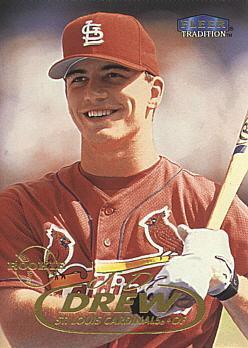
The 1998 Upper Deck Prospects Premium J.D. Drew rookie card is a study in contrasts. On one hand, it’s a classic “rookie card” in the most traditional sense—issued during Drew’s debut season with the St. Louis Cardinals, it captures him in a moment of raw, unfiltered potential. The photograph is unpolished, almost candid: Drew stands in the batter’s box, his stance relaxed but his eyes laser-focused, a bat that looks more like a twig in his massive hands. The background is a blur of stadium lights and indistinct faces, ensuring the viewer’s attention stays locked on the player.
On the other hand, the card’s design is quintessential Upper Deck of the era—glossy, over-saturated, and slightly gaudy. The borders are thick, the foil stamping aggressive, and the team logo rendered in a shade of red that feels more like a warning label than a team color. It’s the kind of card that screams “1998,” a year when baseball cards were as much about the aesthetic as the athlete. The back of the card is a treasure trove of stats and a brief bio, but it’s the front that commands attention—and, for some collectors, scrutiny.
The Player Behind the Card: Talent That Couldn’t Be Contained
J.D. Drew’s rookie season was a masterclass in frustration—for fans, for collectors, and, ultimately, for Drew himself. Drafted second overall in 1997 by the Cardinals, Drew was supposed to be the savior of a franchise starved for star power. He arrived in the majors in 1998 with a reputation as a five-tool phenom: a hitter with power, a fielder with a cannon arm, and a baserunner with wheels. But his rookie year was a rollercoaster. He struggled with injuries, slumps, and the kind of media scrutiny that would make even the most seasoned athletes wilt.
By the end of 1998, Drew had hit .293 with 13 home runs and 44 RBIs in 108 games—a solid debut, but not the kind of numbers that set the world on fire. His defensive metrics were mixed, his plate discipline inconsistent, and his relationship with the Cardinals’ front office was, at best, strained. It was a far cry from the expectations heaped upon him. For collectors, this inconsistency translated into a card that never quite achieved the iconic status of, say, a Ken Griffey Jr. or a Chipper Jones rookie. But was that a flaw—or a feature?
Market Dynamics: The Underdog vs. The Hype Machine
The baseball card market is a fickle beast, driven by nostalgia, scarcity, and, often, sheer hype. Modern rookies like Victor Wembanyama or Shohei Ohtani command astronomical prices not just for their talent, but for the cultural moment they represent. Their rookie cards are treated like blue-chip stocks, their value dictated by the whims of the internet and the next viral highlight reel. J.D. Drew’s rookie card, by contrast, exists in the shadows of that hype machine. It’s not a “modern” card, but it’s not a true vintage piece either. It’s caught in a purgatory of sorts—a card that’s old enough to be nostalgic but not old enough to be rare.
As of 2025, a PSA 10 copy of the 1998 Upper Deck Prospects Premium J.D. Drew rookie card can fetch anywhere from $150 to $300, depending on the market’s mood. A PSA 9? Closer to $50–$100. That’s a far cry from the $1,000+ prices of a 1989 Ken Griffey Jr. Topps rookie or the $500+ of a 2001 Ichiro Bowman Chrome. But here’s the thing: Drew’s card isn’t chasing those giants. It’s playing a different game entirely.
The key to its value lies in its story. Drew’s career never quite lived up to the hype, but that’s precisely why his rookie card has appeal. It’s a card for collectors who appreciate the what ifs, the near-misses, the players who burned bright but briefly. It’s a card for the contrarians, the ones who see value in the overlooked. And in a market saturated with overhyped modern rookies, that’s a refreshing change of pace.
Condition and Scarcity: The Devil in the Details
Of course, no discussion of card value is complete without diving into condition and scarcity. The 1998 Upper Deck Prospects Premium J.D. Drew rookie isn’t a card that was printed in astronomical quantities, but it’s also not a true “short print” in the traditional sense. Upper Deck’s Prospects line was always a bit of a wildcard—some cards were pulled from packs more often than others, and the quality of the printing varied wildly. That means finding a high-grade copy (PSA 9 or better) can be a challenge, but it’s not an impossible one.
The card’s biggest enemy? Centering. The borders on this card are thick, and the design is asymmetrical, making perfect centering a rarity. A PSA 10 requires near-perfect symmetry, which is why high-grade copies command a premium. The surface quality is another hurdle—Upper Deck’s foil in the late ’90s was prone to scratching and print defects, so even a card that looks flawless to the naked eye might fail under a loupe.
For collectors willing to put in the work, though, the payoff can be worth it. A well-preserved copy of this card isn’t just a piece of cardboard; it’s a piece of history—a tangible link to a player whose career was as unpredictable as the market that now surrounds it.
The Investment Angle: Is It a Steal or a Gamble?
So, should you buy a J.D. Drew rookie card? The answer depends entirely on what you’re looking for. If your goal is to chase the next big thing—a Mike Trout, a Fernando Tatis Jr.—then Drew’s card is a non-starter. It’s not a “blue-chip” investment, and it’s unlikely to see the kind of explosive growth that modern rookies command. But if you’re a collector who values story, nostalgia, and the thrill of the hunt, then this card might just be the perfect fit.
Consider this: Drew’s career, while not Hall of Fame worthy, was undeniably impactful. He was a two-time All-Star, a World Series champion, and a player whose defensive prowess in center field was often overshadowed by his offensive struggles. His rookie card captures him at the exact moment when the baseball world was holding its breath, waiting to see if he’d live up to the hype. That tension—the gap between expectation and reality—is what makes this card fascinating.
In the grand scheme of baseball card investing, J.D. Drew’s rookie card is a contrarian play. It’s not the kind of card that will make headlines, but it’s the kind of card that could quietly appreciate over time. As more collectors seek out the “underrated” and the “forgotten,” cards like Drew’s could become the next frontier of the hobby. And if that happens? Well, then the joke’s on the hype machine.
Whether you see it as a hidden gem or a relic of unfulfilled potential, one thing is certain: the 1998 Upper Deck Prospects Premium J.D. Drew rookie card is more than just a piece of cardboard. It’s a conversation starter. It’s a debate trigger. It’s a reminder that in baseball—and in collecting—sometimes the most interesting stories are the ones that don’t end with a bang.